DevOps can speed up releases and improve reliability, but many mid-sized teams get stuck. Tooling is inconsistent, environments drift, incidents are handled reactively, and delivery slows down as systems grow. When you do not have dedicated SRE or DevOps specialists, the challenge is not knowing what to implement first, and what you can safely hand off to a partner.
Fueled by digital transformation, the DevOps outsourcing market is surging as organizations seek to manage complex cloud-native environments, address talent gaps, and accelerate their time-to-market. According to Future Market Report (2025), the market is valued at approximately USD 12.5 billion and is projected to reach USD 28.4 billion by 2032, growing at a CAGR of 10.8%. North America leads with a 35.6% market share, with the U.S. accounting for the largest single-country portion at 22.1%.
This guide breaks down DevOps best practices that work in real projects. We clarify the minimum deliverables to aim for, how to split responsibilities between in-house and outsourced teams, and the common failure patterns that derail DevOps efforts. You will also learn what drives cost, which engagement model fits your situation, and how to evaluate a DevOps partner before you commit.
What DevOps Means in Practice

In real projects, DevOps is not a philosophy deck. It is an operating system for how your team builds, tests, secures, and delivers software.
For companies running web services or internal platforms, DevOps typically includes:
- A standard CI pipeline used by every developer
- Infrastructure as code to control environment drift
- Automated testing and deployment
- Monitoring tied to business impact
- Defined ownership and incident response
The key shift is control. You move from reactive issue handling to a structured, measurable delivery model.
Why DevOps Matters for Mid-sized Teams

For mid-sized organizations, the business impact of slow delivery is now measurable. A 2025 TechRadar Pro report found that software projects are delayed by an average of four months, costing companies approximately £107,000(around USD 135,000) per year due to missed opportunities and inefficiencies. The report emphasizes that executives increasingly view sluggish delivery as a strategic liability that directly affects competitiveness and revenue growth.
At the same time, DevOps is expanding beyond traditional application delivery. Another 2025 TechRadar Pro article highlights that 85% of machine learning models never make it into production, largely due to fragmented processes between development, operations, and data teams. This statistic underscores the growing need to unify DevOps and MLOps into a single, end-to-end software supply chain.
Together, these figures reinforce that modern DevOps is not just about faster releases. It is about reducing measurable business loss and ensuring that innovation actually reaches production.
DevOps Best Practices That Actually Work
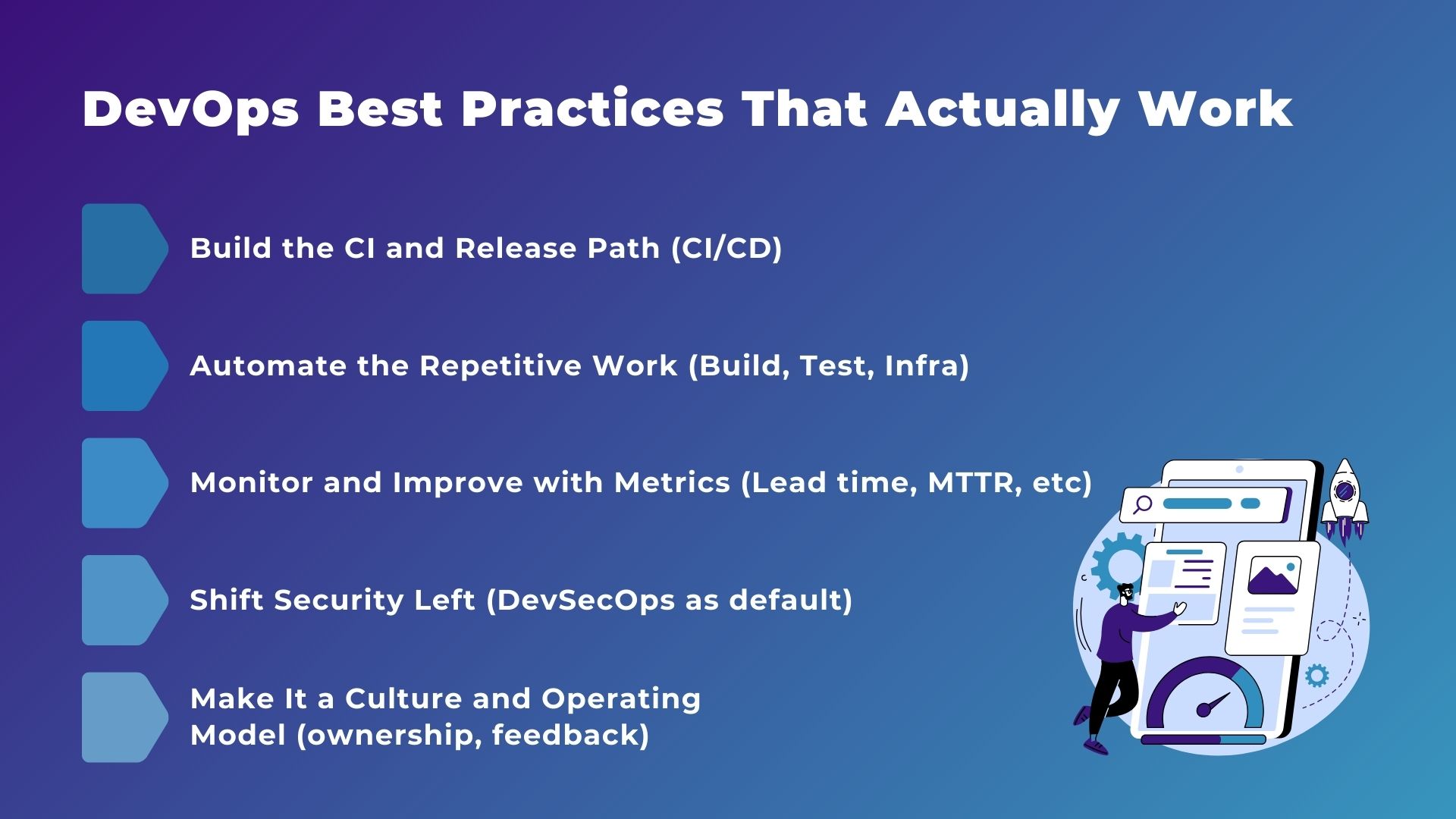
DevOps works best when it combines reliable processes, automation, and a culture of ownership. The practices below show how mid-sized teams can build a delivery system that is fast, secure, and scalable.
Build the CI and Release Path (CI/CD)
A consistent CI/CD workflow is the foundation of reliable delivery. Every change should flow through an automated pipeline from commit to production, ensuring builds, tests, and deployments happen the same way every time. This reduces manual errors, prevents environment drift, and gives teams confidence that changes are safe to release.
Automate the Repetitive Work (Build, Test, Infra)
Manual tasks slow teams down and introduce risk. Automation of builds, testing, infrastructure provisioning, and configuration management frees engineers to focus on higher-value work. As the system grows, these automated processes protect delivery speed and maintain consistency across environments.
Monitor and Improve with Metrics (Lead time, MTTR, etc.)
Monitoring is only effective if it drives action. Teams should track key metrics like lead time and mean time to recovery (MTTR), and tie alerts directly to accountable owners. Structured incident reviews and continuous feedback loops turn monitoring data into real improvements, reducing repeated failures and improving overall reliability.
Shift Security Left (DevSecOps as default)
Security should be part of the pipeline from the start. By integrating automated scans, access controls, and compliance checks early, teams reduce late-stage blockers and prevent vulnerabilities from reaching production. Security becomes a natural part of the workflow rather than an afterthought.
Make It a Culture and Operating Model (ownership, feedback)
DevOps succeeds when it is embedded in the team’s culture. Clear service ownership, fast feedback loops, and shared responsibility for incidents create an environment where continuous improvement thrives. Automation and tooling support the model, but the culture and defined processes are what make it sustainable.
Minimum Deliverables Checklist
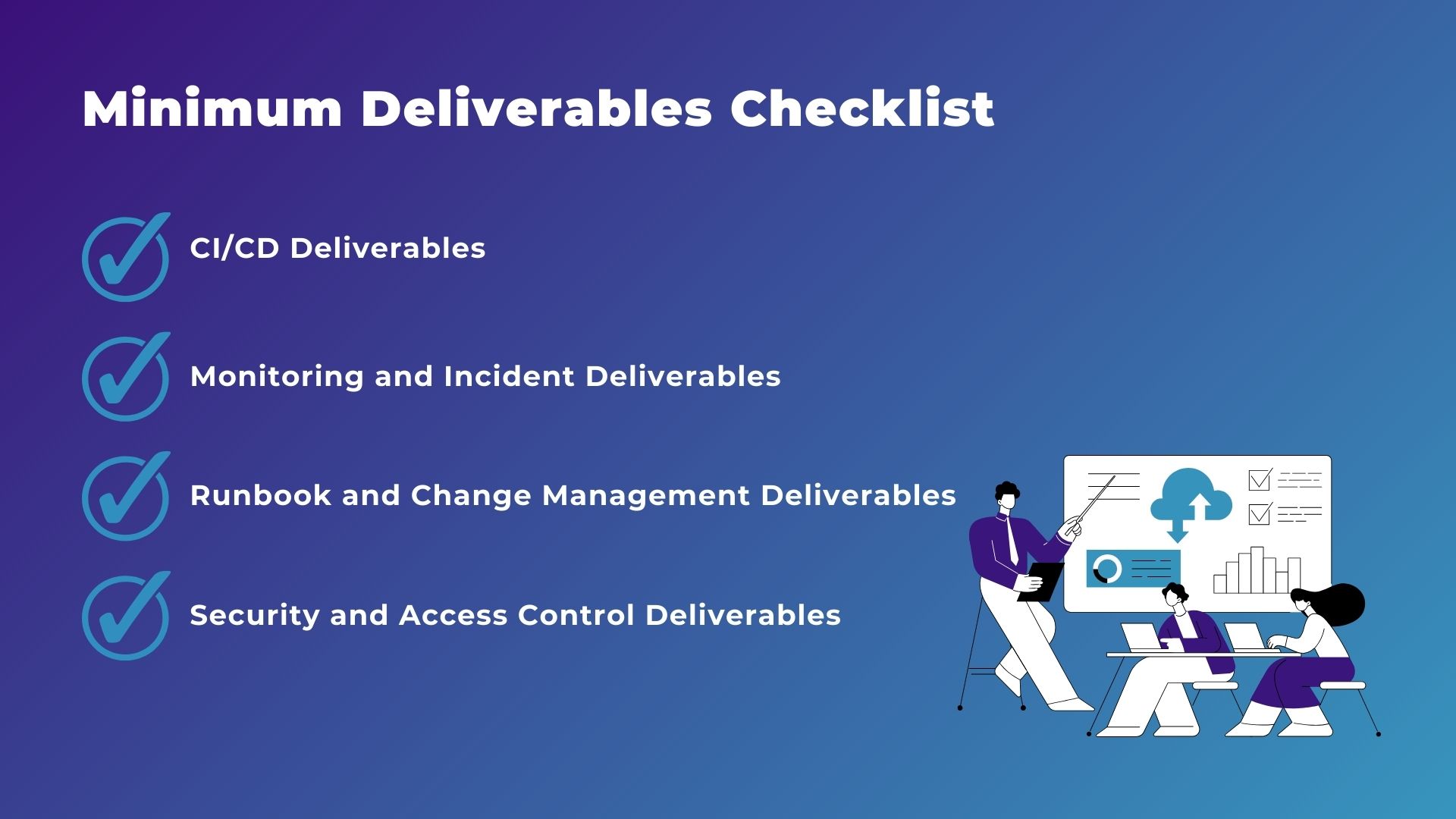
When implementing DevOps, it’s important to define concrete deliverables to ensure reliability and consistency.
Key deliverables include:
- CI/CD Deliverables: A standardized pipeline covering automated builds, testing, staging and production deployments, and rollback procedures.
- Monitoring and Incident Deliverables: Centralized logging, actionable alerts tied to ownership, and structured incident response processes.
- Runbook and Change Management Deliverables: Operational runbooks, escalation procedures, release checklists, and post-incident review templates.
- Security and Access Control Deliverables: Role-based permissions, secrets management, automated vulnerability scanning, and audit logging.
Together, these deliverables create a clear operational framework that supports faster, safer, and more predictable software delivery.
What to Outsource vs Keep In-house

Deciding what to handle internally versus what to outsource is critical for mid-sized teams with limited DevOps resources. A clear strategy ensures that your team focuses on high-value work while partners handle tasks that benefit most from specialized expertise.
What You Should Keep In-house
Core responsibilities that directly affect your product and business outcomes should remain in-house. This includes strategic decisions about architecture, service ownership, and compliance responsibilities. Internal teams should also maintain control over final security decisions and business-critical workflows to ensure accountability and alignment with company goals.
What You Can Outsource Safely
Tasks that are repetitive, highly technical, or require specialized expertise can often be outsourced. This includes setting up CI/CD pipelines, implementing infrastructure as code, integrating monitoring systems, and managing automated security tools. By leveraging external partners for these areas, your internal team can focus on product development and operational oversight rather than low-level setup and maintenance.
Where a Hybrid Model Works Best
Many mid-sized teams benefit from a hybrid approach, where external partners build and maintain foundational systems while internal teams oversee operations and gradually take ownership. This model allows for knowledge transfer, continuous improvement, and ensures that your team retains control over critical decisions while still leveraging external expertise for speed and scalability.
Common Failure Patterns and How to Avoid Them

Even with the right tools, DevOps initiatives can fail if teams neglect process, ownership, or culture. Understanding common failure patterns helps mid-sized teams avoid costly mistakes and implement DevOps effectively.
Tool-first Implementation (no operating model)
Many teams focus on adopting tools before defining how work should flow, which leads to inconsistent practices and confusion. Tools alone cannot enforce collaboration, standardization, or accountability. To avoid this, first establish a clear operating model that defines workflows, responsibilities, and feedback loops, then select tools that support that model.
No Ownership and Unclear Responsibilities
When no one is explicitly responsible for a service, incidents, or releases, tasks fall through the cracks and problems persist. Clear ownership at both team and individual levels ensures accountability. Documenting roles and responsibilities, and linking them to incident management and monitoring processes, prevents delays and repeated errors.
CI/CD Exists but Releases Are Still Manual
Implementing CI/CD pipelines is not enough if the final deployment still relies on manual steps. This undermines the benefits of automation and introduces human error. Fully automating the release process, including rollback and verification, ensures that teams can deploy reliably at any time.
Monitoring Without Action (alerts, but no response)
Setting up monitoring without defining how alerts will be handled creates noise and frustration. Alerts must be actionable, assigned to responsible owners, and tied to follow-up processes. Combining monitoring with structured incident response and post-mortem reviews ensures that data leads to meaningful improvements rather than ignored warnings.
Cost Drivers and Engagement Models

Understanding the costs of implementing DevOps and choosing the right engagement model is essential for mid-sized teams planning their budgets.
What Drives Cost Up
The figures below are indicative estimates based on global market data. Actual costs may vary depending on your region, team size, and project scope.
DevOps costs vary widely depending on project complexity, required expertise, and tool selection. Setting up a CI/CD pipeline typically costs between USD5,000 and USD15,000, while implementing IaC ranges from USD8,000 to USD25,000. Full-stack managed DevOps services usually run USD8,000 to USD20,000 per month, and 24/7 monitoring or incident response adds another USD2,500 to USD6,000 per month. Larger projects, such as full CI/CD automation or cloud migrations, can cost USD100,000 to USD200,000, and enterprise-wide DevOps transformations may exceed USD200,000.
Common Engagement Models (Fixed, T&M, Dedicated Team)
There are several common engagement models with different cost implications and flexibility. Fixed-scope projects, such as implementing CI/CD or security integration, usually fall between USD10,000 and USD50,000, offering predictable budgets. Time & Materials (T&M) contracts provide flexibility for evolving requirements but monthly costs vary depending on hours and expertise. Dedicated team arrangements, where external DevOps engineers work alongside internal teams, typically cost USD6,000 to USD14,000 per engineer per month.
How to Choose a DevOps Partner
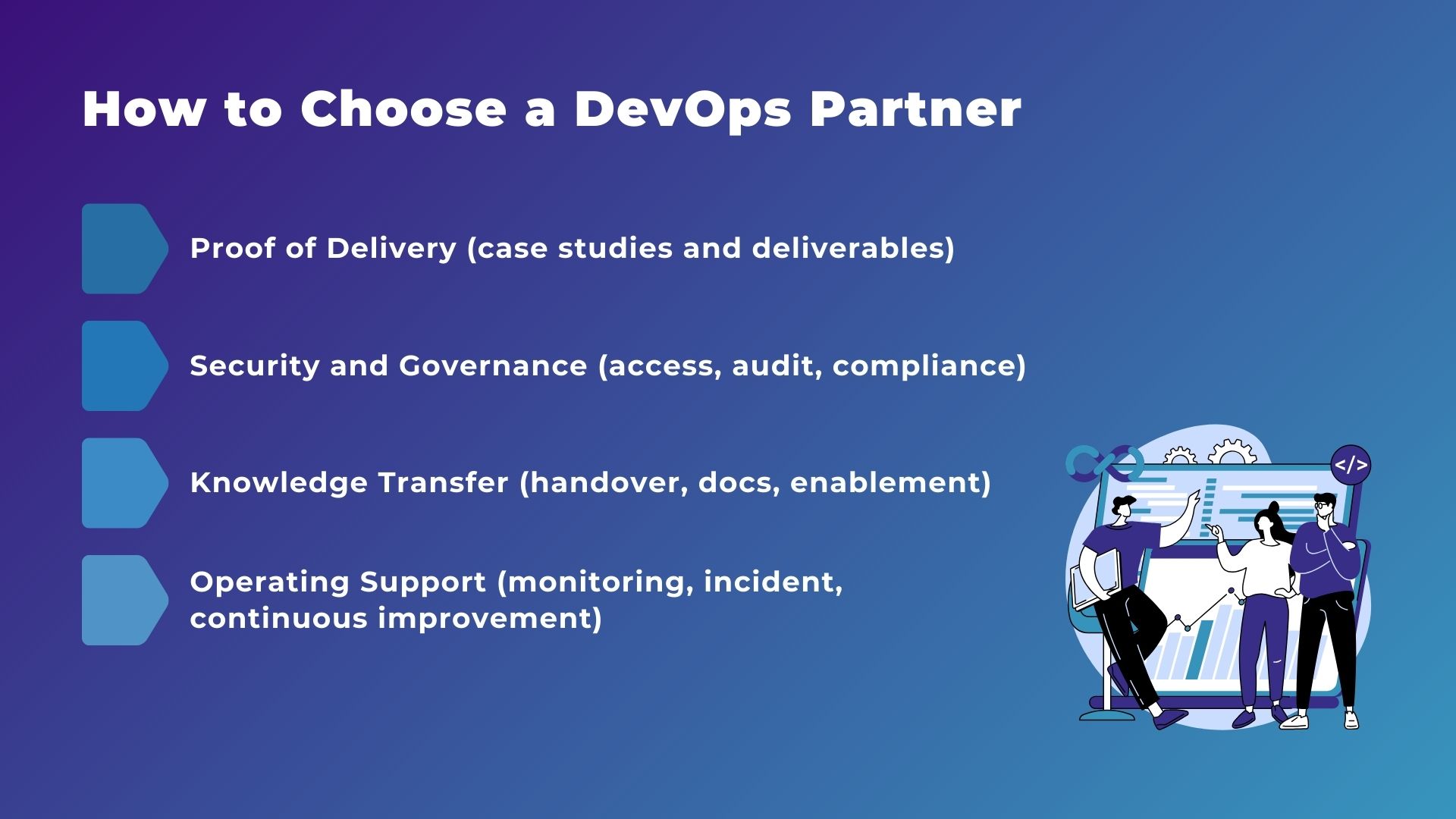
Choosing the right DevOps partner is about more than just price or reputation. Start by looking for proof of delivery, such as case studies or concrete results like CI/CD pipelines and monitoring systems. It’s also important to make sure they follow strong security and governance practices, including proper access controls, audits, and compliance.
Equally important is knowledge transfer. Clear documentation and training help your team maintain systems on their own. Finally, consider their operating support. Reliable partners provide ongoing monitoring, incident response, and continuous improvement to keep your systems running smoothly and securely.
How IVC Can Support

ISB Vietnam (IVC) supports mid-sized teams with a structured, practical approach to DevOps implementation.
Why teams choose IVC
IVC is especially strong in security-sensitive and high-scale environments. We have experience designing secure systems in domains such as healthcare and logistics, and building low-latency systems that handle large volumes of device or event data.
We also emphasize team enablement, including documentation, handover, and cost optimization guidance, so the system remains stable and affordable after launch.
IVC’s Core DevOps Deliverables
IVC focuses on a minimum set of deliverables that reduce release risk and operational workload. We implement Infrastructure as Code (Terraform or CloudFormation) to recreate Dev, Test, and Prod environments consistently.
We also build automated CI/CD pipelines (for example, GitHub Actions or AWS CodePipeline) with safe release controls, including rollback paths when deployments fail. On the operations side, we set up dashboards and alert rules, and deliver runbooks so teams can handle routine operations and incidents with clear procedures.
Security is built in through least-privilege IAM, network isolation, and audit-ready access and change logs.
Operational quality and safeguards
To keep DevOps reliable after go-live, IVC emphasizes operational controls such as automated rollback design in CI/CD, least-privilege access control, audit-ready logs for access and changes, and runbooks that define how to respond when alerts fire. We also support knowledge transfer so teams can operate confidently without depending on a few key individuals.
Typical DevOps Implementation Roadmap
ISB Vietnam (IVC) supports mid-sized teams with a structured, practical approach to DevOps implementation. Below is an illustrative roadmap to give a concrete idea of how a typical initial “Pilot” or single-application project may proceed.
This example is meant as a reference only. The actual duration and level of effort vary significantly depending on the agreed scope, long-term roadmap, current system complexity, legacy technical debt, and specific security or compliance requirements.
Phase 1. Assessment & Strategy
Estimated Duration: 1 to 2 weeks
IVC begins by auditing the current infrastructure and workflows. The goal is to identify bottlenecks, operational risks, and security gaps, then define clear automation and security objectives aligned with business priorities.
Key Deliverables:
- Gap Analysis Report
- DevOps Roadmap
Customer's Role: Provide scoped system access and share existing workflow challenges and security concerns.
Phase 2. Architecture Design
Estimated Duration: 2 to 4 weeks
IVC designs the target cloud architecture, CI/CD flow, and infrastructure-level security, including IAM policies and network isolation. The focus is on building a scalable and secure foundation before implementation begins.
Key Deliverables:
- Architecture Blueprint
- Security Policy Draft
Customer's Role: Define application-level security requirements and data classification, following the shared responsibility model. Review and approve the proposed design to ensure it aligns with business needs.
Phase 3. Build & Automation
Estimated Duration: 2 to 4 weeks
IVC implements Infrastructure as Code using tools such as Terraform or CloudFormation, builds CI/CD pipelines, and configures cloud security controls including VPCs and security groups.
Key Deliverables:
- Live Infrastructure
- Working CI/CD Pipelines
Customer's Role: Ensure application code security and manage end-user access to the application.
Phase 4. Handover & Enablement
Estimated Duration: 1 to 2 weeks
IVC hands over the system, conducts training sessions, and formalizes the ongoing shared responsibility matrix to clarify operational ownership.
Key Deliverables:
- Operation Runbooks
- Training Sessions
Customer's Role: Attend training, perform user acceptance testing, and take over daily application-level operations.
This phased approach allows teams to move from assessment to operational readiness in a structured and transparent way, while clearly defining responsibilities on both sides.
Ready to build a more reliable DevOps foundation?
IVC can assess your environment and recommend a phased roadmap that fits your scale and budget.
Get a Free ConsultationConclusion

DevOps is not just about tools. It is about building a repeatable operating model that improves delivery speed, strengthens reliability, and reduces operational risk as your systems grow. For many mid-sized teams, the real challenge is knowing where to start, what “good” looks like, and how to balance internal ownership with external expertise.
With a clear roadmap, defined ownership, and measurable outcomes, DevOps becomes a structured capability instead of an ongoing experiment.
Ready to move from reactive operations to structured DevOps?
Let's turn uncertainty into a clear, actionable roadmap grounded in real delivery.
Contact IVC TodaySources / References
Data and insights in this article are based on the following sources:
External image links
FREE WEBINAR
How Australian Startups Extend Runway.
Join our upcoming session for founders exploring offshore engineering.
 The adoption of AI-powered tools has significantly accelerated the creation of code, documents, and various drafts. At the same time, many U.S. companies are reducing headcount, prompting organizations to reassess where engineering teams should focus their efforts. As a result, the challenge in practice is no longer about simply increasing output. What matters most now is ensuring that AI-generated work is accurate, secure, and ready to be used seamlessly within real-world workflows