In the world of C++ programming, performance is always a key factor. The language gives us fine-grained control over how data is allocated, copied, and freed. However, before C++11, handling large data structures often led to a serious issue: unnecessary copying. This inefficiency was one of the driving forces behind the introduction of Move Semantics.
The Problem Before Move Semantics
Imagine you have a std::vector<int> containing millions of elements. If you write a function that returns this vector, compilers before C++11 would create a full copy of the vector upon return. That’s because the only available mechanism was the copy constructor.
This led to:
-
Huge performance costs (copying each element one by one).
-
Significant memory overhead (temporarily storing two copies).
Example:
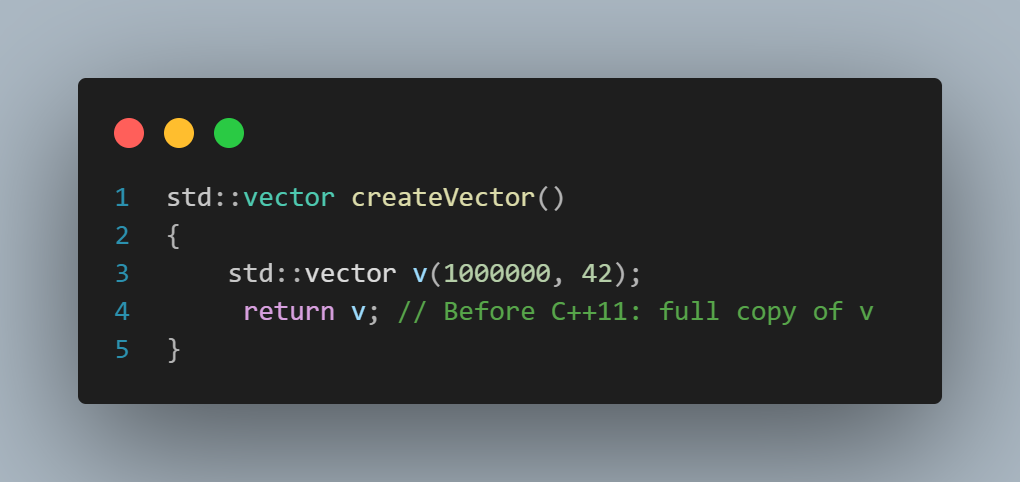
For large data, this copy is not only wasteful but completely unnecessary since v is a temporary object that will be destroyed right after the function ends.
What is Move Semantics?
Move semantics is a mechanism introduced in C++11 that allows transferring resources instead of copying them. Instead of duplicating memory or file handles, the program simply transfers ownership of those resources from one object to another.
In short:
-
Copy: makes a deep copy of data → slower.
-
Move: transfers ownership of data → much faster.
Example:
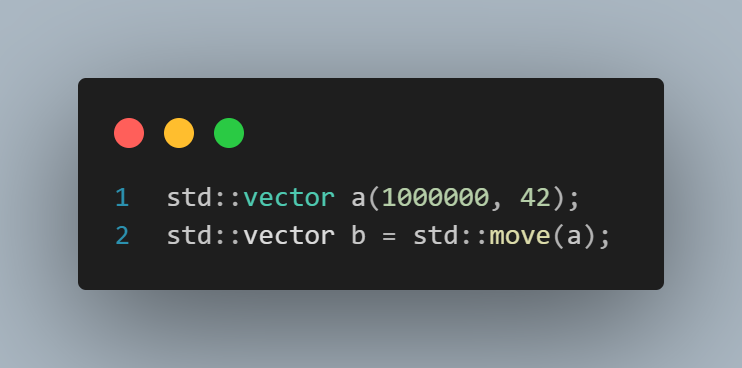
Here, b “steals” the memory buffer from a. After the move, a becomes empty but remains valid. No expensive copy takes place.
How It Works
Move semantics relies on the move constructor and move assignment operator, which are declared as:
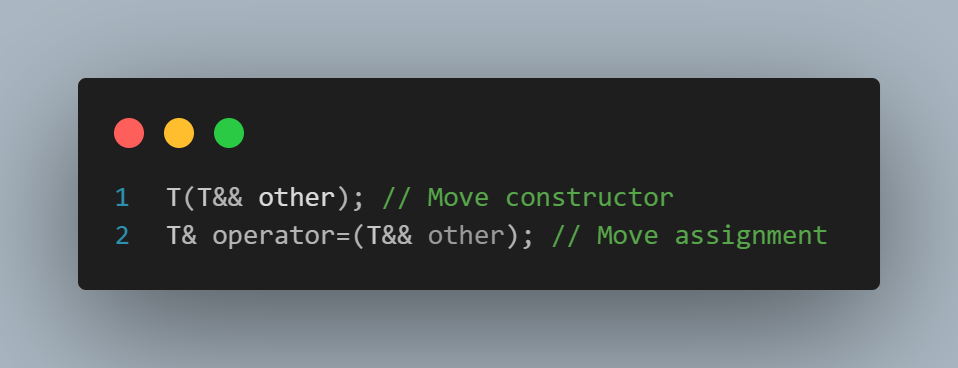
The T&& type is an rvalue reference, which binds to temporary objects. This allows the compiler to safely transfer resources instead of duplicating them.
Example:
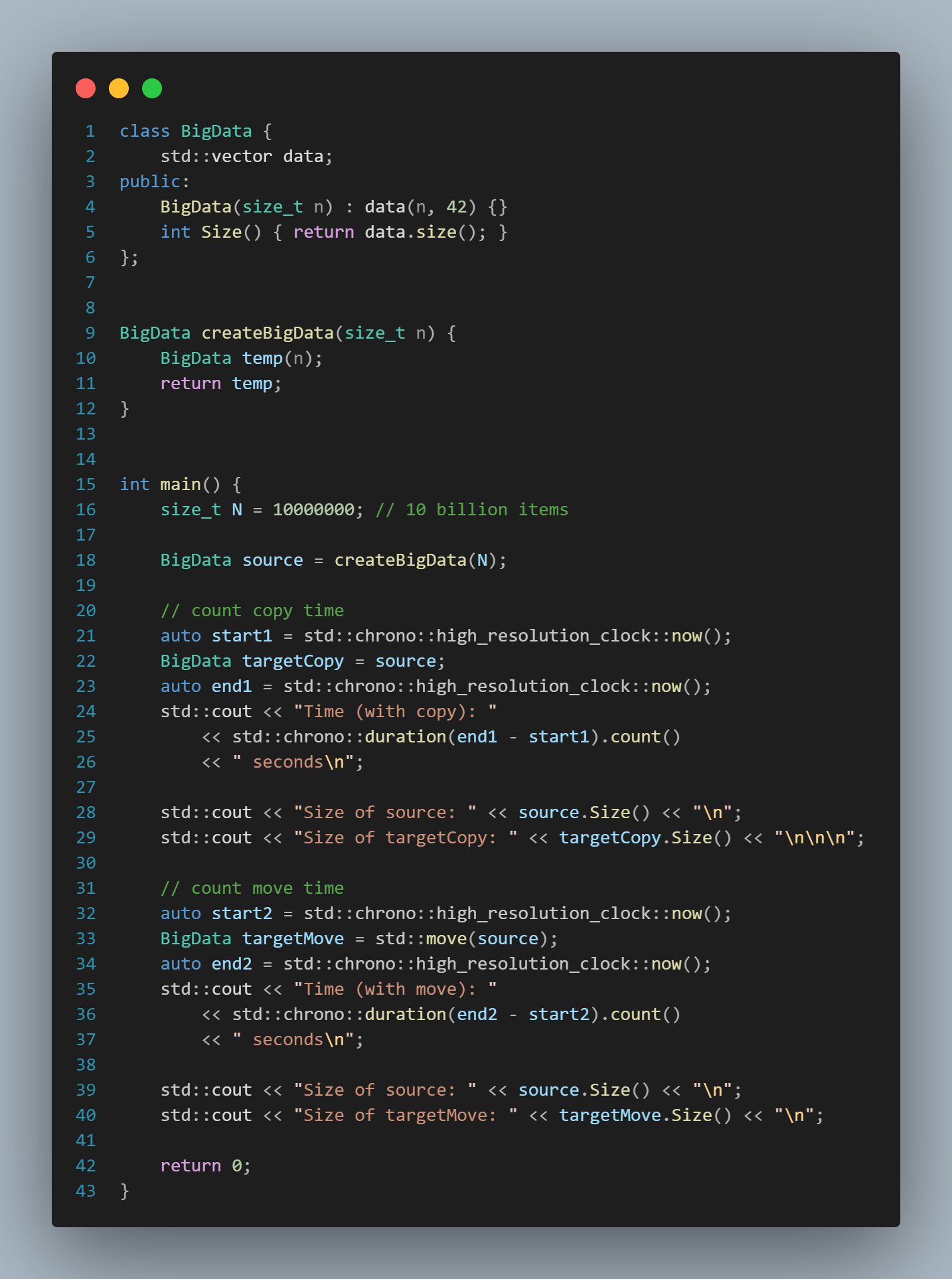
Output:
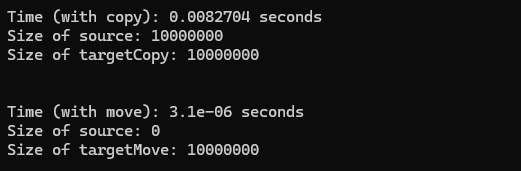
Time (with copy): 0.0082704 seconds
Time (with move): 0.0000031 seconds
Real Benefits
-
Performance boost: no deep copy of large data.
-
STL integration: all standard containers (
std::vector,std::string,std::map, etc.) support move semantics. -
Essential for smart pointers:
std::unique_ptrrelies on move semantics to transfer ownership safely.
Benchmarking often shows:
-
Copying may take 0.1 seconds for large objects.
-
Moving takes only tens of microseconds (0.00003 seconds).
That’s a performance difference of several orders of magnitude.
When to Use Move
-
When dealing with temporary objects.
-
When you need to transfer ownership rather than keep multiple copies.
-
When optimizing code that manages large data structures.
Keep in mind: move semantics doesn’t replace copying — it gives you an additional, more efficient option.
Conclusion
Move semantics is one of the biggest advancements introduced in C++11. It makes C++ more modern and efficient without losing the low-level control that developers value. By mastering this feature, you can write code that is faster, leaner, and safer.
If you were ever worried about returning large objects by value, worry no more. Since C++11, compilers prefer moving over copying, and you can explicitly use std::move to enforce it when needed.
Whether you need scalable software solutions, expert IT outsourcing, or a long-term development partner, ISB Vietnam is here to deliver. Let’s build something great together—reach out to us today. Or click here to explore more ISB Vietnam's case studies.
References:
Ready to get started?
Contact IVC for a free consultation and discover how we can help your business grow online.
Contact IVC for a Free Consultation