OUTSOURCING

March 16, 2026

DevOps Best Practices: What to Build and What to Outsource

DevOps can speed up releases and improve reliability, but many mid-sized teams get stuck. Tooling is inconsistent, environments drift, incidents are handled reactively, and delivery slows down as systems grow. When you do not have dedicated SRE or DevOps specialists, the challenge is not knowing what to implement first, and what you can safely hand off to a partner.

Fueled by digital transformation, the DevOps outsourcing market is surging as organizations seek to manage complex cloud-native environments, address talent gaps, and accelerate their time-to-market. According to Future Market Report (2025), the market is valued at approximately USD 12.5 billion and is projected to reach USD 28.4 billion by 2032, growing at a CAGR of 10.8%. North America leads with a 35.6% market share, with the U.S. accounting for the largest single-country portion at 22.1%.

This guide breaks down DevOps best practices that work in real projects. We clarify the minimum deliverables to aim for, how to split responsibilities between in-house and outsourced teams, and the common failure patterns that derail DevOps efforts. You will also learn what drives cost, which engagement model fits your situation, and how to evaluate a DevOps partner before you commit.

What DevOps Means in Practice

devops best practices

In real projects, DevOps is not a philosophy deck. It is an operating system for how your team builds, tests, secures, and delivers software.

For companies running web services or internal platforms, DevOps typically includes:

  • A standard CI pipeline used by every developer
  • Infrastructure as code to control environment drift
  • Automated testing and deployment
  • Monitoring tied to business impact
  • Defined ownership and incident response

    The key shift is control. You move from reactive issue handling to a structured, measurable delivery model.

    Why DevOps Matters for Mid-sized Teams

    devops best practices

    For mid-sized organizations, the business impact of slow delivery is now measurable. A 2025 TechRadar Pro report found that software projects are delayed by an average of four months, costing companies approximately £107,000(around USD 135,000) per year due to missed opportunities and inefficiencies. The report emphasizes that executives increasingly view sluggish delivery as a strategic liability that directly affects competitiveness and revenue growth.

    At the same time, DevOps is expanding beyond traditional application delivery. Another 2025 TechRadar Pro article highlights that 85% of machine learning models never make it into production, largely due to fragmented processes between development, operations, and data teams. This statistic underscores the growing need to unify DevOps and MLOps into a single, end-to-end software supply chain.

    Together, these figures reinforce that modern DevOps is not just about faster releases. It is about reducing measurable business loss and ensuring that innovation actually reaches production.

    DevOps Best Practices That Actually Work

    devops best practices

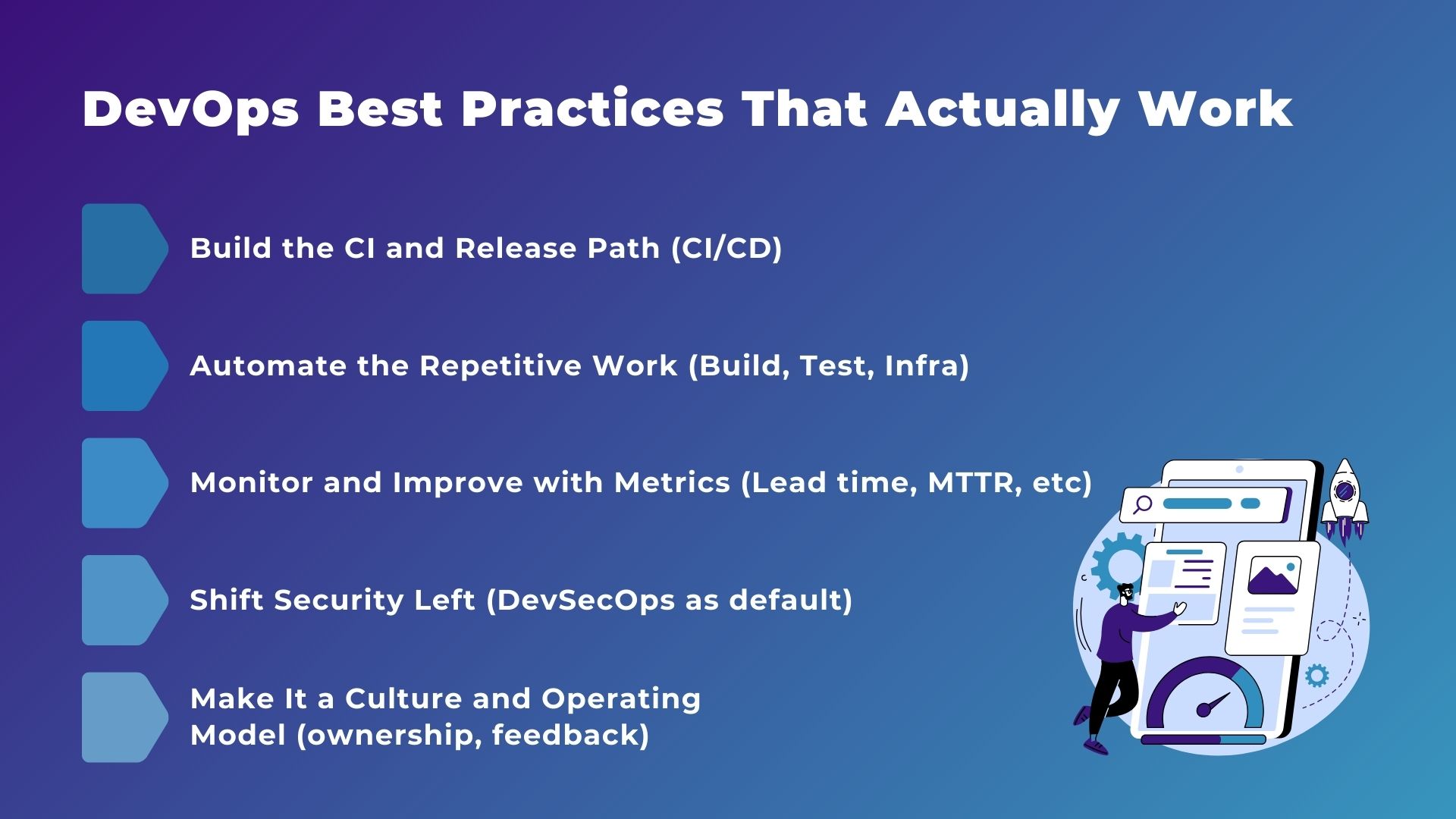
    DevOps works best when it combines reliable processes, automation, and a culture of ownership. The practices below show how mid-sized teams can build a delivery system that is fast, secure, and scalable.

    Build the CI and Release Path (CI/CD)

    A consistent CI/CD workflow is the foundation of reliable delivery. Every change should flow through an automated pipeline from commit to production, ensuring builds, tests, and deployments happen the same way every time. This reduces manual errors, prevents environment drift, and gives teams confidence that changes are safe to release.

    Automate the Repetitive Work (Build, Test, Infra)

    Manual tasks slow teams down and introduce risk. Automation of builds, testing, infrastructure provisioning, and configuration management frees engineers to focus on higher-value work. As the system grows, these automated processes protect delivery speed and maintain consistency across environments.

    Monitor and Improve with Metrics (Lead time, MTTR, etc.)

    Monitoring is only effective if it drives action. Teams should track key metrics like lead time and mean time to recovery (MTTR), and tie alerts directly to accountable owners. Structured incident reviews and continuous feedback loops turn monitoring data into real improvements, reducing repeated failures and improving overall reliability.

    Shift Security Left (DevSecOps as default)

    Security should be part of the pipeline from the start. By integrating automated scans, access controls, and compliance checks early, teams reduce late-stage blockers and prevent vulnerabilities from reaching production. Security becomes a natural part of the workflow rather than an afterthought.

    Make It a Culture and Operating Model (ownership, feedback)

    DevOps succeeds when it is embedded in the team’s culture. Clear service ownership, fast feedback loops, and shared responsibility for incidents create an environment where continuous improvement thrives. Automation and tooling support the model, but the culture and defined processes are what make it sustainable.

    Minimum Deliverables Checklist

    devops best practices

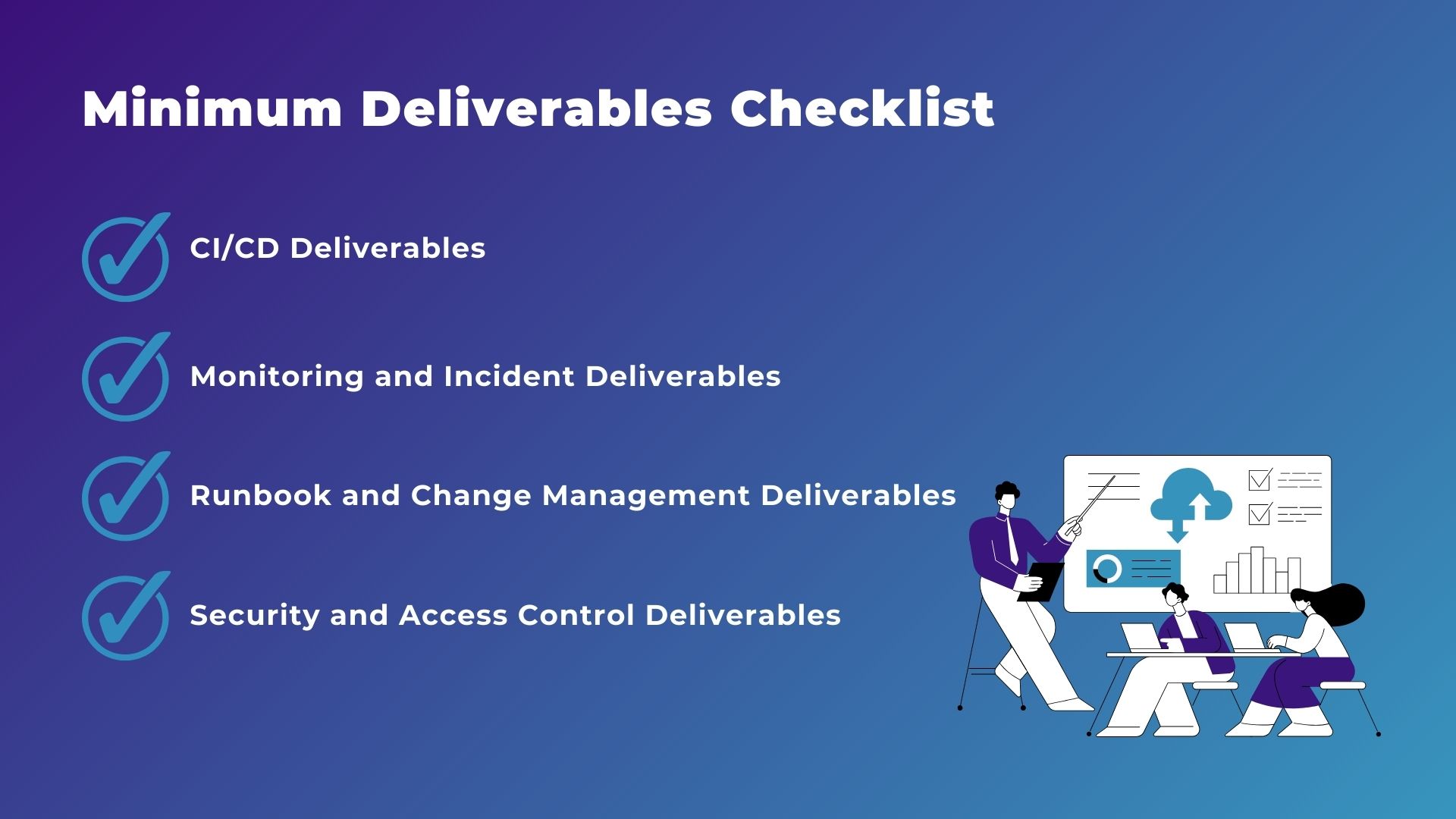
    When implementing DevOps, it’s important to define concrete deliverables to ensure reliability and consistency.

    Key deliverables include:

    • CI/CD Deliverables: A standardized pipeline covering automated builds, testing, staging and production deployments, and rollback procedures.
    • Monitoring and Incident Deliverables: Centralized logging, actionable alerts tied to ownership, and structured incident response processes.
    • Runbook and Change Management Deliverables: Operational runbooks, escalation procedures, release checklists, and post-incident review templates.
    • Security and Access Control Deliverables: Role-based permissions, secrets management, automated vulnerability scanning, and audit logging.

    Together, these deliverables create a clear operational framework that supports faster, safer, and more predictable software delivery.

    What to Outsource vs Keep In-house

    devops best practices

    Deciding what to handle internally versus what to outsource is critical for mid-sized teams with limited DevOps resources. A clear strategy ensures that your team focuses on high-value work while partners handle tasks that benefit most from specialized expertise.

    What You Should Keep In-house

    Core responsibilities that directly affect your product and business outcomes should remain in-house. This includes strategic decisions about architecture, service ownership, and compliance responsibilities. Internal teams should also maintain control over final security decisions and business-critical workflows to ensure accountability and alignment with company goals.

    What You Can Outsource Safely

    Tasks that are repetitive, highly technical, or require specialized expertise can often be outsourced. This includes setting up CI/CD pipelines, implementing infrastructure as code, integrating monitoring systems, and managing automated security tools. By leveraging external partners for these areas, your internal team can focus on product development and operational oversight rather than low-level setup and maintenance.

    Where a Hybrid Model Works Best

    Many mid-sized teams benefit from a hybrid approach, where external partners build and maintain foundational systems while internal teams oversee operations and gradually take ownership. This model allows for knowledge transfer, continuous improvement, and ensures that your team retains control over critical decisions while still leveraging external expertise for speed and scalability.

    Common Failure Patterns and How to Avoid Them

    devops best practices

    Even with the right tools, DevOps initiatives can fail if teams neglect process, ownership, or culture. Understanding common failure patterns helps mid-sized teams avoid costly mistakes and implement DevOps effectively.

    Tool-first Implementation (no operating model)

    Many teams focus on adopting tools before defining how work should flow, which leads to inconsistent practices and confusion. Tools alone cannot enforce collaboration, standardization, or accountability. To avoid this, first establish a clear operating model that defines workflows, responsibilities, and feedback loops, then select tools that support that model.

    No Ownership and Unclear Responsibilities

    When no one is explicitly responsible for a service, incidents, or releases, tasks fall through the cracks and problems persist. Clear ownership at both team and individual levels ensures accountability. Documenting roles and responsibilities, and linking them to incident management and monitoring processes, prevents delays and repeated errors.

    CI/CD Exists but Releases Are Still Manual

    Implementing CI/CD pipelines is not enough if the final deployment still relies on manual steps. This undermines the benefits of automation and introduces human error. Fully automating the release process, including rollback and verification, ensures that teams can deploy reliably at any time.

    Monitoring Without Action (alerts, but no response)

    Setting up monitoring without defining how alerts will be handled creates noise and frustration. Alerts must be actionable, assigned to responsible owners, and tied to follow-up processes. Combining monitoring with structured incident response and post-mortem reviews ensures that data leads to meaningful improvements rather than ignored warnings.

    Cost Drivers and Engagement Models

    devops best practices

    Understanding the costs of implementing DevOps and choosing the right engagement model is essential for mid-sized teams planning their budgets.

    What Drives Cost Up

    The figures below are indicative estimates based on global market data. Actual costs may vary depending on your region, team size, and project scope.

    DevOps costs vary widely depending on project complexity, required expertise, and tool selection. Setting up a CI/CD pipeline typically costs between USD5,000 and USD15,000, while implementing IaC ranges from USD8,000 to USD25,000. Full-stack managed DevOps services usually run USD8,000 to USD20,000 per month, and 24/7 monitoring or incident response adds another USD2,500 to USD6,000 per month. Larger projects, such as full CI/CD automation or cloud migrations, can cost USD100,000 to USD200,000, and enterprise-wide DevOps transformations may exceed USD200,000.

    Common Engagement Models (Fixed, T&M, Dedicated Team)

    There are several common engagement models with different cost implications and flexibility. Fixed-scope projects, such as implementing CI/CD or security integration, usually fall between USD10,000 and USD50,000, offering predictable budgets. Time & Materials (T&M) contracts provide flexibility for evolving requirements but monthly costs vary depending on hours and expertise. Dedicated team arrangements, where external DevOps engineers work alongside internal teams, typically cost USD6,000 to USD14,000 per engineer per month.

    How to Choose a DevOps Partner

    devops best practices

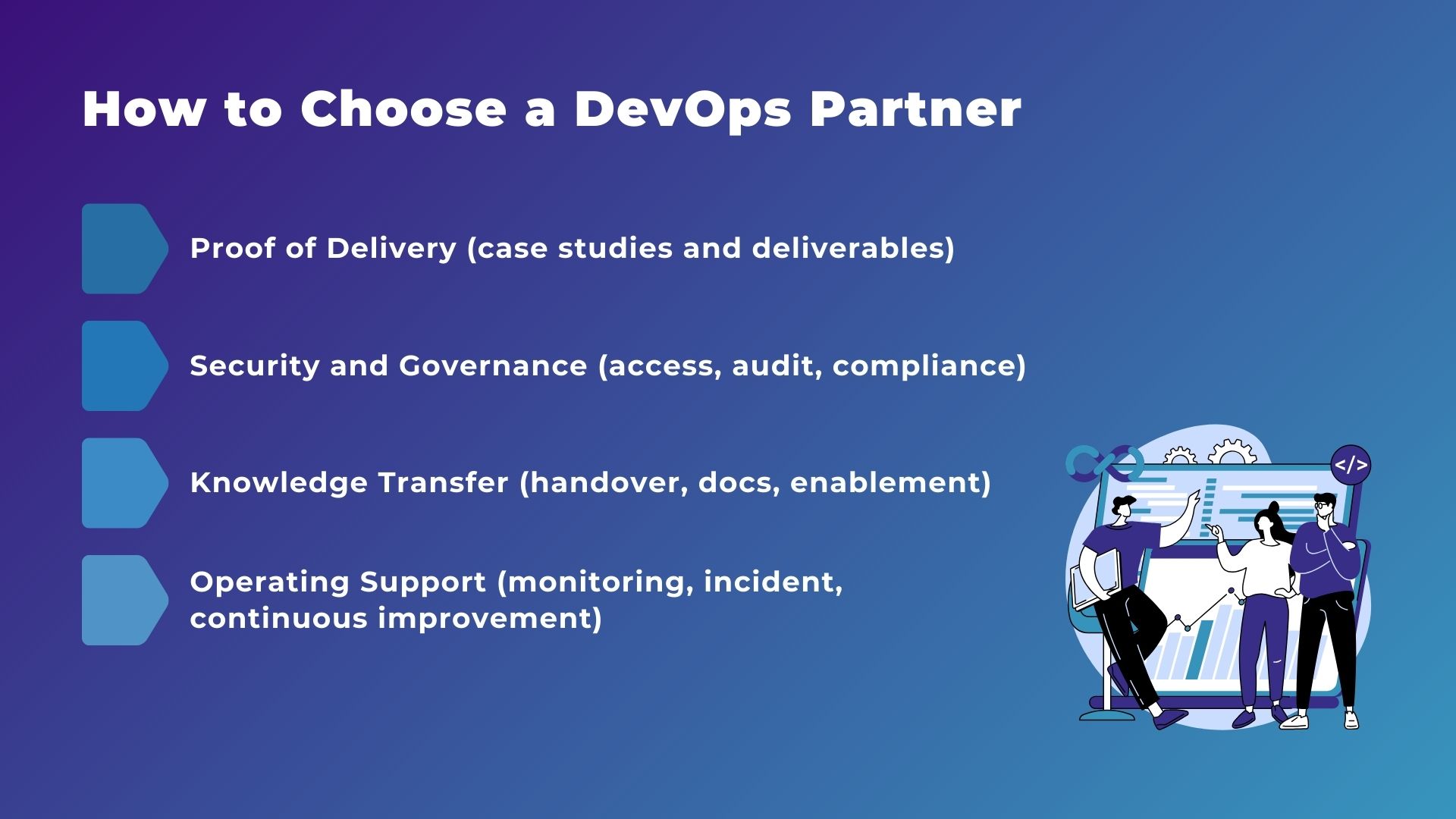
    Choosing the right DevOps partner is about more than just price or reputation. Start by looking for proof of delivery, such as case studies or concrete results like CI/CD pipelines and monitoring systems. It’s also important to make sure they follow strong security and governance practices, including proper access controls, audits, and compliance.

    Equally important is knowledge transfer. Clear documentation and training help your team maintain systems on their own. Finally, consider their operating support. Reliable partners provide ongoing monitoring, incident response, and continuous improvement to keep your systems running smoothly and securely.

    How IVC Can Support

    devops best practices

    ISB Vietnam (IVC) supports mid-sized teams with a structured, practical approach to DevOps implementation.

    Why teams choose IVC

    IVC is especially strong in security-sensitive and high-scale environments. We have experience designing secure systems in domains such as healthcare and logistics, and building low-latency systems that handle large volumes of device or event data. 

    We also emphasize team enablement, including documentation, handover, and cost optimization guidance, so the system remains stable and affordable after launch.

    IVC’s Core DevOps Deliverables

    IVC focuses on a minimum set of deliverables that reduce release risk and operational workload. We implement Infrastructure as Code (Terraform or CloudFormation) to recreate Dev, Test, and Prod environments consistently. 

    We also build automated CI/CD pipelines (for example, GitHub Actions or AWS CodePipeline) with safe release controls, including rollback paths when deployments fail. On the operations side, we set up dashboards and alert rules, and deliver runbooks so teams can handle routine operations and incidents with clear procedures.

    Security is built in through least-privilege IAM, network isolation, and audit-ready access and change logs.

    Operational quality and safeguards

    To keep DevOps reliable after go-live, IVC emphasizes operational controls such as automated rollback design in CI/CD, least-privilege access control, audit-ready logs for access and changes, and runbooks that define how to respond when alerts fire. We also support knowledge transfer so teams can operate confidently without depending on a few key individuals.

    Typical DevOps Implementation Roadmap

    ISB Vietnam (IVC) supports mid-sized teams with a structured, practical approach to DevOps implementation. Below is an illustrative roadmap to give a concrete idea of how a typical initial “Pilot” or single-application project may proceed.

    This example is meant as a reference only. The actual duration and level of effort vary significantly depending on the agreed scope, long-term roadmap, current system complexity, legacy technical debt, and specific security or compliance requirements.

    Phase 1. Assessment & Strategy

    Estimated Duration: 1 to 2 weeks

    IVC begins by auditing the current infrastructure and workflows. The goal is to identify bottlenecks, operational risks, and security gaps, then define clear automation and security objectives aligned with business priorities.

    Key Deliverables:

    • Gap Analysis Report
    • DevOps Roadmap

    Customer's Role: Provide scoped system access and share existing workflow challenges and security concerns.

    Phase 2. Architecture Design

    Estimated Duration: 2 to 4 weeks

    IVC designs the target cloud architecture, CI/CD flow, and infrastructure-level security, including IAM policies and network isolation. The focus is on building a scalable and secure foundation before implementation begins.

    Key Deliverables:

    • Architecture Blueprint
    • Security Policy Draft

    Customer's Role: Define application-level security requirements and data classification, following the shared responsibility model. Review and approve the proposed design to ensure it aligns with business needs.

    Phase 3. Build & Automation

    Estimated Duration: 2 to 4 weeks

    IVC implements Infrastructure as Code using tools such as Terraform or CloudFormation, builds CI/CD pipelines, and configures cloud security controls including VPCs and security groups.

    Key Deliverables:

    • Live Infrastructure
    • Working CI/CD Pipelines

    Customer's Role: Ensure application code security and manage end-user access to the application.

    Phase 4. Handover & Enablement

    Estimated Duration: 1 to 2 weeks

    IVC hands over the system, conducts training sessions, and formalizes the ongoing shared responsibility matrix to clarify operational ownership.

    Key Deliverables:

    • Operation Runbooks
    • Training Sessions

    Customer's Role: Attend training, perform user acceptance testing, and take over daily application-level operations.

    This phased approach allows teams to move from assessment to operational readiness in a structured and transparent way, while clearly defining responsibilities on both sides.

    Ready to build a more reliable DevOps foundation?

    IVC can assess your environment and recommend a phased roadmap that fits your scale and budget.

    Get a Free Consultation

    Conclusion

    devops best practices

    DevOps is not just about tools. It is about building a repeatable operating model that improves delivery speed, strengthens reliability, and reduces operational risk as your systems grow. For many mid-sized teams, the real challenge is knowing where to start, what “good” looks like, and how to balance internal ownership with external expertise.

    With a clear roadmap, defined ownership, and measurable outcomes, DevOps becomes a structured capability instead of an ongoing experiment.

    Ready to move from reactive operations to structured DevOps?

    Let's turn uncertainty into a clear, actionable roadmap grounded in real delivery.

    Contact IVC Today

    Sources / References

    Data and insights in this article are based on the following sources:

    External image links

    • All images featured in this article are provided by Unsplash, a platform for freely usable images.
    • The diagrams used in this article were created using Canva.       
    View More
    OUTSOURCING

    February 12, 2026

    Generative AI Development Services: Integration, Automation, and Workflow Solutions for Businesses

    Generative AI has moved beyond the hype, and many enterprises are now piloting models and tools. However, moving from a promising demo to a system that works reliably inside real business workflows is still difficult.

    A report by Project NANDA (MIT NANDA) describes this gap as the GenAI Divide: only about 5% of integrated generative AI pilots achieve sustained, measurable business value, while roughly 95% fail to show clear P&L impact due to brittle workflows, weak integrations, and unclear governance. (※)

    In this guide,we explain what generative AI development services cover, common enterprise use cases, delivery approaches such as RAG and API integrations, and the security, compliance, and cost factors you should evaluate when choosing a development partner.


    (※)The GenAI Divide – State of AI in Business 2025(MIT Project NANDA / MIT NANDA)


    From GenAI Hype to Production Reality

    Generative AIThe adoption of AI-powered tools has significantly accelerated the creation of code, documents, and various drafts. At the same time, many U.S. companies are reducing headcount, prompting organizations to reassess where engineering teams should focus their efforts. As a result, the challenge in practice is no longer about simply increasing output. What matters most now is ensuring that AI-generated work is accurate, secure, and ready to be used seamlessly within real-world workflows


    This shift explains why pilots alone are not enough. To turn Generative AI into a reliable system, teams need strong engineering practices after generation, including review and validation, access control, audit logging, failure handling, and integration with existing systems. In other words, the companies that succeed will not be the ones producing the most. They will be the ones that can rigorously govern and deliver high-quality outcomes.

    Generative AI development services support this transition by covering the full path from use case discovery and data preparation to architecture, security design, system integration, and ongoing monitoring. With the right partner, companies can move from prototype to production without sacrificing quality or control.

    What Are Generative AI Development Services?

    Generative AI Development Services

    Generative AI development services refer to professional support for integrating generative AI into business operations and digital products. These services typically cover the full delivery lifecycle, including requirements definition, data preparation, selection of approaches such as RAG or custom models, application and system integrations, evaluation and testing, security and access control design, and production deployment.

    Rather than focusing only on models, generative AI development services help organizations build solutions that are reliable, secure, and ready for real-world use.

    Why Businesses Are Investing in GenAI Integration and Automation

    Generative AI Development Services

    Businesses are investing in generative AI integration and automation to address growing operational pressure, including labor shortages and increasing workloads. By applying generative AI to repetitive, time-consuming tasks, organizations aim to improve productivity while keeping operating costs under control.

    Common targets include customer inquiries, internal knowledge search, and routine reporting, areas where generative AI can reduce manual effort and standardize outputs. When integrated with existing systems, these capabilities extend beyond isolated use cases and enable end-to-end workflow automation across business applications, rather than only small efficiency improvements.

    Common Generative AI Use Cases for Business Apps

    Generative AI Development Services

    Generative AI is most effective when applied to clearly defined workflows within business applications. The following categories represent common, practical use cases that organizations prioritize when moving beyond experimentation. These patterns also inform the delivery approaches discussed in later sections.

    Customer Support and Internal Helpdesk

    Generative AI is used to draft responses, classify incoming requests, and assist agents by referencing relevant knowledge. In both customer support and internal helpdesk scenarios, Generative AI helps reduce handling time while maintaining consistent guidance across teams.

    Document Search, Summarization, and Knowledge Assist

    This is one of the most established enterprise use cases. Using RAG, generative AI systems search internal documents and generate summaries or answers grounded in source material, improving access to policies, manuals, and institutional knowledge.

    Workflow Automation and Operational Efficiency

    Generative AI supports language-based tasks such as drafting text or assisting with decisions, while execution is handled through API integrations or RPA. This approach treats generative AI as part of a broader automation pipeline rather than a standalone tool.

    Content and Marketing Operations Support

    Generative AI is commonly used to generate first drafts of marketing copy, emails, proposals, summaries, and test ideas. While human review remains essential, these workflows, while long established in B2C, are increasingly adopted in B2B environments.

    Delivery Approaches and Architecture Options

    Generative AI Development Services

    There is no single way to implement generative AI in business applications. Common approaches include RAG, fine-tuning, and integrations with existing systems, each suited to different requirements around accuracy, explainability, cost, operations, and security. Choosing the right architecture depends on business goals and constraints, not on technology trends alone.

    Before comparing these approaches, it is important to clarify one principle: prompts are a design capability, not a shortcut. Prompts encode business rules, constraints, and quality standards that guide AI behavior.  Well-designed prompts improve consistency and reliability. From an AX perspective, prompts should be treated as operational assets and managed through version control, review, and testing.

    In practice, prompt design is becoming a core capability. It requires understanding the workflow, defining quality criteria, and translating them into instructions that the system can consistently follow.


    RAG for Enterprise Knowledge

    Retrieval-Augmented Generation (RAG) allows AI systems to answer questions by retrieving relevant internal documents and providing source-backed responses. It is well suited for enterprise knowledge such as policies, manuals, FAQs, and contracts, where traceability matters. Key considerations include data sources, access control, document freshness, chunking strategy, and evaluation methods.

    RAG failures are often caused by outdated content, poor document granularity, unclear permissions, or missing citations. Effective deployments therefore require ongoing operations, including content updates, logging, and structured review and improvement processes.

    Fine-Tuning and Custom Models

    Fine-tuning adapts models to specific domains, terminology, or tone, and is most useful when consistent behavior or stable classification is required. This approach requires high-quality training and evaluation data, defined quality criteria, and a plan for retraining and maintenance. In many cases, however, RAG alone is sufficient, and the key decision is whether the issue lies in data access or in model behavior itself.

    Integrations with Existing Systems and APIs

    Generative AI delivers the most value when integrated with existing systems such as CRM or help desk platforms. These integrations require careful design of permissions, audit logs, data flows, and failure handling. Organizations must also decide when AI actions can be automated and when human approval is required, while managing usage and cost as part of ongoing operations.


    Data, Security, and Compliance Considerations

    Generative AI Development Services

    When using generative AI in business applications, data management, security, and compliance become critical design considerations. This section outlines the key areas organizations should address and the requirements to confirm when working with external development partners.

    Data Handling and Access Control

    Teams must clearly define which data is used, where it is stored, and who can access it. This typically includes least-privilege access control, authentication, audit logging, restrictions on data export, data retention policies, and clear responsibility boundaries when third parties are involved.

    Privacy and Responsible AI Practices

    Organizations need to establish rules for handling personal and sensitive information, as well as managing risks related to incorrect or biased outputs. This includes usage policies, data usage and training restrictions, internal guidelines, explainability expectations, and identifying where human review should be applied.

    Evaluation and Validation for Production

    Before deployment, generative AI systems should be evaluated beyond accuracy alone. Validation typically covers source reliability, consistency, error rates, security testing, performance under load, cost behavior, and operational monitoring, with clear criteria for moving from PoC to production.

    Cost Drivers and Engagement Models

    Generative AI Development Services

    The cost of generative AI development depends on project scope, complexity, and delivery approach. Key cost drivers include data preparation, model selection, system integrations, security and compliance work, and post-launch monitoring.

    As a benchmark,generative AI projects typically cost $50,000–$100,000 for small pilots, $100,000–$400,000 for production-ready applications with integrations and RAG, and $300,000–$600,000+ for enterprise-scale deployments involving multiple systems, custom models, or advanced security.

    Engagement models also affect cost structure. Fixed-price contracts are best for clearly defined scopes, while time-and-materials or dedicated team models offer flexibility for iterative development and ongoing optimization. In practice, data preparation, integrations, and operational monitoring often make up the largest portion of the budget, not just model usage or API fees. 

    How to Choose a Generative AI Development Partner

    Generative AI Development Services

    Choosing the right generative AI development partner is key to ensuring a successful project. Look for partners with a proven track record in similar projects, strong data and security practices, and the ability to support evaluation, testing, and operational monitoring throughout the project lifecycle. They should also be skilled at integrating generative AI with existing systems and APIs, and clearly define responsibilities and deliverables in their contracts.

    Avoid common pitfalls such as selecting a partner based solely on price, stopping at the PoC stage, or neglecting operational planning. The ideal partner provides guidance and support from prototype through production, helping organizations deploy generative AI effectively while minimizing risk.

    Make sure your partner can clearly explain how they review and validate AI outputs in production, and what concrete safeguards are in place for access control, audit logging, and error handling.

    Conclusion

    Generative AI Development Services

    Generative AI has the power to accelerate creation, automate decisions, and standardize outputs across business applications. However, real value does not come from “letting AI do everything.” As AI handles more generative work, humans remain essential for reviewing results, confirming their correctness, keeping systems secure, and integrating AI safely into real-world operations. Successful adoption depends on this balance: the speed and scale of AI on one side, and rigorous human oversight, governance, and quality assurance on the other.

    At IBS Vietnam (IVC), we are deliberately working toward this new quality standard, where AI is used aggressively in development but never without accountability. We actively leverage AI within our engineering processes while maintaining strong human review, testing, and integration discipline. For organizations looking beyond the hype and seeking reliable, long-term IT outsourcing support that treats AI as a tool rather than a risk, IVC is committed to building systems you can trust.


    Reference

    Data and insights in this article are based on the following sources:

      External image links

      • All images featured in this article are provided by Unsplash, a platform for freely usable images.
      View More
      OUTSOURCING

      December 29, 2025

      Healthcare IT Outsourcing: A Complete Guide for Medical Software Development

      Healthcare IT outsourcing has become a strategic approach for hospitals, clinics, and healthcare technology providers aiming to modernize systems, enhance patient care, and optimize operational costs.

      As the global healthcare IT outsourcing market has continued to grow in 2025, more organizations are partnering with specialized software development companies to accelerate innovation, ensure compliance, and strengthen data security.

      In this guide, we’ll explore the key areas driving the rise of healthcare IT outsourcing, including electronic health record (EHR) systems, telemedicine solutions, and medical data management.

      You’ll also learn how ISB Vietnam (IVC) leverages its strong expertise in secure software development to support the healthcare industry’s evolving digital needs.


      Ready to build your next-generation medical software?
      Let’s collaborate to develop secure, compliant, and high-performance medical systems tailored to your needs.
      Contact IVC for a Free Consultation
       

      What Is Healthcare IT Outsourcing?

      What Is Healthcare IT Outsourcing?

      Healthcare IT outsourcing refers to delegating healthcare-related IT functions to external service providers.
      These services typically include software development, data management, digital infrastructure, and ongoing IT support designed for healthcare environments.

      Unlike general IT outsourcing, it requires specialized expertise in clinical systems, strict security controls, and compliance with healthcare data privacy regulations.

      According to Vantage Market Research, the global healthcare IT outsourcing market is projected to reach approximately USD 92.2 billion by 2035, driven by escalating operational costs and the growing requirement to streamline internal operations and improve financial liquidity.

      At the same time, growth is limited by concerns over patient data security and privacy, as well as operational risks like vendor dependency and weaker internal controls.
      Outsourcing, however, is expected to help mitigate many of these challenges.


      Why Healthcare Organizations Outsource IT Services

       Why Healthcare Organizations Outsource IT Services

      Healthcare organizations outsource IT to reduce cost and improve budget efficiency. Outsourcing also provides access to specialized digital expertise in areas such as cloud systems, EHR platforms, and AI-driven healthcare solutions.

      Security and compliance are major drivers as well, with experienced outsourcing providers helping healthcare organizations meet regulatory requirements while maintaining secure patient data systems. This allows internal teams to focus more on core care delivery.


      Market Insights: The Growth of Healthcare IT Outsourcing

      Market Insights: The Growth of Healthcare IT Outsourcing

      According to Vantage Market Research, the global healthcare IT outsourcing market is projected to grow steadily at a compound annual growth rate of around 6.1% from 2025 to 2035. The market is expected to reach about USD 92.2 billion by 2035. (※)

      Regionally, North America leads the healthcare IT outsourcing market, supported by advanced infrastructure and strong demand for secure, compliant IT services. Asia-Pacific is expected to grow the fastest, fueled by rising healthcare investments and greater adoption of outsourcing. Europe is also growing steadily as providers implement digital health systems and meet regulatory requirements.

      From a technology standpoint, most investments are focused on EHR management, cloud-based infrastructure, and automation technologies such as robotic process automation (RPA). These solutions allow healthcare organizations to enhance data management, streamline operations, and support scalable digital transformation initiatives.


      Key Areas of Healthcare IT Outsourcing

      Key Areas of Healthcare IT Outsourcing

      Commonly outsourced areas in healthcare IT include the implementation and maintenance of electronic health record (EHR) systems, telemedicine solutions, healthcare data analytics, billing and revenue cycle management, as well as IT infrastructure and cloud migration, all of which contribute to improved patient safety, reduced workload and greater efficiency for healthcare professionals, and the overall optimization and quality improvement of healthcare services.

      The next section explores how medical software development outsourcing is applied across key healthcare IT areas.

      Medical Software Development Outsourcing

      Medical software development outsourcing allows healthcare providers and medical device companies to build advanced digital systems while keeping internal teams focused on core operations. Medical software projects often require specialized medical knowledge, strict regulatory compliance, and seamless integration with existing hospital and device systems, making outsourcing a practical choice.

      Commonly outsourced medical software development projects include the following types of systems.

      ◾️ Ultrasound System Development

      Ultrasound system development outsourcing typically involves image processing, embedded software development, and user interface design for medical imaging devices. External development partners support manufacturers by improving image clarity, system responsiveness, and usability for clinical environments.

      These systems require real time data processing and high precision graphics handling to ensure accurate diagnosis. In addition, compatibility with hospital information systems and other medical devices is essential, making compliance with international medical imaging standards such as DICOM a key requirement.

      ◾️ Clinical Decision Support System (CDSS)

      Clinical Decision Support System (CDSS) outsourcing focuses on developing software that assists doctors in making accurate and timely clinical decisions based on patient data and medical guidelines. These systems analyze large volumes of medical information and provide decision support during diagnosis, treatment planning, and patient care.

      Because CDSS solutions handle sensitive patient data and must deliver reliable results in real clinical settings, outsourcing partners are often responsible for data analysis logic, system performance optimization, and security measures that meet healthcare regulations.

      ◾️ Patient Monitoring and Alert Systems

      Patient monitoring and alert systems continuously track vital signs and notify medical staff when abnormalities are detected. Outsourced development typically includes real time data processing, alert logic design, and system reliability engineering.

      These systems must operate with low latency and high fault tolerance to ensure patient safety. Development partners play a critical role in building stable architectures that maintain continuous monitoring while integrating smoothly with hospital networks and medical devices.

      Benefits and Challenges of Healthcare IT Outsourcing

      Benefits and Challenges of Healthcare IT Outsourcing


      Healthcare IT outsourcing offers significant advantages, including improved efficiency and access to specialized expertise, but it also requires careful management to address potential risks and challenges.

      Benefits

      Key benefits include cost reduction, improved operational efficiency, scalability, access to specialized talent, and continuous system monitoring with strong data protection. Outsourcing helps healthcare organizations lower development and maintenance costs while improving efficiency by shifting IT operations to experienced providers. 

      Additionally, the operating models that firms such as IVC use ensures quick and seamless scaling of systems & teams, and provides fast and reliable access to specialists with specific healthcare sector experience & domain knowledge.

      Challenges

      Whilst many IT Outsourcing partnerships create tremendous value for healthcare companies, undertaking due diligence is vital. Challenges can exist in communication, time-zone differences that aren't accounted for, data security and oversight. 

      IVC addresses these challenges through standardized processes, strong governance, and proactive risk management.


      How to Choose the Right IT Outsourcing Partner

      How to Choose the Right IT Outsourcing Partner

      Selecting the right healthcare IT outsourcing partner is critical. Organizations should evaluate a provider’s healthcare industry experience and technical expertise. Security certifications such as ISO and CMMI are strong indicators of quality and compliance.

      Cultural compatibility and language support, including English and Japanese communication capabilities, help ensure smooth collaboration. Effective project management, transparent communication, and flexible engagement models are also essential for long-term success.


      Why Choose ISB Vietnam (IVC)?

      Why Choose ISB Vietnam (IVC)?

      ISB Vietnam (IVC) is a trusted healthcare IT outsourcing provider with a strong focus on security, quality, and operational efficiency. The company follows Japanese-quality standards while offering cost-effective development solutions.

      IVC provides full-cycle development services, from initial planning to long-term system support. Its expertise spans AI integration, cloud systems, API development, and scalable digital healthcare platforms. With bilingual support teams, IVC ensures clear communication and reliable project execution for global clients.

      Ready to build your next-generation medical software?
      Let’s collaborate to develop secure, compliant, and high-performance medical systems tailored to your needs.
      Contact IVC for a Free Consultation
       

      Conclusion

      Conclusion

      Healthcare IT outsourcing has become an essential strategy for healthcare organizations seeking to modernize systems, strengthen data security, and enhance patient care. As digital health technologies such as AI, cloud platforms, and remote monitoring systems evolve, outsourcing enables organizations to adopt innovation efficiently without excessive internal burden.

      However, choosing the right partner is crucial. A reliable outsourcing provider must understand healthcare regulations, deliver secure and scalable systems, and align with real-world operational needs.

      ISB Vietnam (IVC) offers proven healthcare IT outsourcing solutions that help organizations achieve digital transformation with confidence. As a reliable long-term partner, IVC supports healthcare technology goals and helps build future-ready healthcare systems. Contact IVC today to learn how we can collaborate on your digital transformation journey.

      Ready to build your next-generation medical software?
      Let’s collaborate to develop secure, compliant, and high-performance medical systems tailored to your needs.
      Contact IVC for a Free Consultation


      Reference

      Data and insights in this article are based on the following sources:

      External image links

      • All images featured in this article are provided by Unsplash, a platform for freely usable images.
      View More
      OUTSOURCING

      November 25, 2025

      Fintech Development Outsourcing: The Ultimate Guide for 2026

      Outsourcing fintech development has become a strategic move for financial organizations seeking innovation, agility, and cost efficiency. As the fintech market continues to grow in 2025, more companies are leveraging specialized partners to accelerate product launches, ensure regulatory compliance, and stay ahead of digital transformation trends.


      But how do you choose a reliable outsourcing partner? What are the risks and opportunities?


      This guide will walk you through the latest market data, the pros and cons of fintech development outsourcing, key factors to consider when selecting a partner, and actionable steps for successful collaboration.


      Whether you’re a startup or an established financial institution, use this guide to make informed decisions and unlock new growth with outsourced fintech solutions.


      Market Trends and the Rise of Fintech Outsourcing

      fintech development outsourcing

      The fintech market is booming, and outsourcing is helping companies keep pace. This section highlights key trends and why fintech outsourcing is on the rise globally.

      What is Fintech Development Outsourcing?

      Fintech Development Outsourcing means delegating fintech software projects—like apps, payment systems, or compliance tools—to an external partner. These specialists bring deep domain knowledge, security expertise, and scalable resources to help you innovate faster and manage costs.

      US & Global Fintech Market Growth

      According to Fortune Business Insights, the global fintech market is projected to be worth USD 394.88 billion in 2025 and reach USD 1,126.64 billion by 2032, with a CAGR of 16.2% during the forecast period. (※1)

      Another report from Custom Market Insights estimates the market is projected to grow at a CAGR of 16.5% from 2025 to 2034, reaching USD 255.1 billion in 2025 and an estimated USD 1,008.56 billion by 2034.
      (※2)

      The global fintech market is growing rapidly due to digital and mobile banking, adoption of cloud computing, and API-driven open banking. Advances in AI, cybersecurity, and analytics are driving demand for new financial solutions. With rising competition, outsourcing fintech development to trusted partners is becoming essential to stay ahead.

      Why More Companies Outsource Fintech Development

      Many financial organizations are turning to outsourcing due to talent shortages in AI, data, and cybersecurity and the high costs of in-house development. Outsourcing also enables faster launches, scalable solutions, and access to global fintech expertise that would be difficult to develop internally.

      Benefits of Outsourcing Fintech Development

      fintech development outsourcing

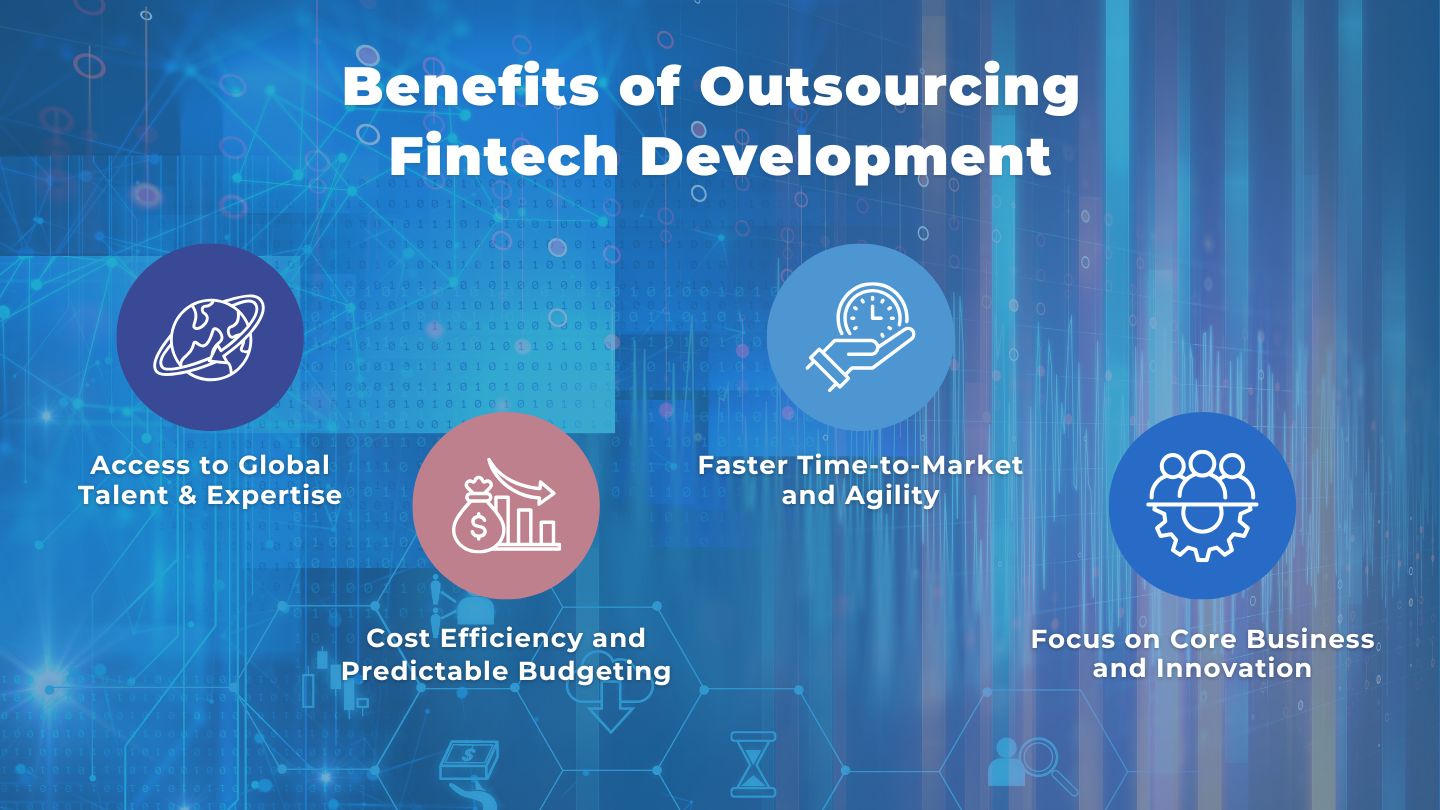
      Outsourcing fintech development enables financial firms to innovate faster, manage costs, and maintain a competitive edge.

      Cost Efficiency and Predictable Budgeting

      Outsourcing reduces overhead associated with hiring, training, and infrastructure, while offering fixed or flexible pricing models that support budget control.

      Access to Global Talent & Expertise

      Companies gain access to experienced fintech engineers skilled in payments, APIs, and secure system architecture without long-term hiring commitments.

      Faster Time-to-Market and Agility

      Dedicated outsourcing teams accelerate project delivery and help businesses respond quickly to market changes and regulatory updates.

      Focus on Core Business and Innovation

      Internal teams can concentrate on strategic growth and innovation, while technical execution is handled by specialized partners.

      Key Services You Can Outsource in Fintech

      fintech development outsourcing

      Fintech outsourcing covers a wide range of services that help financial organizations modernize systems, enhance security, and deliver seamless digital experiences.

      Custom App & Software Development (Web/Mobile)

      Outsourced teams can design and build web or mobile applications tailored to specific financial services, from online banking platforms to investment and lending apps.

      Payment & Banking Solutions (Blockchain, AI, APIs)

      Specialized providers develop secure payment gateways, digital banking systems, and AI-driven automation tools. In addition to blockchain-based transaction security and API integrations with traditional financial systems, cryptocurrency solutions are also part of the broader fintech landscape.

      Regulatory Compliance & Data Security

      Outsourcing partners ensure that products meet key financial regulations such as GDPR, PCI DSS, and AML, implementing strong encryption and data governance frameworks.

      Integration, Cloud Migration & Maintenance

      Service providers also handle system integration, cloud migration, and continuous maintenance, ensuring scalability, uptime, and efficient performance across all digital platforms.

      Challenges and How to Overcome Them

      fintech development outsourcing

      While fintech outsourcing offers many advantages, it can present certain challenges, especially regarding security, quality, and communication. Here’s how to manage them effectively.

      Data Security & Compliance (GDPR, AML, etc.)

      Ensure partners meet global standards, conduct regular audits, and maintain transparent data practices. Strong data encryption, secure cloud environments, and continuous monitoring help prevent breaches and maintain customer trust.

      Quality Control and Project Management

      Set clear milestones, KPIs, and QA processes using Agile or DevOps frameworks. Regular progress reviews and automated testing ensure consistent product quality and faster issue resolution.

      Communication and Cultural Differences

      Select teams with strong English, overlapping work hours, and collaboration tools like Slack or Jira. Encouraging open communication and aligning on shared goals early reduces misunderstandings and builds long-term trust.

      IP Protection & Vendor Reliability

      Use NDAs, define IP ownership, and verify your vendor’s credentials before signing. Choosing partners with proven financial industry experience further safeguards proprietary technology and sensitive data.

      Step-by-Step Guide to Fintech Development Outsourcing

      fintech development outsourcing

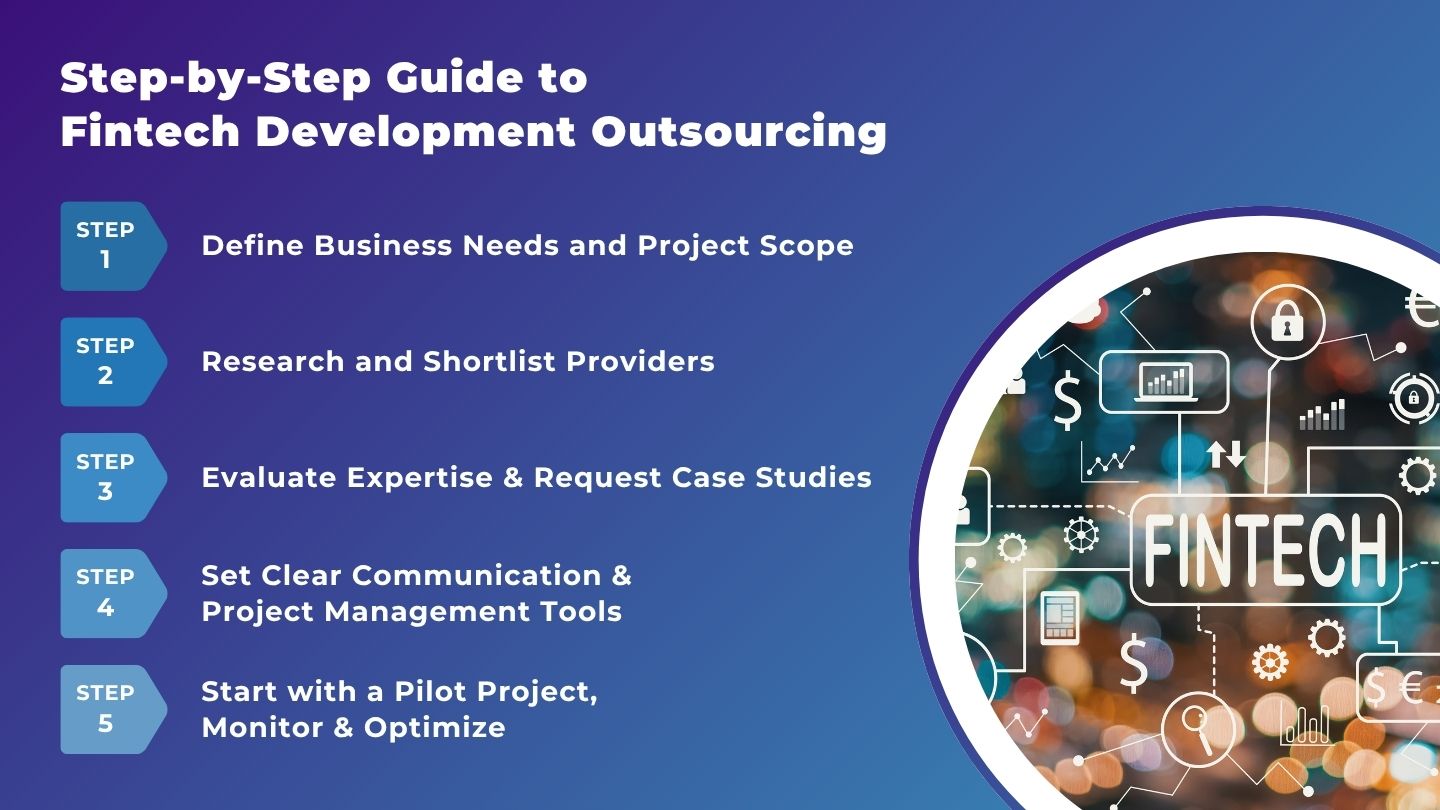
      A structured approach to outsourcing helps financial firms select the right partner, reduce risks, and ensure successful project delivery.

      Step 1: Define Business Needs and Project Scope

      The first step is to clearly outline the business objectives, target users, and the project scope. This ensures alignment between internal teams and potential outsourcing partners from the start.

      Step 2: Research and Shortlist Providers

      Identify and compare potential providers based on their fintech experience, technical expertise, and client references. Shortlisting helps focus on the partners most likely to meet project requirements.

      Step 3: Evaluate Expertise & Request Case Studies

      Review each provider’s past projects and request detailed case studies. This helps assess their capabilities, problem-solving approach, and relevance to your specific fintech needs.

      Step 4: Set Clear Communication & Project Management Tools

      Agree on communication channels, reporting schedules, and project management tools such as Slack, Jira, or Trello. Establishing these early prevents misunderstandings and keeps the project on track.

      Step 5: Start with a Pilot Project, Monitor & Optimize

      Begin with a small pilot project to evaluate collaboration, delivery speed, and quality. Monitor progress closely and optimize processes before scaling up to full development.


      For organizations seeking a long-term fintech partner, ISB Vietnam (IVC) provides expertise in legacy modernization, core banking portals, and scalable solutions.

      Contact us today to learn more and explore collaboration opportunities.

      Ready to scale your fintech vision?

      Let’s collaborate to build secure, scalable, and future-ready fintech solutions.

      Contact IVC for a Free Consultation

      Case Studies: Successful Fintech Outsourcing Projects

      fintech development outsourcing

      ISB Vietnam (IVC) develops professional applications for the Japanese financial market, covering banking, stock trading, and foreign exchange systems. Our teams are skilled in developing detailed specifications and delivering high-quality fintech solutions through secure, scalable, and modern architectures.


      Beyond Japan, ISB Vietnam (IVC) also supports fintech development for clients in Southeast Asia and other international markets, providing scalable and secure solutions tailored to regional compliance requirements.


      Bank Account System Package Maintenance

      Updating and maintaining design documents in Japanese based on the source code of local bank account systems.
      Language: COBOL

      Foreign Exchange System

      Monitoring order status changes and real-time transaction updates in the forex market.
      Languages: Java, JSP, JavaScript (AJAX), Oracle 10G

      Other Development Examples:

      • AI-Powered Legacy Code Modernization
      • Core Banking Web Portal Development
      • Periodic Batch Processing Systems for Banking Operations

      Looking to accelerate your fintech innovation?
      From legacy system transformation to next-generation banking platforms, we support financial enterprises aiming for innovation, compliance, and long-term growth.
      Contact us today to explore collaboration opportunities.

      Ready to scale your fintech vision?

      Let’s collaborate to build secure, scalable, and future-ready fintech solutions.

      Contact IVC for a Free Consultation

      Frequently Asked Questions

      fintech development outsourcing

      Outsourcing fintech development often raises important questions about cost, security, and project management.

      Below are key FAQs that help financial organizations make informed decisions when partnering with a fintech development vendor.

      How much does it cost to outsource fintech development?

      Fintech development outsourcing costs typically range from $30,000 to over $300,000, depending on project size and complexity. Basic apps with simple functions are cheaper, while advanced features like AI insights or fraud detection raise costs.(※3,4)

      Conduct thorough research and obtain multiple quotes to ensure the best value. Partnering with vendors in cost-effective regions like Eastern Europe, Southeast Asia, or Latin America can further reduce expenses.

      Which fintech services are best to outsource?

      Services like payment solutions, compliance tooling, mobile/ web apps, and legacy modernization are commonly outsourced due to their need for specialised expertise.(※5)


      How can you ensure data security?

      Security is critical when outsourcing fintech development, as applications handle sensitive data like account and transaction details. Choosing partners with strong security practices, clear contractual obligations, open communication, and regular audits helps protect customer data and mitigate risk.

      What are best practices for cross-border project management?

      Effective cross-border fintech outsourcing requires clear governance, overlapping work hours, and robust collaboration tools. Setting milestones and KPIs while considering cultural and language differences ensures smooth project execution and successful outcomes.


      Ready to take your fintech project to the next level?


      Partner with ISB Vietnam (IVC) A trusted software development company with deep experience in banking, finance, and digital transformation.

      Contact us today to discuss how we can help you build secure, scalable, and future-ready fintech solutions.

      Conclusion

      fintech development outsourcing

      Fintech development outsourcing can serve as a strategic advantage, helping financial companies accelerate innovation, reduce costs, and access specialized expertise.

      While ISB Vietnam (IVC) does not work with cryptocurrency, we have extensive experience in legacy system modernization and core banking solutions.


      For organizations looking to strengthen their fintech capabilities and build a long-term relationship with a reliable technology partner, contact IVC today to explore how our expertise can support your next project.

      Ready to scale your fintech vision?

      Let’s collaborate to build secure, scalable, and future-ready fintech solutions.

      Contact IVC for a Free Consultation


      Reference

      Data and insights in this article are based on the following sources:

      External image links

      • All images featured in this article are provided by Unsplash, a platform for freely usable images.
      • The diagrams used in this article were created using Canva.       
      View More
      OUTSOURCING

      November 12, 2025

      ISB Vietnam Webinar 4: “Why US IT Leaders Are Turning to Vietnam to Overcome Skill Gaps and Accelerate Innovation”

      Topic:“Why US IT Leaders Are Turning to Vietnam to Overcome Skill Gaps and Accelerate Innovation”


      Date: Tuesday, November 25th, 2025
      Duration: 3:00 PM – 3:30 PM PST (Pacific Standard Time)
      Platform: Online via Google Meet
      MC: Nikki Skovmose
      Host Speaker: Mr. Peter Ratcliff

      [Ho Chi Minh City, November 2025] – ISB Vietnam is pleased to announce the 4th webinar in our new series.


      As US companies continue to face critical tech talent shortages and rising hiring costs, forward-thinking leaders are turning to Vietnam - a rapidly growing technology hub offering reliable, skilled, and cost-effective solutions.

      In this focused 30-minute session, discover how Vietnam is emerging as a reliable, high-quality technology partner for US firms helping bridge skill gaps, modernize systems, and scale innovation faster.

      What You’ll Learn

      • The current US IT talent shortage and how it’s reshaping outsourcing decisions.

      • Key outsourcing trends and tech segments driving demand through 2030.

      • Why Vietnam is a trusted partner for US companies - with proven delivery, scalability, and cost efficiency.

      • Real-world case study from ISB Vietnam showcasing quality, communication, and results.

      • Practical insights on how US firms are leveraging Vietnam’s growing tech ecosystem for sustainable, competitive advantage.

      Join us to discover how ISB Vietnam continues to build trust and deliver value for international clients through expertise, transparency, and innovation.


      REGISTER NOW!


      Thank you.

      View More
      OUTSOURCING

      November 3, 2025

      Outsource Mobile App Development: How to Build the Right Software Partnership in 2026

      Outsourcing mobile app development has become a proven strategy for businesses looking to bring high-quality applications to market without the overhead of building an in-house engineering team. 


      But choosing the right partner isn’t just about saving money; it’s about finding a team that understands your product vision and has the software engineering capabilities to make it a reality.


      At IVC, we’ve worked with startups and SMEs to deliver scalable, user-centric mobile applications through flexible and transparent outsourcing models. 


      In this article, we’ll walk you through:

      • What outsourcing mobile app development really involves
      • The pros, cons, and risks you need to know
      • How to evaluate and select a trustworthy development partner
      • Best practices to manage outsourced projects effectively


        Whether you’re launching your first app or looking to improve development efficiency, this guide will help you make informed decisions and avoid costly mistakes.


        Ready to get started?

        Contact IVC for a free consultation and discover how we can help your business grow online.

        Contact IVC for a Free Consultation
         

        What Does It Mean to Outsource Mobile App Development?

        outsource mobile app development

        Outsourcing mobile app development means working with an external software company to design, build, and maintain your app instead of relying only on in-house engineers.

        This approach gives businesses access to global talent, lower costs, and faster delivery.


        The mobile app development market itself continues to expand at a rapid pace. According to Straits Research(※), the global market is projected to grow from USD 302.1 billion in 2025 to USD 753.34 billion by 2033, with a compound annual growth rate (CAGR) of approximately 12.1%.

        This growth is driven by the widespread adoption of smartphones, the deepening reliance on mobile solutions across sectors like banking, financial services, insurance, e-commerce, and healthcare, as well as the overall pace of digital transformation.

        At the same time, high development costs remain a challenge. Factors such as operating system or platform choice, feature complexity, and vendor location can create significant cost variations, which can make advanced apps more costly to develop. 


        For many companies, outsourcing provides a smart solution, which can be seen as a practical and strategic path forward.


        Frequent updates to operating systems and the growing variety of devices make it increasingly challenging for in-house teams to keep up. Outsourcing to an experienced partner can help companies stay current without overburdening internal resources.


        Ready to get started?

        Contact IVC for a free consultation and discover how we can help your business grow online.

        Contact IVC for a Free Consultation
         

        ※Source: Straits Research – Mobile App Development Market Report


        In-house vs Outsourcing: Key Differences

        Building apps in-house requires hiring, training, and managing developers—a process that demands time, money, and long-term commitment. 


        Outsourcing, on the other hand, gives companies access to global talent pools without the overhead. The key difference lies in scalability and flexibility: outsourced teams can adapt faster to changing project needs.

        Who Should Consider Outsourcing?

        Startups, SMEs, and even enterprises that lack large internal engineering teams often find outsourcing beneficial. 


        It’s particularly effective for:

        • Businesses launching their first mobile product
        • Companies with limited technical expertise
        • Organizations needing to scale quickly without long-term headcount growth

          What Types of Mobile Apps Can Be Outsourced?

          From consumer-facing apps like e-commerce platforms and social media tools to enterprise apps for internal workflow management, virtually any mobile application can be outsourced. 


          Popular categories include gaming apps, fintech apps, healthcare apps, and e-learning apps.


          Benefits and Risks of Outsourcing Mobile App Development

          outsource mobile app development

          Like any strategic decision, outsourcing has both advantages and challenges.

          Understanding these upfront helps you prepare and maximize results.

          Advantages: Cost, Speed, Expertise

          Outsourcing provides access to skilled developers at a lower cost compared to hiring in-house staff. External partners bring proven experience across industries, accelerating project timelines while maintaining high quality.

          Common Risks: Miscommunication, Low Quality, Delays

          Without proper project management, outsourcing can lead to challenges such as unclear requirements, cultural or time-zone gaps, and unexpected delays. Some companies also risk low-quality code if vendor selection is rushed.

          How to Minimize These Risks Effectively

          To reduce risks, businesses should:

          • Define clear project requirements and success metrics
          • Establish strong communication channels and tools
          • Work with partners who follow transparent development methodologies (Agile, Scrum)
          • Conduct regular testing and code reviews


            How to Choose the Right Mobile App Development Partner

            outsource mobile app development

            Selecting the right outsourcing partner is the most critical step. 

            A reliable software company becomes an extension of your team.

            What to Look for in a Reliable Software Company

            When evaluating potential partners, focus on companies with a strong track record and relevant technical expertise. 


            Look for:

            • Proven portfolio of mobile apps across industries
            • Strong client testimonials and case studies
            • Expertise in your required technology stack (iOS, Android, Flutter, React Native)
            • Transparent pricing and project management approach

              These qualities indicate that the company can deliver quality results and communicate effectively throughout the development process.


              Questions to Ask During the Selection Process

              Before making your decision, ask your shortlisted companies questions that help clarify their workflow and reliability. 


              For example:

              • How do you handle communication and reporting?
              • What tools do you use for project management?
              • How do you ensure code quality and security?
              • Can you provide references from past clients?

                Asking these questions gives you insight into the company’s professionalism and helps prevent misunderstandings later.


                Red Flags to Watch Out For

                While reviewing potential partners, be alert to warning signs such as:

                • Vague pricing or hidden costs
                • Lack of portfolio or unclear past project results
                • Poor communication or delayed responses
                • Overpromising unrealistic delivery timelines

                  If you notice any of these issues, it’s best to proceed with caution or consider other options.


                  Key Steps to Outsource Mobile App Development Successfully

                  outsource mobile app development


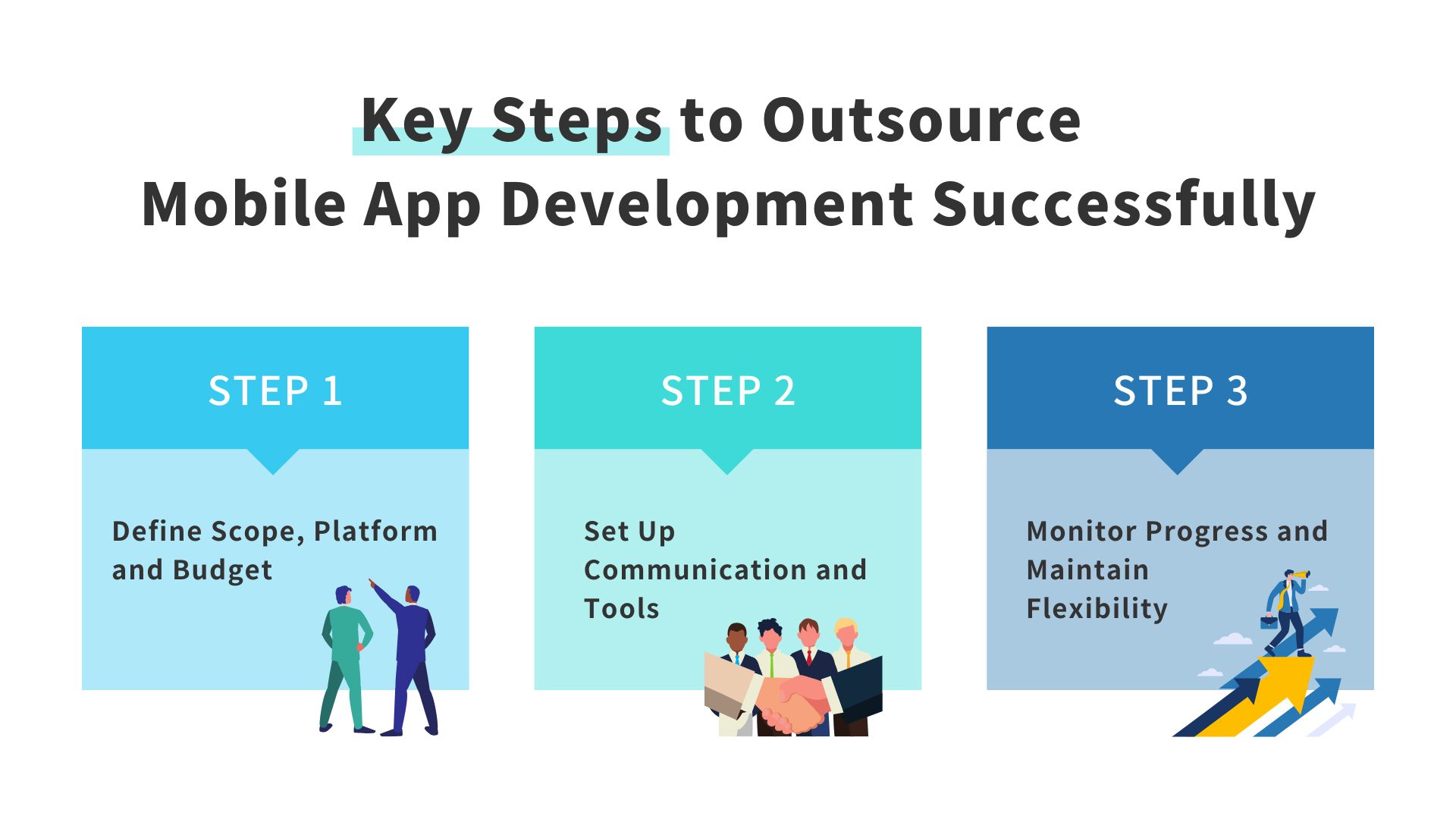
                  Following a structured process helps ensure smooth collaboration and high-quality outcomes.

                  Step 1: Define Scope, Platform and Budget

                  Start with clear documentation: project goals, target audience, desired features, platform choice (iOS, Android, cross-platform), and budget range.

                  Step 2: Set Up Communication and Tools

                  Agree on tools for communication (Slack, Teams), project management (Jira, Trello), and version control (GitHub, GitLab).

                  Regular stand-ups and status updates keep everyone aligned.

                  Step 3: Monitor Progress and Maintain Flexibility

                  Track deliverables with milestone reviews. Stay flexible to adjust scope based on user feedback, market shifts, or technical challenges.


                  IVC’s Approach: Software-Driven, Transparent and Scalable

                  outsource mobile app development

                  At ISB Vietnam (IVC), we prioritize trust, transparency, and business alignment.

                  Our outsourcing models are designed to empower clients with flexibility and control.

                  Supporting Diverse Industries and Business Goals

                  We have delivered mobile apps for a wide range of industries, such as camera control, fintech, education, and utilities. Our team uses technologies like C++, Objective-C, and Java to create effective solutions for different business needs.

                  With over 100 experienced engineers, we offer end-to-end support, covering everything from requirements gathering to deployment and maintenance. We also have expertise in both global and Japanese markets.

                  Flexible Outsourcing Models Tailored to Client Needs

                  We offer:

                  • Dedicated long-term development teams
                  • Short-term project-based outsourcing
                  • On-demand technical support

                  Our flexible contracts allow us to adapt to client goals, budgets, and timelines while maintaining quality through agile or waterfall models.

                  IVC’s Mobile App Development Case Studies

                  IVC has delivered a wide range of mobile applications for clients across various industries, including finance, education, utilities, and technology.


                  Below are several representative projects that highlight our ability to deliver robust, user-focused solutions tailored to each client’s needs.


                  WiFi Camera Control App

                  An application enables users to control and view live images on QBiC cameras via Wi-Fi. It also allows users to insert images into MP4 videos or trim clips from them.

                  • Platforms: iOS 5.X+, ANDROID 2.2.X+ AND 4.X+
                  • Languages: C++, OBJECTIVE-C, JAVA, JNI

                  FX Client App

                  Developed for the finance sector, this app supports multi-exchange rates, detailed statistics, and visualization charts.

                  • Platforms: iOS 3.X, 4.X, ANDROID 2.2.X
                  • Languages: JAVA, OBJECTIVE-C

                  Voice Book App

                  Users can record their voice and embed it into the original image to create personalized image books. The app also allows uploads to YouTube, browsing and purchasing of voice books, and supports multiple languages including English, Japanese, and Korean.

                  • Platform: Android
                  • Language: JAVA

                  Kids Learning App

                  This app is designed for English learning through drawing, featuring handwriting-based drills and a server-side system to store learning history.

                  • Platforms: ANDROID, PHONEGAP
                  • Languages: HTML5, JAVASCRIPT, CSS, JAVA

                  SDM Launcher App

                  A utility app for Secure Device Management (SDM) users, allowing admins to remotely change app order and helping users launch apps and access shortcuts.

                  • Platform: ANDROID 7.0+
                  • Language: Kotlin 1.5.31

                  Further case studies and detailed project insights are available on IVC Case Studies.


                  At IVC, we value long-term relationships with our clients. Reach out to us and let’s create innovative mobile apps that drive lasting value together.


                  Ready to get started?

                  Contact IVC for a free consultation and discover how we can help your business grow online.

                  Contact IVC for a Free Consultation


                  Frequently Asked Questions (FAQ) 

                  outsource mobile app development

                  Have questions about outsourcing mobile app development?

                  Here are some of the most common inquiries we receive from clients, along with clear answers to help you make informed decisions.

                  How much does it cost to outsource mobile app development?

                  The cost of outsourcing mobile app development can vary widely depending on the app’s complexity, features, and the region of the development team. 


                  For example, in North America, developing a mobile app may cost significantly more than in Eastern Europe or South Asia. A basic MVP might start around $5,000–$50,000, while more advanced or enterprise-level applications with complex integrations can cost over $200,000.

                  Source: SpaceO Technologies, Aalpha Information Systems

                  What platforms (iOS, Android, cross-platform) can I outsource?

                  All major platforms can be outsourced, including native apps (iOS, Android) and cross-platform frameworks (Flutter, React Native, Xamarin).

                  Can I change vendors in the middle of a project?

                  Yes, but it requires careful transition planning. Ensure all documentation, code repositories, and assets are handed over properly to minimize disruptions.

                  How can I ensure quality when outsourcing overseas?

                  To maintain high quality, choose partners with robust QA practices, regular testing cycles, and clear, transparent communication. Ask for demos, code samples, and client references to evaluate their work before committing.


                  At IVC, we combine proven QA processes with open communication and end-to-end project support.

                  Reach out to us to discuss how we can deliver a high-quality mobile app tailored to your needs while building a long-term partnership.

                  Ready to get started?

                  Contact IVC for a free consultation and discover how we can help your business grow online.

                  Contact IVC for a Free Consultation
                   

                  Conclusion

                  outsource mobile app development

                  Choosing to outsource mobile app development is more than just a way to cut costs. It is a strategic decision that can accelerate business growth, improve flexibility, and help you deliver high-quality products to the market more quickly. The most important factor for success is finding a partner who truly understands your goals and brings technical expertise, transparency, and strong communication skills.


                  At IVC, we believe that successful outsourcing is built on trust, collaboration, and a clear understanding of your business needs. If you are ready to take the next step in mobile app development, talk to our team. We are here to help turn your ideas into reality.

                  Ready to get started?

                  Contact IVC for a free consultation and discover how we can help your business grow online.

                  Contact IVC for a Free Consultation
                   

                  Reference

                  Data and insights in this article are based on the following sources:


                  External image links

                  • All images featured in this article are provided by Unsplash, a platform for freely usable images.
                  • The diagrams used in this article were created using Canva.       
                  View More
                  OUTSOURCING

                  November 3, 2025

                  Business Development Outsourcing: Benefits, Services & How to Start

                  Struggling to expand your business due to limited internal resources, lack of sales expertise, or a slow lead generation process?

                  Business development outsourcing is emerging as a cost-effective and scalable solution for companies aiming to grow faster without overloading their in-house teams.


                  At IVC, we have helped many startups and mid-sized companies grow by providing outsourced sales and marketing operations. In some cases, we also implement customized CRM or workflow tools to improve efficiency and transparency.


                  In this article, we’ll walk you through:

                  • What types of business development tasks can be outsourced
                  • Key benefits and potential risks of outsourcing
                  • How to choose the right outsourcing partner and start smoothly


                  Whether you’re a startup or an established company, this guide will help you understand how to leverage outsourcing to accelerate growth and stay competitive in today’s global market.


                  Ready to get started?

                  Contact IVC for a free consultation and discover how we can help your business grow online.

                  Contact IVC for a Free Consultation
                   

                  What is Business Development Outsourcing?

                  business development outsourcing         

                  Business development outsourcing involves delegating sales, marketing, and growth-related tasks to external experts, allowing companies to expand faster while staying focused on core activities.


                  What does it mean to outsource business development?

                  Outsourcing business development means partnering with an external team to handle activities like lead generation, sales prospecting, and partnership building. Instead of hiring and training an in-house team, companies rely on specialized providers who bring expertise, technology, and proven processes.


                  Common services outsourced (sales, marketing, lead gen, etc.)

                  Business development outsourcing typically covers functions that require both expertise and scalability, helping companies grow without the heavy investment required to build large in-house teams.


                  Some of the most commonly outsourced services include:

                  • Business Development Representatives (BDRs): Handling outreach, prospecting, and pipeline generation.
                  • Sales Development Representatives (SDRs): Qualifying leads and preparing them for the sales team.
                  • Partnership Development: Identifying, negotiating, and managing strategic alliances.
                  • Marketing and Demand Generation: Running campaigns, content marketing, and digital outreach to drive awareness.
                  • Lead Generation and Appointment Setting: Keeping the sales funnel active and ensuring a steady flow of opportunities.

                  These services are widely used not only by large enterprises but also by startups and SMEs that need quick access to sales expertise, technology, and market knowledge without overloading their internal resources.


                  Who typically uses BD outsourcing? (Startups, SMEs, etc.)

                  While business development outsourcing was once primarily used by large enterprises, it is now increasingly adopted by startups, SMEs, and fast-scaling companies.

                  These organizations often face challenges such as limited sales capacity, lack of in-house expertise, and the high costs of building a full internal team.

                  Outsourcing provides a strategic solution by enabling them to:

                  • Enter new markets quickly without the delays of hiring and training.
                  • Access expert knowledge and advanced tools without a heavy upfront investment.
                  • Stay flexible and control costs while scaling operations as needed.

                  For smaller firms especially, outsourcing levels the playing field—allowing them to compete on a global stage, expand their customer base, and focus internal resources on innovation and core business functions.


                  Benefits of Outsourcing Business Development

                  business development outsourcing

                  Outsourcing business development isn’t just about reducing costs; it’s also a way for companies to achieve strategic goals. 

                  According to Deloitte’s 2026 Global Business Services Survey, organizations today appear to be striving for greater efficiency, scalability, digital transformation, and enhanced customer experience. (※)

                  At the same time, the survey shows that demand for skilled talent remains high, and outsourcing may offer a way to address talent gaps while helping to drive innovation. By leveraging outsourcing, these goals can often be achieved more effectively than by relying solely on in-house resources.

                  (※)Reference:2025 Deloitte’s Global Business Services (GBS) Survey


                  Access to Expert Talent and Tools

                  Outsourcing allows companies to quickly access experienced professionals, proven strategies, and advanced tools for marketing. Experts can be brought in for areas such as customer acquisition, sales, website development, app development, and after-sales support, enabling businesses to accelerate growth using external expertise without building an internal team from scratch.


                  Cost Savings and Operational Efficiency

                  Outsourcing reduces the need for large upfront investments in recruitment, training, and infrastructure. Instead, companies can adapt resources as needed, driving efficiency and cost control while focusing their budgets on high-value areas.


                  Faster Market Entry and Scalability

                  External partners bring industry knowledge and market-ready processes, allowing businesses to expand into new regions quickly and scale operations with less friction. This agility supports faster growth in competitive global markets.


                  Focus on Core Business Functions

                  By outsourcing lead generation, sales development, or market research, internal teams can prioritize innovation, product development, and customer success. Outsourcing ensures essential functions continue to drive revenue while the company focuses on long-term strategic initiatives.


                  Potential Challenges and How to Overcome Them

                  business development outsourcing

                  Understand the common challenges of outsourcing business development and how to manage them effectively.


                  Communication and Alignment Issues

                  Clear communication channels, defined processes, and regular check-ins help avoid misalignment. It’s also important to clarify roles and responsibilities upfront so that every team member understands their tasks and objectives.


                  Quality Control and Brand Consistency

                  Setting guidelines, providing training, and monitoring performance ensure brand consistency. Regular audits and feedback sessions can further maintain high standards across all outsourced activities.


                  Data Security and Confidentiality

                  Work with partners that follow strict compliance standards and sign NDAs to protect sensitive customer and business data. Implementing access controls and encryption adds an extra layer of protection for critical information.


                  How to Manage Outsourced Teams Effectively

                  Use project management tools, set KPIs, and establish regular performance reviews to keep outsourced teams aligned with your goals. Fostering open communication and building strong relationships with the team also helps sustain motivation and accountability.


                  Key Services in Business Development Outsourcing

                  business development outsourcing

                  From outbound sales to CRM support, here are the most valuable outsourced BD services. These services help companies scale their business development efforts efficiently while accessing specialized expertise and technology that might not be available in-house.


                  Sales Development and Outbound Prospecting

                  Cold outreach, follow-ups, and building qualified sales pipelines. Outsourced teams can help expand your reach more quickly than an in-house team alone, ensuring a steady flow of potential clients.


                  Marketing and Demand Generation

                  Content marketing, campaigns, and digital advertising to drive inbound leads. They also allow companies to experiment with new channels and strategies without overloading internal staff.

                  In many BDO projects, especially in marketing and sales outsourcing, effective management tools are essential to ensure visibility and performance. Depending on the client’s needs, we can assist in selecting, customizing, or even developing these tools.

                  One example is ISB Vietnam(IVC)’s customization of Odoo, an open-source business suite. We built a system that enables clients to track leads, manage tasks, and streamline team communication across outsourced operations.


                  Ready to get started?

                  Contact IVC for a free consultation and discover how we can help your business grow online.

                  Contact IVC for a Free Consultation


                  Market Research and Competitive Analysis

                  Gather insights on industry trends, competitors, and target markets. Regular research helps inform both sales and marketing strategies, improving decision-making and reducing market entry risks.


                  Appointment Setting and CRM Support

                  Scheduling qualified meetings and maintaining clean CRM data. Consistent data management ensures your sales team can focus on closing deals rather than administrative tasks.


                  Outsourcing Business System Development to Optimize Internal BizDev Operations

                  business development outsourcing

                  Beyond outsourcing outward-facing BizDev tasks such as lead generation and appointment setting, many companies also outsource the development of internal business systems to improve overall productivity across their business development departments.


                  At ISB Vietnam, we specialize in building tailored systems that streamline internal operations, enhance data visibility, and support strategic decision-making.  

                  The following are examples of systems we’ve developed to support business development through internal operational efficiency.


                  Part-time Management System

                  This system was developed for logistics companies to manage shift-based operations. It supports time tracking, calculates profit and loss, handles billing and invoicing, and maintains master data—all essential features for smooth part-time workforce management. It was built using PHP and CakePHP.


                  Sales Distribution System (Odoo ERP)

                  Using Odoo Community v8, we created an ERP module to manage sales reporting on a daily, weekly, and yearly basis. It also includes a discount reporting feature for accounting teams and supports data import and master data management. The system was developed using Python, PostgreSQL, and JasperReport.


                  Network Configuration and Business Management System

                  These two systems were designed to work together: one handles detailed network setting and configuration, while the other streamlines business workflow management. Both systems were built with PHP and CakePHP 3.5.


                  Asset Information Management System (ISO 27001)

                  To support information security risk management, we built a system that maintains a detailed asset registry and offers risk forecasting and monitoring features. This solution was implemented using Java, JSP, and HTML.


                  Tablet Ordering System

                  Developed for restaurants, this system allows staff to monitor and manage orders via iPads. It integrates both web and mobile interfaces to ensure a seamless customer experience and optimized kitchen operations. Technologies used include iOS7, Objective-C, and PHP.


                  These systems go beyond simple digital tools, helping businesses reduce manual workload, improve transparency, and remain compliant as they grow.


                  How to Choose the Right Business Development Outsourcing Partner

                  business development outsourcing

                  Selecting the right partner requires clear goals, tools, industry knowledge, and cultural fit.


                  Define Your Goals and Scope

                  Be clear about whether you need lead generation, full sales support, or market entry. Defining objectives upfront prevents misunderstandings and ensures measurable outcomes.


                  Evaluate Industry Experience and Case Studies

                  Check past clients, success stories, and proven results. This gives confidence that the partner can handle the specific challenges of your market or industry.


                  Check Tech Stack and Tools Used

                  Ensure the partner uses advanced CRM systems, automation, and analytics. The right technology stack ensures efficiency, scalability, and accurate reporting.


                  Consider Cultural Fit and Communication

                  Successful outsourcing depends on both skills and cultural fit. Aligning values and communication styles ensures smooth collaboration and long-term success. 

                  With extensive experience in the Japanese market, ISB Vietnam (IVC) delivers high-quality work on time while building lasting partnerships and fostering trust and transparency.

                   Looking for a partner who shares your values and supports sustainable growth? Contact us today to start a long-term collaboration.


                  Getting Started with BD Outsourcing: Step-by-Step

                  business development outsourcing

                  Follow these steps to launch your outsourcing journey smoothly and effectively, ensuring alignment, performance, and growth.


                  Step 1: Identify Which BD Tasks to Outsource

                  Prioritize activities where your team lacks expertise or resources. Focus on tasks that have the biggest impact on growth, such as lead generation, sales outreach, or market research. This helps maximize ROI and ensures outsourcing delivers real value.


                  Step 2: Set KPIs and Expectations

                  Define clear metrics such as the number of leads, qualified meetings, or conversion rates. Establishing expectations upfront allows you to measure progress and adjust strategies efficiently.


                  Step 3: Choose and Onboard Your Partner

                  Work closely with your outsourcing partner to align workflows, tools, and communication. A thorough onboarding ensures the team understands your goals and can hit the ground running.

                  Ready to start working with the right partner and build a long-term, trusted collaboration that supports sustainable growth? Contact us today to begin your outsourcing journey and accelerate your growth.


                  Step 4: Monitor Performance and Iterate

                  Track KPIs regularly and review outcomes against expectations. Continuous monitoring helps identify bottlenecks, optimize strategies, and ensure your outsourced team remains aligned with business objectives.


                  Conclusion

                  business development outsourcing

                  Business development outsourcing is no longer just a cost-saving tactic.t’s a strategic move that empowers companies to grow faster, scale smarter, and access expert-level capabilities without overextending internal resources. Especially for startups and SMEs, outsourcing enables rapid market entry, improved lead generation, and greater operational focus.


                  While challenges such as communication gaps and quality control exist, they can be effectively managed through clear goal-setting, regular performance monitoring, and choosing the right outsourcing partner.


                  Ultimately, if your business is aiming for sustainable growth and wants to stay agile in a competitive landscape, business development outsourcing may be the key to unlocking your next stage of success.


                  Ready to get started?

                  Contact IVC for a free consultation and discover how we can help your business grow online.

                  Contact IVC for a Free Consultation


                  Related Post

                  Why Outsource App Development? Key Benefits, Hidden Costs, and How to Get It Right

                  Top Software Outsourcing Companies in 2026: Find the Best Partner for Your Business

                  Reference

                  2025 Deloitte’s Global Business Services (GBS) Survey

                  External image links

                  All images featured in this article are provided by Unsplash, a platform for freely usable images.

                  The diagrams used in this article were created using Canva.      

                  View More
                  OUTSOURCING

                  November 1, 2025

                  Website Development Outsourcing:2026 Guide to Benefits&Risks

                  Website development outsourcing has become an essential strategy for companies looking to build cutting-edge websites, scale operations, and reduce costs in 2026. 


                  By partnering with the right development team, businesses can focus on their core functions while entrusting their technical needs to experts who understand the nuances of modern web development.


                  In this article, we’ll dive into the key benefits of outsourcing your website development, the risks you need to consider, and how to find the right outsourcing partner to ensure your project’s success.


                  Why Outsource Website Development?

                  website-development-outsourcing

                  Outsourcing website development is no longer just a cost-saving tactic. It's a strategic move that helps businesses accelerate growth and deliver quality experiences.


                  Save Time and Resources

                  Developing a website in-house often requires significant time and staff. By outsourcing, companies can offload time-consuming development tasks to professionals, allowing internal teams to focus on core business activities.


                  Access Global Talent

                  Outsourcing gives businesses access to a diverse global talent pool with specialized skills in UX/UI design, responsive development, security, and SEO optimization. This expertise can be difficult or costly to maintain in-house.


                  Reduce Costs and Increase Efficiency

                  Hiring full-time developers, especially in the U.S., can be expensive. By working with offshore partners, businesses can optimize development costs while still achieving high-quality results through efficient workflows, skilled professionals, and flexible team structures tailored to each project.


                  Key Considerations Before Outsourcing Your Website Development

                  website-development-outsourcing

                  Before jumping into outsourcing, companies need a clear strategy. Here are some essential elements to evaluate.


                  Defining Your Project’s Scope

                  Clarify your goals, deliverables, timeline, budget, and platform requirements. A well-documented project scope prevents misunderstandings and keeps all stakeholders aligned.


                  Assessing Your Outsourcing Needs (skills, expertise, timeline)

                  Identify the technical skills required, desired experience level, and your launch timeline. Different projects may need different models—from full-cycle development to frontend-only support.


                  Understanding the Communication Process

                  Seamless communication is key to successful outsourcing. Ensure you understand the vendor’s working hours, communication tools, and language fluency. Establishing regular check-ins and clear reporting structures helps avoid confusion.


                  The Risks of Outsourcing Website Development

                  website-development-outsourcing

                  While outsourcing offers many advantages, it also comes with risks that businesses must proactively manage.


                  Quality Control Issues

                  Lack of proper quality assurance can lead to buggy or underperforming websites. Choose partners who offer transparent QA processes and showcase a proven track record.


                  Security and Data Privacy Concerns

                  Outsourcing may expose your business to security risks, especially when handling sensitive user data. Make sure your vendor follows international security standards (like GDPR) and signs a strict Non-Disclosure Agreement (NDA) to protect your sensitive information.


                  Misalignment of Expectations

                  Time zone differences, cultural gaps, and vague requirements can lead to mismatched outcomes. Avoid this by setting clear expectations and leveraging project management tools for transparency.


                  How to Choose the Right Website Development Outsourcing Partner

                  website-development-outsourcing

                  Finding the right partner is essential to the success of your outsourcing initiative. The ideal vendor should align with your business goals and be equipped to grow alongside you.


                  Identifying the Best-fit Company (skills, portfolio, reviews)

                  Look for vendors with industry-specific experience, a proven portfolio, and credible client testimonials. Reviewing case studies can help you understand how they’ve tackled challenges similar to yours.


                  Cultural Fit and Communication

                  Shared values, clear communication, and proactive collaboration are key to bridging cultural differences and building trust. A small trial project can be a great way to assess compatibility.


                  Evaluate Flexibility and Support

                  Your needs may evolve over time as your project grows. Choose a partner that offers flexible engagement models and remains committed to long-term support beyond the initial launch.


                  Why Vietnam Is a Top Destination for Website Development Outsourcing

                  Vietnam has emerged as a leading outsourcing destination due to its cost-efficiency, skilled talent pool, strong technical education, and growing English proficiency.

                  Companies like ISB Vietnam (IVC) combine global standards with local expertise to deliver reliable, scalable website development services.

                  Ready to get started?

                  Contact IVC for a free consultation and discover how we can help your business grow online.

                  Contact IVC for a Free Consultation


                  Outsourcing Models and Engagement Options

                  website-development-outsourcing

                  There is no one-size-fits-all model. Understanding your options helps tailor the collaboration to your needs.


                  Fixed-price Model

                  Best for small projects with a clear scope. Costs and deliverables are defined upfront, minimizing financial risk but reducing flexibility.


                  Time and Material Model

                  Ideal for evolving projects. You pay based on actual hours worked, allowing greater adaptability as project requirements change.


                  Dedicated Development Team

                  Perfect for long-term partnerships. A dedicated team works exclusively on your project, offering deeper integration and consistent output.


                  How Outsourcing Helps Your Website Scale and Grow

                  website-development-outsourcing

                  Beyond development, outsourcing can fuel long-term digital success. It provides the flexibility and resources needed to adapt as your business evolves.


                  Faster Launch Times

                  With a dedicated team already in place, development can start immediately, significantly reducing time-to-market.


                  Continuous Maintenance and Updates

                  Outsourcing partners often offer post-launch support, bug fixes, and regular updates to keep your site secure and modern.


                  Scalability and Flexibility

                  Whether you need to add new features or expand to new markets, outsourcing allows you to scale your development team on demand without lengthy hiring cycles.


                  Conclusion

                  website-development-outsourcing

                  Website development outsourcing in 202 offers a powerful way to grow faster, build better, and stay competitive, as long as it’s done right.


                  From reducing costs and speeding up timelines to gaining access to top-tier global talent, outsourcing provides flexibility and scalability that in-house teams often can’t match.


                  However, success depends on choosing the right partner. Consider your goals, budget, timeline, and communication style carefully. 


                  And if you’re looking for a reliable, security-focused partner with experience across industries, ISB Vietnam (IVC) is ready to support your vision with full-cycle website development services. 


                  IVC is dedicated to fostering long-term partnerships that grow and adapt with your business over time.


                  Ready to get started?

                  Contact IVC for a free consultation and discover how we can help your business grow online.

                  Contact IVC for a Free Consultation


                  External image links

                  All images featured in this article are provided by Unsplash, a platform for freely usable images.

                  The diagrams used in this article were created using Canva.     

                  View More
                  OUTSOURCING

                  October 30, 2025

                  Why Outsource IT Development? Benefits and Challenges in 2026

                  Outsourcing IT development is no longer just a cost-cutting tactic—it’s a strategic approach to building faster, scaling smarter, and staying competitive with access to top global talent and technologies.


                  However, choosing the wrong partner or model can lead to project delays, poor quality, and unexpected costs.


                  In this 2026 guide, we’ll cover:

                  • Why more companies are outsourcing their IT needs
                  • The risks to watch for
                  • How to select the best outsourcing model and partner


                  Whether you’re launching a SaaS platform, integrating AI, or modernizing your infrastructure, this article will help you make the right decisions for long-term IT success.


                  What Is IT Development Outsourcing?

                  outsourcing-it-development

                  IT development outsourcing refers to delegating software development work such as design, coding, testing, and maintenance to external teams.


                  Definition and Scope of Outsourcing

                  Outsourcing IT development involves hiring external companies or professionals to design, develop, and test software products or systems. Instead of managing everything in-house, businesses collaborate with specialized teams based in other countries or regions.


                  Common Models (Offshore, Nearshore, Hybrid, etc.)

                  • Offshore: Partnering with companies in distant regions (e.g., Vietnam, India).
                  • Nearshore: Working with nearby countries that share similar time zones (e.g., Mexico for U.S. companies).
                  • Onshore: Outsourcing within your own country.
                  • Hybrid: A mix of offshore, nearshore, and onshore strategies to design, develop, and test software products or systems. Instead of managing everything in-house, businesses collaborate with specialized teams based in different regions.


                  Why More Businesses Are Outsourcing in 2026

                  outsourcing-it-development

                  In today’s fast-paced digital landscape, businesses are turning to outsourcing as a strategic lever—not just to cut costs, but to unlock innovation, agility, and competitive advantage.


                  Shift from Cost-Saving to Strategic Growth

                  Companies are increasingly viewing outsourcing not just as a way to reduce costs, but as a path to innovation and speed. The focus is on accessing advanced technology solutions and engineering expertise quickly.


                  Talent Shortage and Demand for Speed

                  The global tech industry faces a significant talent shortage. Outsourcing fills this gap, providing faster turnaround and scalable software development resources.


                  Access to Innovation and Specialized Expertise

                  Outsourcing gives businesses access to engineers skilled in emerging tech like AI, blockchain, cloud infrastructure, and more—driving smarter solutions and better products.


                  Benefits of Outsourcing IT Development

                  outsourcing-it-development

                  Outsourcing offers more than financial savings—it accelerates development, boosts productivity, and enables companies to focus on what they do best.


                  Cost Savings and Scalability

                  Outsourcing reduces hiring, training, and operational costs. Partnering with teams in regions with lower labor costs allows companies to allocate budgets more efficiently. It also provides the flexibility to scale teams up or down depending on the project's lifecycle or market demand.


                  Faster Time to Market

                  With 24/7 productivity through distributed global teams, development cycles are significantly shorter. By leveraging time zone differences, teams can ensure continuous progress, resulting in quicker iterations, reduced downtime, and faster launches.


                  Focus on Core Business Functions

                  Delegating tech development allows companies to concentrate on core competencies like product strategy, marketing, and customer experience. This strategic focus drives better decision-making and aligns teams with high-impact business objectives.


                  24/7 Productivity Through Global Teams

                  Offshore and nearshore outsourcing ensures that work continues around the clock, speeding up testing, delivery, and iterations. Companies benefit from the “follow-the-sun” model, where progress is maintained even when in-house teams are offline.


                  Risks and Challenges to Watch Out For

                  outsourcing-it-development

                  Despite its benefits, outsourcing comes with potential pitfalls that can disrupt timelines and compromise quality if not properly managed.


                  Quality Issues and Hidden Costs

                  Without clear quality benchmarks and oversight, some vendors may deliver subpar results. Unexpected costs can arise from miscommunication, lack of documentation, or the need to rework flawed deliverables—reducing the financial appeal of outsourcing.


                  Communication and Time Zone Barriers

                  Differences in working hours and language fluency can lead to misalignment, slow responses, or missed updates. Clear processes, regular check-ins, and cultural awareness are key to mitigating these issues.


                  Data Security and Compliance Concerns

                  Entrusting external teams with sensitive information raises risks related to data breaches and non-compliance. It’s critical to work with partners who follow best practices for cybersecurity and meet regulatory standards relevant to your industry.


                  Mismatched Expectations or Culture

                  Cultural misunderstandings, differing work ethics, or unclear expectations can derail progress. Ensuring a cultural fit, aligning on values, and investing in relationship-building early can reduce friction.


                  How to Choose the Right Outsourcing Partner

                  outsourcing-it-development

                  Finding the right outsourcing partner is critical to long-term project success. It requires careful vetting, clear expectations, and transparent collaboration.


                  Key Evaluation Criteria

                  Choose a partner with the right mix of skills, communication style, and domain knowledge. 


                  Consider their:

                  • Technical expertise in your industry
                  • Language proficiency and communication tools
                  • Time zone compatibility
                  • Proven experience with similar projects

                  What to Ask Before Signing a Contract

                  Before finalizing any agreement, ensure alignment on expectations, process, and security.

                  Ask:

                  • What security protocols are in place?
                  • How do they handle project management and reporting?
                  • Can they provide client references or case studies?


                  Red Flags to Avoid

                  Some warning signs can predict a poor outsourcing experience.

                  Watch out for:

                  • Vague pricing structures
                  • Poor responsiveness during early communication
                  • Lack of transparency on team structure


                  Top Outsourcing Destinations in 2026

                  outsourcing-it-development

                  As outsourcing becomes more strategic, certain countries are emerging as go-to destinations due to their tech talent, infrastructure, and value.


                  Leading Countries

                  Leading Countries

                  • Vietnam: Known for strong engineering talent, competitive pricing, and growing English proficiency.
                  • India: Established outsourcing powerhouse with massive scale and expertise.
                  • Ukraine: Skilled developers and cultural alignment with Europe/U.S.


                  Why Vietnam Is Rising in Popularity

                  Vietnam combines cost-effectiveness with a high-quality tech workforce. Many companies report excellent outcomes in software design, development, and testing.


                  Partner Spotlight: ISB Vietnam (IVC)

                  ISB Vietnam (IVC) offers robust consulting and development services across industries. Their experienced teams provide custom software solutions, AI integration, and end-to-end project management tailored to each client’s needs.

                  Ready to get started?

                  Contact IVC for a free consultation and discover how we can help your business grow online.

                  Contact IVC for a Free Consultation


                  Best Practices for Successful IT Outsourcing

                  outsourcing-it-development

                  Following proven best practices can dramatically improve the outcome of your outsourcing efforts—from smoother onboarding to higher-quality deliverables.


                  Start with a Small Pilot Project

                  Starting small allows you to test the waters before fully committing. It helps identify potential communication gaps, assess quality standards, and adjust workflows without risking your entire project. A successful pilot builds confidence and a foundation for scaling up.

                   

                  Set Up Clear Documentation and KPIs

                  Clear and thorough documentation ensures everyone understands project requirements, timelines, and responsibilities. Define measurable Key Performance Indicators (KPIs) to track progress and quality. Regularly review these KPIs to identify issues early and keep the project aligned with your business goals.


                  Maintain Consistent Communication

                  Effective communication is the backbone of successful outsourcing. Establish regular meetings, status updates, and feedback loops using video calls, emails, or messaging platforms. Encourage transparency and proactive reporting to minimize misunderstandings and keep all stakeholders informed.


                  Use the Right Collaboration Tools

                  Leveraging tools like Jira for project management, Slack for instant messaging, and GitHub for code collaboration can streamline workflows and boost productivity. Choose tools that fit your team’s needs and ensure everyone is trained and comfortable using them. Proper tool usage bridges distance and time zone gaps.

                   

                  Conclusion: Maximize the Value of IT Outsourcing

                  outsourcing-it-development

                  Outsourcing in 2026 is about more than cost savings—it’s a strategic move to gain innovation, speed, and a competitive edge. 

                  By understanding the benefits, mitigating the risks, and choosing the right partner, companies can build better digital solutions, faster.

                  IVC stands out as a reliable strategic partner offering deep industry experience, engineering talent, and innovative technology solutions tailored to your business goals.

                  Ready to get started?

                  Contact IVC for a free consultation and discover how we can help your business grow online.

                  Contact IVC for a Free Consultation


                  Related Post

                  Why Outsource App Development? Key Benefits, Hidden Costs, and How to Get It Right

                  Top Software Outsourcing Companies in 2026: Find the Best Partner for Your Business

                  External image links

                  All images featured in this article are provided by Unsplash, a platform for freely usable images.

                  The diagrams used in this article were created using Canva.

                  View More
                  OUTSOURCING

                  October 30, 2025

                  Why Outsource App Development? Key Benefits, Hidden Costs, and How to Get It Right

                  In 2026, outsourcing app development remains a strategic move for businesses looking to save time, reduce costs, and access top-tier tech talent worldwide.

                  But how do you avoid common pitfalls like hidden fees, communication breakdowns, or unclear project scopes?

                  In this updated guide, we’ll walk you through the major benefits, potential risks, and proven methods for choosing the right outsourcing partner—so your next app project doesn’t just stay on track, but truly thrives.


                  What Is App Development Outsourcing?

                  outsourcing-app-development

                  App development outsourcing means partnering with an external team or agency to manage the technical aspects of your application, from concept and coding to launch and ongoing updates.

                  This can involve web apps, mobile apps, or full-cycle development services.


                  Definition and types (web, mobile, full-cycle)

                  There are several ways to outsource app development, depending on the project scope and target platform.


                  Types of Development Services:

                  • Web App Development:
                    Browser-based applications accessible across multiple devices
                  • Mobile App Development:
                    Native or hybrid apps developed for iOS, Android, or both platforms
                  • Full-Cycle Development:
                    End-to-end services including planning, UI/UX, development, QA, deployment, and maintenance


                  Each type of app development outsourcing serves different business needs.

                  Choosing the right type depends on your project’s goals, target audience, required features, and long-term vision.


                  In particular, partnering with outsourcing hubs like Vietnam can offer flexible solutions across web, mobile, and full-cycle development, making it easier for startups and growing companies to scale efficiently without compromising quality.


                  In-house vs. outsourcing: Pros and cons

                  While in-house development offers control and proximity, outsourcing provides flexibility, faster results, and access to global talent at a fraction of the cost.


                  In-House vs. Outsourcing Comparison:

                  • Cost:
                    In-house is higher (salaries, equipment, overhead) / Outsourcing is lower (pay-per-project or per-hour)
                  • Speed:
                    In-house is slower (due to recruitment and onboarding) / Outsourcing offers faster start and delivery
                  • Flexibility:
                    In-house is less scalable / Outsourcing allows easy scalability
                  • Control:
                    In-house allows direct, daily communication / Outsourcing requires structured communication
                  • Access to Talent:
                    In-house is limited to local hires / Outsourcing gives access to a global talent pool


                  While in-house development gives you more direct control, outsourcing offers flexibility, faster time to market, and access to a broader talent pool—often at a significantly lower cost.

                  Ultimately, the best choice depends on your project’s size, timeline, and long-term goals.

                  Many startups and growing businesses are now opting for outsourcing models that balance quality, speed, and affordability, with Vietnam emerging as one of the most trusted destinations.


                  Thinking about outsourcing to Vietnam?

                  Let’s talk about how a trusted development partner like ISB Vietnam can help you scale your app project efficiently.

                  Contact IVC for a Free Consultation


                  Why Outsourcing App Development Is a Smart Move for Startups

                  outsourcing-app-development


                  For startups, every dollar and hour count.

                  Outsourcing gives you access to world-class expertise and advanced technologies, while allowing your internal team to stay focused on what matters most: growing the business.


                  Reduce cost without sacrificing quality

                  Offshore teams can deliver high-quality work at significantly lower rates.

                  Locations such as Vietnam, India, and Eastern Europe offer experienced developers with strong technical skills, without the premium cost of hiring locally in the U.S. or Western Europe.


                  Faster time to market and scalability

                  Outsourced teams are ready to start immediately.

                  This enables you to launch faster, iterate more quickly, and scale your resources up or down depending on your project needs.


                  Access to global talent and technologies

                  Outsourcing gives you access to experts in blockchain, AI, AR/VR, and cloud-native development.

                  These specialists can bring your vision to life using advanced tools and technologies that may not be available locally.


                  Ability to focus on core business

                  By outsourcing technical execution, you and your team can dedicate more time to growth strategy, marketing, user acquisition, and customer support—the core functions that drive business success.


                  Hidden Costs and Common Pitfalls to Watch Out For

                  outsourcing-app-development

                  Outsourcing can be a powerful strategy, but without proper planning, it can quickly lead to delays, miscommunication, and unexpected expenses.


                  Here are some of the most common mistakes to avoid when outsourcing app development.


                  Poor communication and unclear requirements

                  One of the biggest risks in outsourcing is miscommunication.

                  Even the best developers can miss expectations if the scope is vague or updates are inconsistent.


                  Solution:

                  • Create clear, detailed project specifications to avoid misunderstandings
                  • Use wireframes or prototypes to align on visual expectations early
                  • Leverage tools like Jira, Trello, or Slack to ensure consistent communication


                  By setting clear expectations and maintaining steady communication, you can greatly reduce the risk of project delays and costly misunderstandings.


                  Choosing the cheapest = biggest risk

                  Low-cost offers may look appealing, but they often result in poor quality, delays, or the need for expensive rework.


                  Red Flags to Avoid:

                  • No client references
                  • Vague deliverables or unclear timelines
                  • Lack of project management tools


                  It’s better to pay a fair rate for a reliable team than to waste time and money fixing mistakes later.


                  Security and data privacy concerns

                  Outsourcing means sharing sensitive business data with external teams.

                  If not handled properly, this can lead to data breaches, compliance issues, or loss of IP.


                  What to do:

                  • Sign NDAs and include IP ownership clauses in your contract
                  • Use secure file-sharing and communication tools
                  • Work with firms that follow international security standards (e.g., ISO 27001)


                  By taking strong security measures from the beginning, you can protect your sensitive information and avoid major risks down the line.


                  How to Outsource App Development the Right Way

                  outsourcing-app-development

                  Whether you’re a startup or scaling business, understanding the process is key to avoiding pitfalls and getting the results you want.


                  Step 1: Define your project scope and goals

                  Before hiring a team, it’s essential to get crystal clear on your app’s purpose, users, and functionality.

                  A well-defined scope sets the foundation for smooth collaboration and successful delivery.


                  Ask yourself:

                  • What business problem does the app solve?
                  • Who are the target users, and what do they need?
                  • What core features must be included in the first release?
                  • Are you building a prototype, MVP, or full-scale product?
                  • What is your ideal timeline for development and launch?


                  Having this clarity upfront helps your outsourcing partner align with your goals, suggest the right technologies, and manage time and costs efficiently.


                  Step 2: Select the right outsourcing model

                  There are several outsourcing engagement models to choose from, each suited to different project types.


                  Common Pricing Models:

                  • Fixed Price – Best for small, well-defined projects.
                    Predetermined cost and deliverables.
                  • Time & Materials – Best for evolving scope.
                    Pay per hour, with flexibility to adapt scope as needed.
                  • Dedicated Team – Best for long-term or complex projects.
                    A remote team that acts as an extension of your in-house team.

                  Your choice should align with your budget, project complexity, and need for flexibility.


                  Step 3: Vet your outsourcing partner

                  Don’t rush into signing with the first agency you come across. 

                  Instead, take the time to evaluate a few key areas:

                  • Portfolio of past work
                  • Client reviews on platforms like Clutch, GoodFirms
                  • Technical skills (ask for a code sample or do a test project)
                  • Cultural and time zone compatibility
                  • Language proficiency and communication style


                  It’s a good idea to compare at least 2 to 3 candidates before making your final decision.


                  Step 4 : Use tools for tracking and communication

                  A successful outsourced project depends on transparency and alignment.

                  Leverage modern tools to bridge the distance:

                  • Slack / Microsoft Teams: Real-time messaging
                  • Jira / Trello / ClickUp: Task management and sprint planning
                  • Figma / Zeplin: Design collaboration
                  • Google Meet / Zoom: Video meetings and daily stand-ups


                  Using the right tools keeps everyone on the same page and helps your project stay on track.

                  We also bring experience with flexible and proven methodologies like Agile and Waterfall.

                  At IVC, we prioritize seamless collaboration and draw on industry-standard project management practices to keep things running smoothly. We're also quick to adapt.

                  Whether you're using a specific framework or a custom workflow, we align with your processes to ensure everything stays on track.


                  Ready to get started?

                  Contact IVC for a free consultation and discover how we can help your business grow online.

                  Contact IVC for a Free Consultation


                  Where to Outsource in 2026? Top Destinations Compared

                  outsourcing-app-development

                  Outsourcing isn’t just about cutting costs, it’s about finding the right talent, time zone alignment, and cultural fit.

                  Here’s how the top regions stack up in 2026.


                  Popular outsourcing regions (Asia, Eastern Europe, Latin America)

                  Outsourcing opens global opportunities. Your ideal region depends on budget, goals, and work style.

                  Here’s a quick look at the top outsourcing destinations.


                  Comparison by Region:

                  • Asia (Vietnam, India, Philippines)
                    Strengths:
                    Cost-effective, large talent pool, improving English proficiency, strong government support for IT education (especially in Vietnam)
                    Ideal for:
                    Startups, MVPs, long-term projects
                  • Eastern Europe (Ukraine, Poland, Romania)
                    Strengths:
                    High technical expertise, strong focus on data security, cultural compatibility with Western clients, excellent English skills
                    Ideal for:
                    SaaS platforms, fintech, enterprise-grade applications

                  • Latin America (Brazil, Colombia, Mexico)
                    Strengths:
                    Time zone alignment with the U.S., strong cultural affinity, bilingual teams (Spanish-English)
                    Ideal for:
                    Agile collaboration, customer support roles, B2C services for U.S. market

                  In 2026, Asia—especially Vietnam—is gaining increased attention due to its growing tech talent pool, competitive rates, and strong government support for the IT sector.


                  Why Vietnam is gaining global attention

                  Vietnam has quickly become one of the most attractive outsourcing destinations in recent years. Here's why it's standing out:


                  • Competitive pricing with reliable quality
                    Offering excellent value for money, Vietnam delivers strong results at lower costs than many Western countries.

                  • Strong English proficiency
                    Many Vietnamese developers and project managers have solid English skills, making communication smoother.

                  • Rapidly growing tech talent pool
                    With a strong emphasis on STEM education and a thriving startup culture, Vietnam is producing skilled professionals at a fast pace.

                  • Supportive government policies
                    The Vietnamese government actively promotes IT services and export-oriented industries through incentives and infrastructure investment.

                  • Ability to quickly apply new technical trends
                    Deliver a Proof of Concept (PoC) application quickly (e.g., in 1–4 weeks), leveraging new technical trends like AI.


                  In 2026, Vietnam is especially appealing to startups and SMBs seeking scalable, cost-effective solutions in web and mobile app development.


                  Ready to get started?

                  Contact IVC for a free consultation and discover how we can help your business grow online.

                  Contact IVC for a Free Consultation


                  What US businesses value most in partners

                  If your business is based in the U.S., here are the qualities U.S. companies typically prioritize when outsourcing.


                  • Reliability and accountability
                    A partner who consistently delivers results as expected and takes full responsibility when issues arise.

                  • Security and data protection compliance
                    A partner capable of handling sensitive information securely and adhering to major regulations such as GDPR and HIPAA.

                  • Speed of execution
                    A partner with a fast and efficient development process that enables quicker time-to-market.

                  • Proactive communication
                    A partner who proactively provides updates and suggestions at the right time, rather than passively waiting for instructions.

                  • Cultural compatibility
                    A partner who understands and adapts to your business culture, expectations, and working style.


                  Finding a partner who aligns with these values can make all the difference in delivering a successful app on time and on budget.


                  Final Tips to Ensure a Smooth Outsourcing Experience

                  outsourcing-app-development

                  Successfully outsourcing app development goes beyond choosing the right partner.

                  To make sure your project stays on track and meets expectations, it’s essential to manage the process effectively.

                  Here are some final tips to help you navigate the journey smoothly and avoid common pitfalls.


                  Start small and build trust gradually

                  Begin with a pilot or a limited-scope engagement to test the waters and build trust with your outsourcing partner. This allows you to evaluate their communication, delivery speed, and the quality of their work without committing to a large-scale project upfront.

                  By starting small, you can identify potential issues early and adjust expectations or workflows before scaling up.
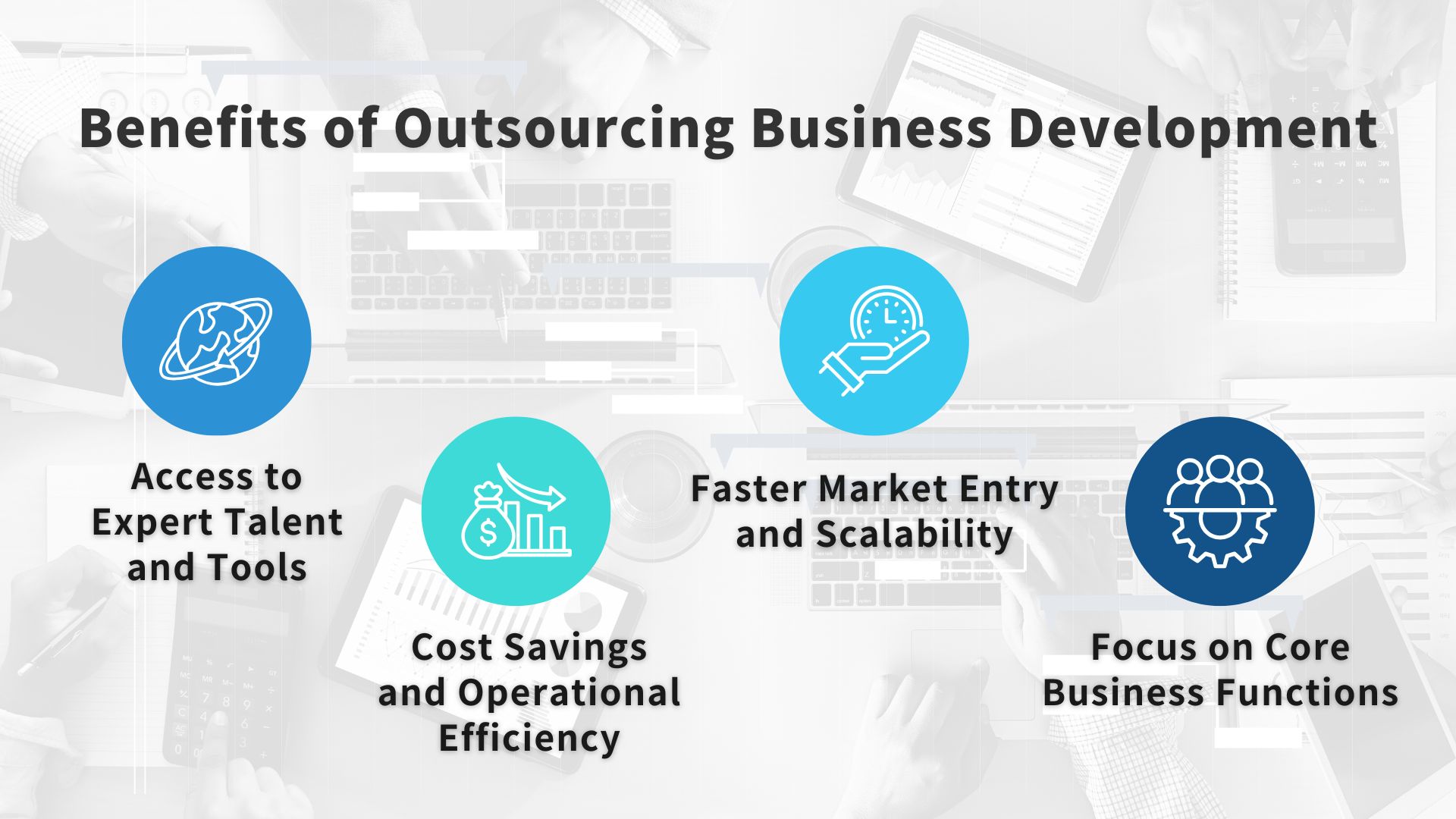
                   

                  Schedule regular feedback sessions

                  Maintain momentum and transparency by scheduling weekly calls, sprint demos, and regular progress updates. Frequent check-ins allow you to address any concerns immediately and ensure that the project is moving in the right direction.

                  These meetings also keep the team motivated and aligned with your vision, helping to foster a collaborative and productive working relationship throughout the development process.


                  Keep documentation and communication clear

                  Clear, thorough documentation is critical to avoid miscommunication and ensure that both parties stay on the same page. Make sure to document all project requirements, design specifications, changes, and decisions, whether it’s a new feature, an adjustment to the timeline, or an alteration to the scope.

                  Having a clear, written record of all these aspects prevents misunderstandings and provides a reference point if any issues arise down the line.


                  Conclusion

                  outsourcing-app-development

                  Outsourcing app development in 2026 offers a powerful path to build better products, faster, and at a fraction of the in-house cost—if you choose the right partner and manage the project smartly.


                  To recap:

                  • Outsourcing gives you access to global talent, speed, and flexibility
                  • But you need to watch out for hidden costs and vague contracts
                  • A structured approach and clear communication are key to success


                  By keeping these key points in mind, you can maximize the benefits of outsourcing while minimizing the risks. A thoughtful approach will set your project up for success from day one.

                  If you’re looking for a reliable partner with full-cycle development expertise and proven experience in high-security fields like healthcare and finance, IVC Vietnam is ready to support you.

                  Get in touch today and discover how we can help you turn your vision into reality—with trusted quality, clear communication, and flexible engagement models.


                  If you have any pain points regarding Digital Transformation within your company, feel free to contact IVC for a consultation on potential solutions.

                  Ready to get started?

                  Contact IVC for a free consultation and discover how we can help your business grow online.

                  Contact IVC for a Free Consultation


                   Related Posts

                  Top Software Outsourcing Companies in 2026: Find the Best Partner for Your Business

                  Why Outsource IT Development? Benefits and Challenges in 2026


                  External image links

                  All images featured in this article are provided by Unsplash, a platform for freely usable images.

                  The diagrams used in this article were created using Canva.

                  View More
                  1 2