OUTSOURCING

October 30, 2025

Why Outsource App Development? Key Benefits, Hidden Costs, and How to Get It Right

In 2026, outsourcing app development remains a strategic move for businesses looking to save time, reduce costs, and access top-tier tech talent worldwide.

But how do you avoid common pitfalls like hidden fees, communication breakdowns, or unclear project scopes?

In this updated guide, we’ll walk you through the major benefits, potential risks, and proven methods for choosing the right outsourcing partner—so your next app project doesn’t just stay on track, but truly thrives.


What Is App Development Outsourcing?

outsourcing-app-development

App development outsourcing means partnering with an external team or agency to manage the technical aspects of your application, from concept and coding to launch and ongoing updates.

This can involve web apps, mobile apps, or full-cycle development services.


Definition and types (web, mobile, full-cycle)

There are several ways to outsource app development, depending on the project scope and target platform.


Types of Development Services:

  • Web App Development:
    Browser-based applications accessible across multiple devices
  • Mobile App Development:
    Native or hybrid apps developed for iOS, Android, or both platforms
  • Full-Cycle Development:
    End-to-end services including planning, UI/UX, development, QA, deployment, and maintenance


Each type of app development outsourcing serves different business needs.

Choosing the right type depends on your project’s goals, target audience, required features, and long-term vision.


In particular, partnering with outsourcing hubs like Vietnam can offer flexible solutions across web, mobile, and full-cycle development, making it easier for startups and growing companies to scale efficiently without compromising quality.


In-house vs. outsourcing: Pros and cons

While in-house development offers control and proximity, outsourcing provides flexibility, faster results, and access to global talent at a fraction of the cost.


In-House vs. Outsourcing Comparison:

  • Cost:
    In-house is higher (salaries, equipment, overhead) / Outsourcing is lower (pay-per-project or per-hour)
  • Speed:
    In-house is slower (due to recruitment and onboarding) / Outsourcing offers faster start and delivery
  • Flexibility:
    In-house is less scalable / Outsourcing allows easy scalability
  • Control:
    In-house allows direct, daily communication / Outsourcing requires structured communication
  • Access to Talent:
    In-house is limited to local hires / Outsourcing gives access to a global talent pool


While in-house development gives you more direct control, outsourcing offers flexibility, faster time to market, and access to a broader talent pool—often at a significantly lower cost.

Ultimately, the best choice depends on your project’s size, timeline, and long-term goals.

Many startups and growing businesses are now opting for outsourcing models that balance quality, speed, and affordability, with Vietnam emerging as one of the most trusted destinations.


Thinking about outsourcing to Vietnam?

Let’s talk about how a trusted development partner like ISB Vietnam can help you scale your app project efficiently.

Contact IVC for a Free Consultation


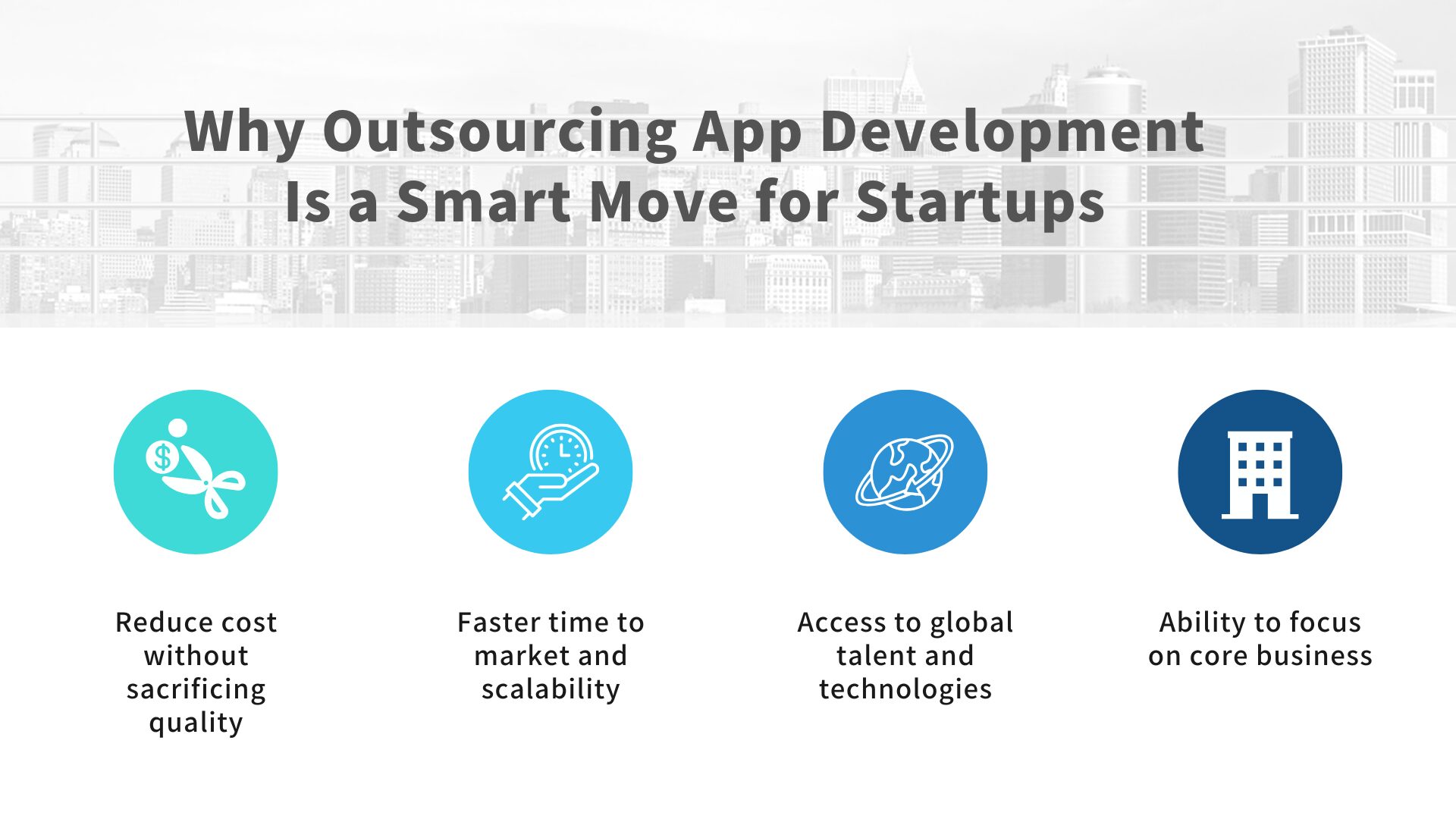
Why Outsourcing App Development Is a Smart Move for Startups
outsourcing-app-development


For startups, every dollar and hour count.

Outsourcing gives you access to world-class expertise and advanced technologies, while allowing your internal team to stay focused on what matters most: growing the business.


Reduce cost without sacrificing quality

Offshore teams can deliver high-quality work at significantly lower rates.

Locations such as Vietnam, India, and Eastern Europe offer experienced developers with strong technical skills, without the premium cost of hiring locally in the U.S. or Western Europe.


Faster time to market and scalability

Outsourced teams are ready to start immediately.

This enables you to launch faster, iterate more quickly, and scale your resources up or down depending on your project needs.


Access to global talent and technologies

Outsourcing gives you access to experts in blockchain, AI, AR/VR, and cloud-native development.

These specialists can bring your vision to life using advanced tools and technologies that may not be available locally.


Ability to focus on core business

By outsourcing technical execution, you and your team can dedicate more time to growth strategy, marketing, user acquisition, and customer support—the core functions that drive business success.


Hidden Costs and Common Pitfalls to Watch Out For

outsourcing-app-development

Outsourcing can be a powerful strategy, but without proper planning, it can quickly lead to delays, miscommunication, and unexpected expenses.


Here are some of the most common mistakes to avoid when outsourcing app development.


Poor communication and unclear requirements

One of the biggest risks in outsourcing is miscommunication.

Even the best developers can miss expectations if the scope is vague or updates are inconsistent.


Solution:

  • Create clear, detailed project specifications to avoid misunderstandings
  • Use wireframes or prototypes to align on visual expectations early
  • Leverage tools like Jira, Trello, or Slack to ensure consistent communication


By setting clear expectations and maintaining steady communication, you can greatly reduce the risk of project delays and costly misunderstandings.


Choosing the cheapest = biggest risk

Low-cost offers may look appealing, but they often result in poor quality, delays, or the need for expensive rework.


Red Flags to Avoid:

  • No client references
  • Vague deliverables or unclear timelines
  • Lack of project management tools


It’s better to pay a fair rate for a reliable team than to waste time and money fixing mistakes later.


Security and data privacy concerns

Outsourcing means sharing sensitive business data with external teams.

If not handled properly, this can lead to data breaches, compliance issues, or loss of IP.


What to do:

  • Sign NDAs and include IP ownership clauses in your contract
  • Use secure file-sharing and communication tools
  • Work with firms that follow international security standards (e.g., ISO 27001)


By taking strong security measures from the beginning, you can protect your sensitive information and avoid major risks down the line.


How to Outsource App Development the Right Way

outsourcing-app-development

Whether you’re a startup or scaling business, understanding the process is key to avoiding pitfalls and getting the results you want.


Step 1: Define your project scope and goals

Before hiring a team, it’s essential to get crystal clear on your app’s purpose, users, and functionality.

A well-defined scope sets the foundation for smooth collaboration and successful delivery.


Ask yourself:

  • What business problem does the app solve?
  • Who are the target users, and what do they need?
  • What core features must be included in the first release?
  • Are you building a prototype, MVP, or full-scale product?
  • What is your ideal timeline for development and launch?


Having this clarity upfront helps your outsourcing partner align with your goals, suggest the right technologies, and manage time and costs efficiently.


Step 2: Select the right outsourcing model

There are several outsourcing engagement models to choose from, each suited to different project types.


Common Pricing Models:

  • Fixed Price – Best for small, well-defined projects.
    Predetermined cost and deliverables.
  • Time & Materials – Best for evolving scope.
    Pay per hour, with flexibility to adapt scope as needed.
  • Dedicated Team – Best for long-term or complex projects.
    A remote team that acts as an extension of your in-house team.

Your choice should align with your budget, project complexity, and need for flexibility.


Step 3: Vet your outsourcing partner

Don’t rush into signing with the first agency you come across. 

Instead, take the time to evaluate a few key areas:

  • Portfolio of past work
  • Client reviews on platforms like Clutch, GoodFirms
  • Technical skills (ask for a code sample or do a test project)
  • Cultural and time zone compatibility
  • Language proficiency and communication style


It’s a good idea to compare at least 2 to 3 candidates before making your final decision.


Step 4 : Use tools for tracking and communication

A successful outsourced project depends on transparency and alignment.

Leverage modern tools to bridge the distance:

  • Slack / Microsoft Teams: Real-time messaging
  • Jira / Trello / ClickUp: Task management and sprint planning
  • Figma / Zeplin: Design collaboration
  • Google Meet / Zoom: Video meetings and daily stand-ups


Using the right tools keeps everyone on the same page and helps your project stay on track.

We also bring experience with flexible and proven methodologies like Agile and Waterfall.

At IVC, we prioritize seamless collaboration and draw on industry-standard project management practices to keep things running smoothly. We're also quick to adapt.

Whether you're using a specific framework or a custom workflow, we align with your processes to ensure everything stays on track.


Ready to get started?

Contact IVC for a free consultation and discover how we can help your business grow online.

Contact IVC for a Free Consultation


Where to Outsource in 2026? Top Destinations Compared

outsourcing-app-development

Outsourcing isn’t just about cutting costs, it’s about finding the right talent, time zone alignment, and cultural fit.

Here’s how the top regions stack up in 2026.


Popular outsourcing regions (Asia, Eastern Europe, Latin America)

Outsourcing opens global opportunities. Your ideal region depends on budget, goals, and work style.

Here’s a quick look at the top outsourcing destinations.


Comparison by Region:

  • Asia (Vietnam, India, Philippines)
    Strengths:
    Cost-effective, large talent pool, improving English proficiency, strong government support for IT education (especially in Vietnam)
    Ideal for:
    Startups, MVPs, long-term projects
  • Eastern Europe (Ukraine, Poland, Romania)
    Strengths:
    High technical expertise, strong focus on data security, cultural compatibility with Western clients, excellent English skills
    Ideal for:
    SaaS platforms, fintech, enterprise-grade applications

  • Latin America (Brazil, Colombia, Mexico)
    Strengths:
    Time zone alignment with the U.S., strong cultural affinity, bilingual teams (Spanish-English)
    Ideal for:
    Agile collaboration, customer support roles, B2C services for U.S. market

In 2026, Asia—especially Vietnam—is gaining increased attention due to its growing tech talent pool, competitive rates, and strong government support for the IT sector.


Why Vietnam is gaining global attention

Vietnam has quickly become one of the most attractive outsourcing destinations in recent years. Here's why it's standing out:


  • Competitive pricing with reliable quality
    Offering excellent value for money, Vietnam delivers strong results at lower costs than many Western countries.

  • Strong English proficiency
    Many Vietnamese developers and project managers have solid English skills, making communication smoother.

  • Rapidly growing tech talent pool
    With a strong emphasis on STEM education and a thriving startup culture, Vietnam is producing skilled professionals at a fast pace.

  • Supportive government policies
    The Vietnamese government actively promotes IT services and export-oriented industries through incentives and infrastructure investment.

  • Ability to quickly apply new technical trends
    Deliver a Proof of Concept (PoC) application quickly (e.g., in 1–4 weeks), leveraging new technical trends like AI.


In 2026, Vietnam is especially appealing to startups and SMBs seeking scalable, cost-effective solutions in web and mobile app development.


Ready to get started?

Contact IVC for a free consultation and discover how we can help your business grow online.

Contact IVC for a Free Consultation


What US businesses value most in partners

If your business is based in the U.S., here are the qualities U.S. companies typically prioritize when outsourcing.


  • Reliability and accountability
    A partner who consistently delivers results as expected and takes full responsibility when issues arise.

  • Security and data protection compliance
    A partner capable of handling sensitive information securely and adhering to major regulations such as GDPR and HIPAA.

  • Speed of execution
    A partner with a fast and efficient development process that enables quicker time-to-market.

  • Proactive communication
    A partner who proactively provides updates and suggestions at the right time, rather than passively waiting for instructions.

  • Cultural compatibility
    A partner who understands and adapts to your business culture, expectations, and working style.


Finding a partner who aligns with these values can make all the difference in delivering a successful app on time and on budget.


Final Tips to Ensure a Smooth Outsourcing Experience

outsourcing-app-development

Successfully outsourcing app development goes beyond choosing the right partner.

To make sure your project stays on track and meets expectations, it’s essential to manage the process effectively.

Here are some final tips to help you navigate the journey smoothly and avoid common pitfalls.


Start small and build trust gradually

Begin with a pilot or a limited-scope engagement to test the waters and build trust with your outsourcing partner. This allows you to evaluate their communication, delivery speed, and the quality of their work without committing to a large-scale project upfront.

By starting small, you can identify potential issues early and adjust expectations or workflows before scaling up.


Schedule regular feedback sessions

Maintain momentum and transparency by scheduling weekly calls, sprint demos, and regular progress updates. Frequent check-ins allow you to address any concerns immediately and ensure that the project is moving in the right direction.

These meetings also keep the team motivated and aligned with your vision, helping to foster a collaborative and productive working relationship throughout the development process.


Keep documentation and communication clear

Clear, thorough documentation is critical to avoid miscommunication and ensure that both parties stay on the same page. Make sure to document all project requirements, design specifications, changes, and decisions, whether it’s a new feature, an adjustment to the timeline, or an alteration to the scope.

Having a clear, written record of all these aspects prevents misunderstandings and provides a reference point if any issues arise down the line.


Conclusion

outsourcing-app-development

Outsourcing app development in 2026 offers a powerful path to build better products, faster, and at a fraction of the in-house cost—if you choose the right partner and manage the project smartly.


To recap:

  • Outsourcing gives you access to global talent, speed, and flexibility
  • But you need to watch out for hidden costs and vague contracts
  • A structured approach and clear communication are key to success


By keeping these key points in mind, you can maximize the benefits of outsourcing while minimizing the risks. A thoughtful approach will set your project up for success from day one.

If you’re looking for a reliable partner with full-cycle development expertise and proven experience in high-security fields like healthcare and finance, IVC Vietnam is ready to support you.

Get in touch today and discover how we can help you turn your vision into reality—with trusted quality, clear communication, and flexible engagement models.


If you have any pain points regarding Digital Transformation within your company, feel free to contact IVC for a consultation on potential solutions.

Ready to get started?

Contact IVC for a free consultation and discover how we can help your business grow online.

Contact IVC for a Free Consultation


 Related Posts

Top Software Outsourcing Companies in 2026: Find the Best Partner for Your Business

Why Outsource IT Development? Benefits and Challenges in 2026


External image links

All images featured in this article are provided by Unsplash, a platform for freely usable images.

The diagrams used in this article were created using Canva.

View More
OUTSOURCING

October 30, 2025

Top Software Outsourcing Companies in 2026: Find the Best Partner for Your Business

Outsourcing software development has become a smart strategy for businesses that want to stay competitive, scale fast, and reduce costs—without sacrificing quality.

But with so many vendors around the world, how do you know which ones are actually reliable?

In this 2026 guide, we’ll introduce top-performing software outsourcing companies that are trusted by global clients. Whether you’re a startup looking to build your first MVP or a growing company scaling your tech stack, this list will help you find the right partner to match your needs.

What Is Software Outsourcing?

Discover what software outsourcing really means and how it fits into modern business operations.

Definition and Scope

Software outsourcing is a smart way to get software built by experts outside your organization. From app development and system maintenance to QA, cloud ops, and support—outsourcing lets you access top talent without the cost and time of hiring full-time staff.

Common Models (Project-Based, Dedicated Teams, Staff Augmentation)

Outsourcing comes in a few different models.

  • Project-Based
    Suitable for clearly defined, short-term initiatives. Vendors deliver a complete solution based on your specifications.

  • Dedicated Teams
    Ideal for long-term collaboration. A remote team works exclusively on your product, functioning as an extension of your in-house team.

  • Staff Augmentation
    Involves hiring individual developers to support your existing team. Offers flexibility to scale resources up or down as needed.


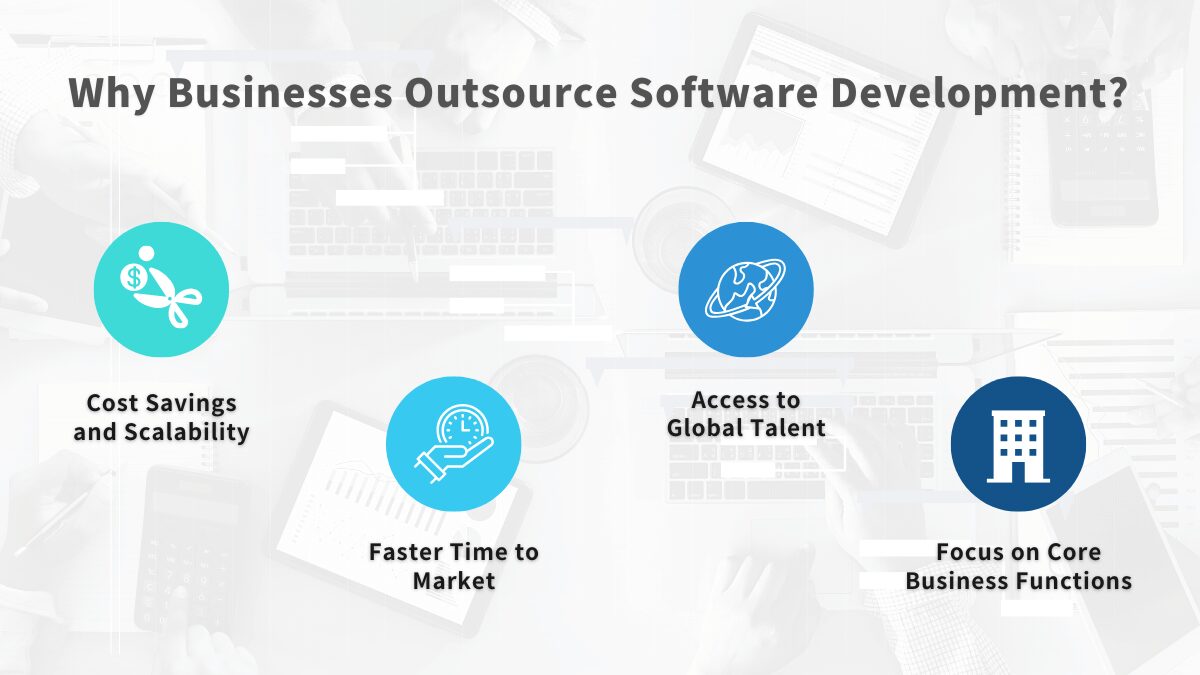
Why Businesses Outsource Software Development in 2026

Understand the key reasons why more companies are choosing to outsource in today’s fast-paced tech landscape.

Cost Savings and Scalability

Outsourcing reduces recruitment and operational costs while providing the flexibility to adjust team size according to project requirements.

Faster Time to Market

Experienced external teams can accelerate development timelines and offer round-the-clock productivity, enabling quicker product launches.

Access to Global Talent

Gain access to highly skilled professionals worldwide, including experts in areas such as AI, DevOps, cybersecurity, and mobile development.

Focus on Core Business Functions

Delegating technical work allows your internal team to concentrate on strategic priorities such as product vision, customer experience, and growth.

How to Choose the Right Outsourcing Partner

Find out what to look for and what to avoid when selecting a software development partner.

What U.S. Companies Value Most

When choosing an outsourcing partner, U.S.-based tech companies tend to prioritize more than just technical skills. Here’s what they’re really looking for:

  • Clear communication
    Teams that can express ideas, ask questions, and provide updates in fluent, professional English.
  • Strong project management
    A reliable process for tracking progress, managing risks, and keeping things on schedule.
  • Time zone overlap
    At least a few hours of shared working time to allow for real-time collaboration and meetings.
  • Security and compliance
    Familiarity with regulations like GDPR, HIPAA, or SOC 2. Especially for companies in healthcare, finance, or SaaS.
  • Cultural fit
    An understanding of U.S. business expectations, including responsiveness, ownership, and transparency.


Red Flags and Risks to Watch Out For

Choosing the wrong outsourcing partner can lead to missed deadlines, poor-quality code, and costly rework. Here are some common red flags to keep an eye on:


  • Vague contracts
    If the contract lacks detail about scope, timelines, or responsibilities, that’s a major warning sign. Always insist on clarity.
  • Unclear deliverables
    When it’s not clear what you’re getting and when, it’s easy for projects to spiral out of control.
  • Overpromising vendors
    Be cautious of teams that say “yes” to everything without fully understanding your requirements.
  • Unusually low pricing
    While budget matters, prices that seem too good to be true often signal inexperience, low-quality work, or hidden costs.
  • Poor communication habits
    If a team is slow to respond or unclear in their answers during the early stages, expect more of the same during development.

Spotting these risks early can help you avoid disappointment and find a partner that’s truly capable of delivering value.

Questions to Ask Before You Hire

Asking the right questions early on helps you avoid mismatches and find a team that aligns with your goals.

Here are some key questions to consider:

  • What’s their development process like?
  • How do they manage communication and feedback?
  • What tools and platforms do they use?
  • Can we see examples from their portfolio?
  • What security protocols do they follow?
  • How do they handle changes in scope or timelines?


Top Software Outsourcing Companies in 2026

Explore our list of trusted outsourcing firms known for delivering quality work, strong communication, and real value.

Top Picks by Development Genre

Looking for a partner to develop your next mobile app? Here are the top firms known for delivering sleek, functional apps across iOS and Android platforms.

◾️ Mobile App Development

Suffescom Solutions Inc - USA
Suffescom Solutions stands out for its expertise in iOS and Android app development, with a strong focus on delivering exceptional UI/UX design. If you're aiming to launch a mobile product that looks sharp and performs flawlessly, they’re a solid pick.

▷10Pearls - USA
10Pearls brings innovation to the forefront by integrating AI and IoT technologies into their mobile app solutions. Security is baked into their development process, making them a smart choice for businesses that prioritize safety and scalability.

◾️ Web Application Development

▷Innowise- Belarus
Specializing in custom web application development, Innowise has a proven track record in high-stakes industries like finance and healthcare. Their tailored solutions are designed to meet complex business requirements with precision.

▷Moravio - Czech Republic
Moravio is known for building sleek, modern web applications using technologies like React and Vue.js. Whether you’re starting from scratch or scaling an existing product, their front-end expertise ensures your app stays fast, responsive, and future-ready.

◾️ Custom Software Development

▷Itransition - USA
With decades of experience in custom software development for enterprises, Itransition delivers scalable solutions tailored to diverse industries. From retail to manufacturing, they know how to align technology with complex business needs.。

▷ScienceSoft - US
ScienceSoft is a trusted partner in developing secure, custom software—especially for high-compliance sectors like healthcare and finance. Their expertise ensures that every solution meets strict regulatory and data protection standards.

◾️ Enterprise Software Development

▷Tata Consultancy Services (TCS) - India
TCS has a proven track record in developing and implementing large-scale ERP and CRM systems for global enterprises. Their ability to manage complex, mission-critical projects makes them a trusted name in enterprise IT.

▷FPT Software - Vietnam
A major player in the Asian tech scene, FPT Software offers robust enterprise solutions including SAP and Microsoft Dynamics 365. Their regional expertise and scalable delivery model make them a strong partner for digital transformation initiatives.

◾️ Cross-Platform / Hybrid App Development

▷ewwave Solutions - Vietnam
Specializing in cross-platform app development, ewwave Solutions leverages Flutter and React Native to build sleek, high-performance apps. They're a go-to choice for startups and businesses looking to launch quickly across both iOS and Android.

▷Kanda Software - USA
Kanda Software delivers end-to-end cross-platform development services—from UX/UI design to full-stack implementation. Their integrated approach ensures consistency, speed, and a seamless user experience across devices.

◾️ AI / ML Solutions

▷SoftServe - Ukraine
SoftServe excels in building AI and machine learning-powered solutions, with a strong track record of collaboration with global enterprises. Their deep tech expertise makes them an ideal partner for data-driven innovation at scale.

▷Coherent Solutions - USA
Focused on advanced analytics and predictive modelling, Coherent Solutions helps businesses harness AI to strengthen business intelligence. Their tailored solutions turn raw data into actionable insights.

◾️ MVP Development for Startups

▷Leanware - Colombia
Leanware specializes in MVP development for startups, offering rapid prototyping and fast time-to-market. If you're looking to validate your idea quickly and efficiently, Leanware delivers with agility and precision.

▷Aloa - USA
Aloa provides flexible development support tailored to the needs of early-stage startups. Their structured approach and dedicated teams help founders build solid product foundations from day one.

Recommended Vendors by Business Needs

◾️ Cost-Effective Companies

▷Computools - Ukraine
Computools delivers high-quality software development at competitive prices, making them an ideal partner for small and mid-sized businesses looking for affordable, reliable solutions.

▷Moravio - Czech Republic
Known for their cost-efficient development services, Moravio is especially popular among startups aiming to maximize value without sacrificing quality.

◾️ Full-Cycle Development Partners 

▷ISB Vietnam (IVC)  - Vietnam
From planning and development to long-term maintenance, IVC offers end-to-end development services, with a strong track record in healthcare and finance.

▷Innowise - Belarus
Innowise provides full-cycle development—from strategic consulting to post-launch support—tailored to complex business needs across industries.

◾️ Security-Focused Companies

▷ISB Vietnam (IVC)  - Vietnam
IVC is well-versed in developing for high-security sectors like healthcare and finance, with infrastructure and practices that meet strict compliance standards.

▷ScienceSoft - USA
With ISO certification and experience in GDPR and HIPAA compliance, ScienceSoft is a trusted name for secure, regulation-ready software development.

◾️ Best Communication & English Support

▷Aloa - USA
Aloa excels in communication with English-speaking clients, ensuring smooth collaboration and clear project alignment from day one.

▷Kanda Software

Highly regarded for their responsiveness and clarity, Kanda Software is a great fit for North American clients looking for seamless, English-first communication.

◾️ Best for Startups

▷Leanware - Colombia
Leanware supports early-stage startups with flexible development models and rapid MVP delivery, helping founders move fast and launch confidently.

▷Aloa
With a startup-centric approach, Aloa offers adaptable team structures and rapid development cycles to help new ventures scale efficiently.

◾️ Best for Mobile

▷Suffescom Solutions Inc - USA
Suffescom specializes in mobile app development with a strong emphasis on UI/UX design, delivering polished products users love.

▷10Pearls - USA
10Pearls combines mobile expertise with advanced technologies like AI and IoT, creating next-gen apps with real business impact.

Best Countries to Outsource Software Development in 2026

Learn which countries offer the best mix of talent, affordability, and reliability for outsourcing.

Asia (Vietnam, India, Philippines)

Asia remains a top outsourcing destination thanks to strong technical talent and cost advantages. Vietnam, in particular, is gaining momentum for its blend of quality and affordability.

Eastern Europe (Ukraine, Poland, Romania)

Eastern Europe offers a great balance of price, quality, and time zone overlap with the U.S. These countries also have strong engineering education systems.

Latin America (Mexico, Colombia, Brazil)

For companies seeking minimal time zone difference and solid English skills, Latin America is an increasingly popular choice.

Why Vietnam Is Gaining Global Attention

Vietnam is quickly becoming a go-to hub for software development. With a growing tech ecosystem, competitive pricing, and strong English communication.

Among the top choices, ISB Vietnam (IVC) stands out for its well-rounded capabilities. If you're a U.S.-based company looking for a reliable software outsourcing partner in Vietnam, IVC is a smart and strategic option.

Backed by years of experience in the medical and finance sectors, IVC not only delivers secure solutions but also provides strategic insight for long-term software success.

Curious about how we can support your next project? Get in touch today to explore tailored solutions that match your business goals.


Final Tips for a Successful Outsourcing Experience

software-outsourcing-companies

Set your project up for success with these simple best practices. A little preparation and structure can go a long way in ensuring smooth collaboration and great results.

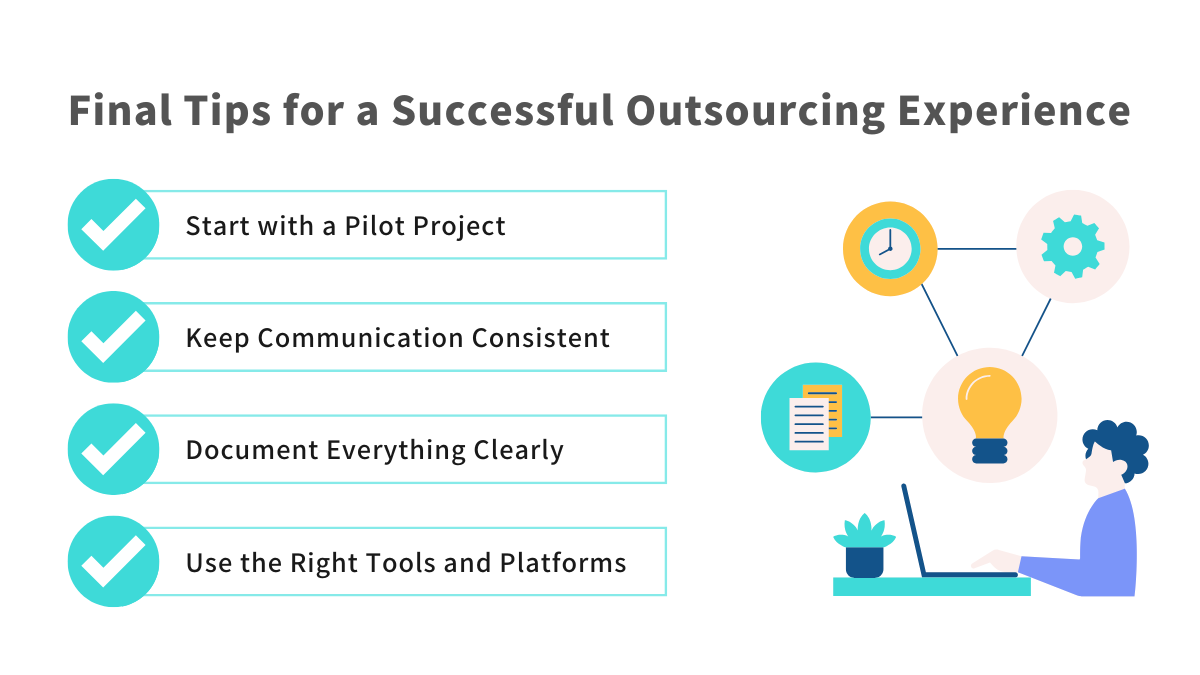
Start with a Pilot Project

Before diving into a large engagement, begin with a small, low-risk project. This gives you a chance to evaluate the team's technical skills, communication style, and ability to meet deadlines. It also helps build mutual trust and allows both sides to understand each other’s working methods.

Keep Communication Consistent

Establish a regular rhythm for updates. Consistent communication reduces uncertainty, keeps everyone on the same page, and allows you to catch issues early. Use communication channels your team is already comfortable with, like Slack, Microsoft Teams, or Zoom.

Document Everything Clearly

Don't leave anything to assumption. Define the project scope, requirements, milestones, and deliverables in writing. Use shared documents, wikis, or project management tools to keep everything accessible and up-to-date. Good documentation acts as a single source of truth and helps avoid costly misunderstandings down the road.

Use the Right Tools and Platforms

Choose tools that match your team’s workflow and simplify collaboration—think Trello, Jira, Notion, or GitHub. Make sure your outsourcing partner is familiar with or willing to adopt these platforms. Having a shared digital workspace helps streamline tasks, track progress, and manage feedback in real time.

Conclusion: Finding the Right Partner for Your Business

The right outsourcing partner can help you move faster, save money, and build better software without the stress. With the right team by your side, you gain access to global talent, industry-specific expertise, and the flexibility to scale as your business evolves.

If you’re looking for a team that offers both full-cycle development and top-notch security, ISB Vietnam (IVC) is a trusted choice.

Ready to build with confidence? Contact us today to explore how our end-to-end solutions can drive your success.

Ready to get started?

Contact IVC for a free consultation and discover how we can help your business grow online.

Contact IVC for a Free Consultation


Related Post

Why Outsource App Development? Key Benefits, Hidden Costs, and How to Get It Right

External image links

All images featured in this article are provided by Unsplash, a platform for freely usable images.

The diagrams used in this article were created using Canva.
View More
OFFSHOREOUTSOURCINGTECH

February 19, 2025

Pros and Cons of Onshore and Offshore Development: Choosing the Right Model for Your Business Growth

While businesses continue to desire growth and better operational efficiency through the use of IT, they often struggle to balance the critical challenges of resource management, cost control, and talent acquisition. To tackle these challenges, many companies resort to onshore and offshore development models. Each of the two models brings its various benefits and potential drawbacks. However, picking the right one is not easy.

This article will discuss the advantages and disadvantages of onshore versus offshore development, taking insights from the knowledge offered by ISB Vietnam, Who has extensive experience with both models. This guide gives key insights into the best outsourcing approach for your business. Whether your priority is saving cost, optimize communication, or unlock access to unique talent, you’ll be equipped to make an informed decision.

What Is Onshoring and Offshoring?

Now let us consider the concepts of onshoring and offshoring and how they differ.

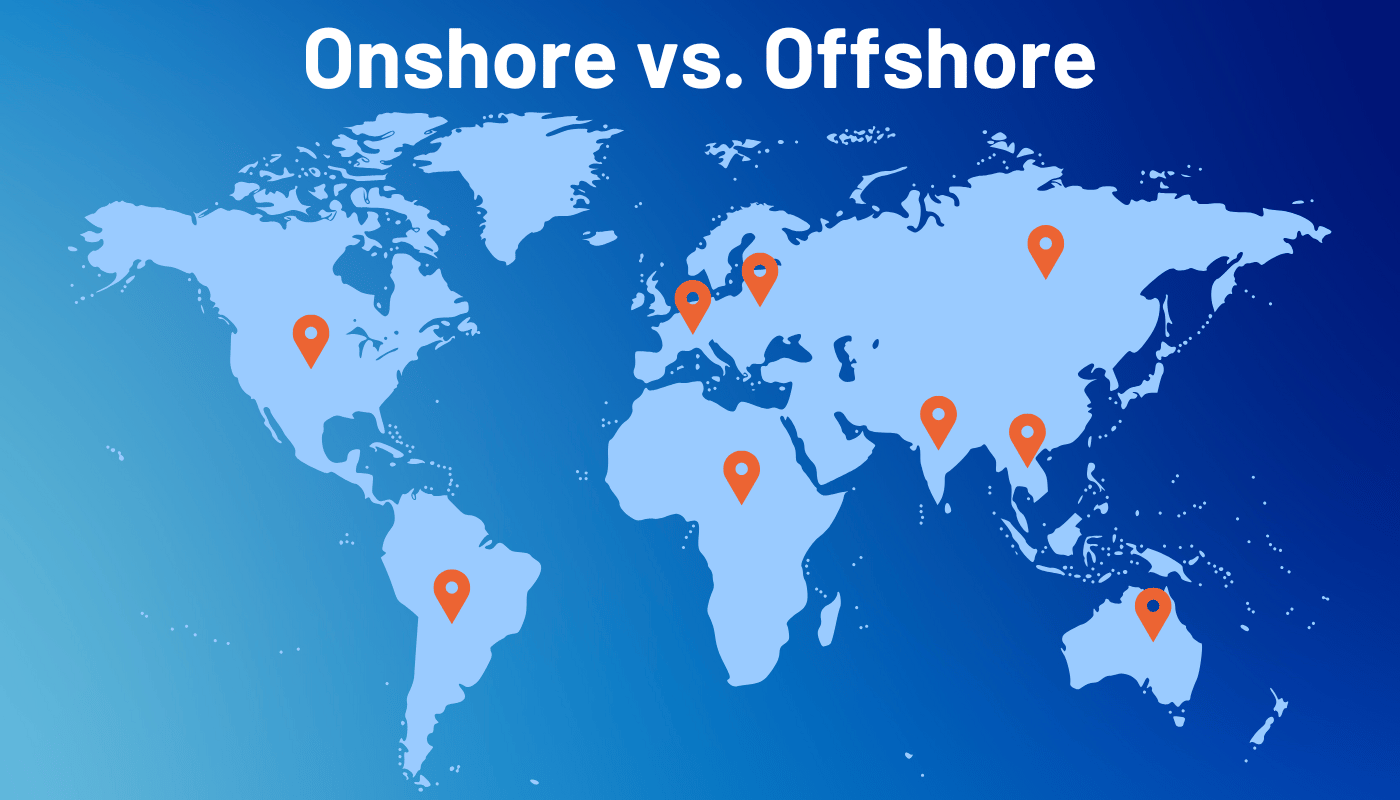
Onshoring is the outsourcing of business operation, like software development, within the same nation in which the client business is located. Through this method, companies are able to take advantage of local skills with the benefits of easier communication, compliance with regulations, and control of operations.

Offshoring, however, refers to outsourcing tasks to a foreign country, typically to destinations where labor is cheaper and high-skilled workers are readily available. It is prevalent in the IT services and software development industry because the businesses can take advantage of cost advantage, availability of a greater talent pool, and nimble scaling.

Main Differences between Onshore and Offshore

Though both models enhance business efficacy through outsourcing, they are diverse in the dimension of cost considerations, location differentiation, communication timeframe, scalability, and compliance requirements.

Onshore development gives businesses the ability to ensure local compliance, real-time collaboration, and cultural matching, but usually with a higher cost. In contrast, offshoring allows businesses to save up costs and avail themselves of a much larger talent pool, but it may brings upon challenges related to communication, time zones, and legal complications.

To delve deeper into the difference between onshore and offshore, look up our article.

Onshore vs. Offshore: Definition, Differences, and Key Considerations

Advantages of Onshoring

Smooth Communication

A great benefit of onshoring is that one gets to work with a team that shares the same language and culture. Without any language barriers, communication is easier, with less possibility of misunderstandings and misinterpretations. This is particularly valuable for complex projects where constant interaction is necessary, with precise instructions and frequent updates being necessary.

Easier Compliance with Laws and Regulations

Because onshoring maintains operations within the home nation, companies are in full compliance with domestic laws and regulations. Compliance with data protection legislation, intellectual property legislation, and labor law is simpler because no effort needs to be made to interpret foreign legal systems. This gives a feeling of security, especially for companies in sectors where compliance is the most important consideration. For any legal issue, businesses can depend on home country law, minimizing uncertainty along with possible risks associated with international legal variations.

Ability to Hold Face-to-Face Meetings

Proximity is also among the greatest advantages of onshoring since it allows businesses to conduct face-to-face communication whenever necessary. This can be particularly useful when there are crises, and on-site visits and personal troubleshooting can be arranged without loss of time. Companies that prefer personal interaction with their employees might find onshoring a preferable alternative since it allows for better collaboration, enhanced relationship-building, and quicker problem-solving.

Disadvantages of Onshoring

Higher Costs

Perhaps the most significant disadvantage of onshoring is cost. Software developers and IT professionals in industrialized nations receive high salaries, which greatly adds to labor expenses. Office rent and the cost of business operations also are likely to be higher than in offshore destinations. Consequently, organizations on a shoestring budget might find it difficult to get projects done within budget limits by utilizing purely onshore talent.

Limited Talent Access

As onshoring limits hiring to domestic markets, organizations might not be able to recruit experts in some areas. New technologies like artificial intelligence, blockchain, and cybersecurity need highly skilled experts, but the availability of such experts is typically less than the demand. This talent shortage increases salaries, and hiring becomes more competitive and expensive. Large companies with deep pockets may have access to the top talent, and small and medium-sized businesses are left with limited options for recruiting qualified software developers.

Challenges in Scaling

Scaling development teams in an onshore model is difficult, especially for fast-growing companies. Compared to offshore models, where companies can scale their workforce rapidly by tapping into international talent pools, onshoring restricts scalability to the quantity of local professionals in the market. Recruiting fresh talent in demanding markets is time-consuming, and companies cannot scale projects up or reallocate resources rapidly as required. Companies planning long-term growth must carefully consider whether onshoring can support their growth strategy.

Advantages of Offshoring


Cost Saving

A great benefit of offshoring is being able to lower business and project expenses significantly, mainly in areas of labor and operational expenses. By outsourcing to nations with lower labor expenses compared to advanced countries, organizations can obtain more resources for the same budget, enabling them to attain higher output without having to sacrifice development quality. Most companies opt for offshoring mainly due to this reason since it is a relatively inexpensive method of adding great software development capacity.

For instance, as per the 2025 Global Software Outsourcing Rates and Trends Guide released by Accelerance, hourly rates of software developers differ based on location.

ROLE

Latin America

Eastern Europe

South Asia

Southeast Asia

Junior Developer

$20 - $70

$30 - $49

$25 - $35

$16 - $44

Intermediate Developer

$30 - $115

$45 - $66

$30 - $45

$20 - $48

Senior Developer

$40 - $125

$55 - $86

$35 - $50

$25 - $51

Lead Developer

$42 - $125

$65 - $93

$38 - $50

$33 - $55

Source: 2025 Global Software Outsourcing Rates and Trends Guide | Accelerance

As evident from the table above, hourly rates for software developers differ by region. The average hourly rate for a software developer in South Asia and Southeast Asia is in the range of approximately $20 to $50, and these two regions are the most cost-saving for outsourcing software development. Eastern Europe is in the middle range, and Latin America is the highest among the offshore regions listed.

While varying by region, offshore development costs are still significantly lower than in Western countries, providing a cost-effective alternative for companies wanting to save their software development expenditure.

With the leverage of offshoring, companies can engage skilled developers at significantly lower rates than employing domestically, providing an attractive solution for companies wanting to maximize their return on investment while being able to maintain high-quality development.

Access to World Talent and Specialized Expertise

Offshoring allows companies to access a global pool of international talent, making it convenient for them to employ experts in new or niche technologies. Companies that find it difficult to find professionals locally owing to a shortage of talent can utilize offshoring to recruit highly skilled software developers in emerging and niche areas like AI, blockchain, cybersecurity, and legacy programming languages. It is especially helpful for companies looking for specialists with uncommon skill sets that are hard to locate in their native country.

Scalability and Flexibility

Offshoring provides a very good level of scalability, which enables companies to scale up or down team size with ease in accordance with project demands. As opposed to onshore hiring, which is usually backed by time-consuming processes of hiring and expensive labor, offshoring enables companies to scale development teams quickly without investing high costs. Such flexibility is particularly worth it for companies engaged in large development projects or businesses with fluctuating workloads, where being able to scale resources for a finite time frame can yield a significant competitive edge.

Development across Time Zones

For businesses with offshore teams located in various time zones, offshoring has the additional advantage of more time available for development. Whereas onshore teams are restricted to normal business hours, offshore teams can still work even after the office hours of the client. The time difference enables quick turnaround of projects since companies can outsource jobs during their business hours and have updates or completed jobs the following morning. Taking advantage of time zone differences can result in enhanced productivity, shorter development cycles, and quicker time-to-market for new features or products.

Disadvantages of Offshoring


Potential communication challenges

Communication challenges brought on by linguistic and cultural boundaries are common issues with offshore. Working with groups that don't have the same first language or business procedures might lead to misunderstandings. However, with the right preparation and expertise, these difficulties can be lessened. Many organizations get around these problems by establishing clear communication channels early on and collaborating with offshore companies that have a lot of expertise dealing with clients from other countries.

Regulatory and Legal Aspects

Offshoring is outsourcing work to a foreign nation, thus businesses must deal with variations in labor laws, data protection laws, intellectual property rights, etc. Even though it might be difficult to comply with foreign standards, businesses can reduce risks by conducting adequate research and drafting appropriate legal agreements.

Possible Increase in Management Effort

Because labor expenses are reduced, offshore can result in large cost savings, but in certain situations, it can also result in more project management work. Effective coordination is essential for managing offshore teams, especially when it comes to progress tracking and remote team management. It could take more time and money to ensure seamless collaboration across time zones and workplace cultures.
However, by carefully choosing a trustworthy offshore partner, using project management and communication tools, and carrying out frequent progress checks, businesses can reduce the risk of higher management costs. Businesses can manage offshore teams efficiently and affordably if they have the proper plans in place.

Offshore or Onshore: Which Approach Is Better?

Both onshore and offshore development have benefits and drawbacks, as was previously mentioned, and the best option will rely on project specifications and business goals. If cutting costs is your main goal, offshore development might be a better choice. However, onshoring might be the better option if regulatory compliance and easy communication are important considerations.
In order to assist companies in making an informed choice, we have listed the main situations in which onshore or offshore development is most appropriate as well as a different hybrid strategy that combines the advantages of both models.

When Should You Choose Onshore Development?

When Real-Time and In-Person Communication Is Essential

Onshoring is ideal for projects that require seamless communication and direct collaboration. Because there are no language or cultural differences, it is possible to communicate freely without the chance of misunderstanding. It is also useful for projects which need to be coordinated in real time and with the ability to make decisions quickly due to the absence of time zone differences. Also, the project coordination can be further enhanced by the fact that face to face meetings can be easily set up.

When Strict Compliance with National Laws and Regulations Is Required

Some sectors including finance, government services, data security among others are highly regulated by the country. In such a case, onshoring is more often preferred as it guarantees adherence to data protection laws, labor laws and industry standards of the country. Also, onshore teams can deal with interactions with regulatory bodies and audits better and more effectively, thus reducing compliance risks.

When Should You Choose Offshore Development?


When Cutting Costs Is a High Priority

The ability to drastically cut costs is one of the main reason why so many companies choose offshore development. Hiring developers in areas with lower labor costs can have a significant positive financial impact because software development salaries make up a large portion of project expenses. This is particularly valid for long-term, large-scale projects, where offshore outsourcing offers consistent cost savings. It is also a desirable choice for new and small companies that have a tight budget and need to create products.

When to Hire Highly Qualified Personnel Rapidly

Offshoring gives companies access to a worldwide talent pool, enabling them to locate experts in cutting-edge domains like artificial intelligence, blockchain, data science, etc. This is especially helpful when hiring speed is a crucial consideration or when domestic talent is in short supply. Offshore outsourcing can help businesses that want to rapidly add highly qualified individuals to their development teams.

When the Task Is Properly Suitable for Remote Work

Software development, QA testing, and customer support are a few business operations that can be effectively managed remotely and don't require physical presence. Offshore teams can produce excellent results at low operating costs if they have the proper management structure and collaboration tools.

When Organizing a Prolonged Maintenance or Development Project

Long-term projects benefit greatly from offshoring since it enables companies to obtain development resources without regard to location. Communication problems frequently go away as offshore teams get more accustomed to the client's procedures and demands. In long-term relationships, this may result in increased productivity and efficiency. Because of this, offshoring becomes more and more cost-effective over time, making it a more attractive option for long-term projects.

Consider a Hybrid strategy: The Best of Both Worlds

Nowadays, a lot of businesses are using a hybrid development strategy that combines the best features of both onshore and offshore development instead of only deciding between the two. A typical hybrid strategy is outsourcing some development phases to an offshore team while maintaining key activities in-house.

For instance, in order to reduce costs without sacrificing quality, requirement analysis and high-level system design may be carried out onshore while the actual development and testing are managed offshore. With this structure, businesses can use offshore scalability for execution while maintaining control over key decision-making processes.

Another strategy is to scale up full-fledged development overseas while developing Minimum Viable Product (MVP) and prototypes onshore.

Businesses may use the flexibility and cost-effectiveness of offshore development while maintaining quality control through onshore management by implementing a hybrid strategy. This approach is becoming a more and more common choice for software development projects as it enables businesses to expand effectively, manage spending, and reduce risks.

Conclusion

Both onshore and offshore development present unique benefits; however, choosing the appropriate strategy involves detailed assessment of various factors including cost, scalability, technical requirements, communication efficiency and regulatory compliance. Businesses must evaluate these elements thoroughly to ascertain the most fitting model for their particular needs.

In numerous instances, a hybrid approach—which strategically merges onshore and offshore resources—can yield the optimal balance between quality, cost efficiency and operational flexibility.

By retaining core tasks such as requirement analysis, system architecture and project management onshore while outsourcing development and testing to offshore teams, companies can enhance their software development processes without sacrificing control over critical project aspects.

Although understanding the strengths and limitations of both onshore and offshore models is essential, it allows businesses to make informed decisions based on project scope, budget and long-term objectives. This strategic leveraging of resources can significantly bolster operational efficiency, expedite project timelines and fortify a company's competitive edge in the market.

About ISB Vietnam

At ISB Vietnam, a leading offshore software development outsourcing company in Vietnam, we’ve spent over 20 years helping companies worldwide navigate their IT requirements—offering not just skilled developers but also the high quality standards and language support that global projects demand.

Reach out to us if you are considering an offshoring strategy or seeking advice from a reliable partner to meet your organization's specific project needs. We would be delighted to showcase our expertise and resources.

Contact us today to explore potential collaboration opportunities and discover how we can contribute to your success.


 Related Posts

Top Software Outsourcing Companies in 2025: Find the Best Partner for Your Business

Why Outsource App Development? Key Benefits, Hidden Costs, and How to Get It Right

View More
OUTSOURCINGTECH

February 19, 2025

Onshore vs. Offshore: Definition, Differences, and Key Considerations

As businesses grow, they often face challenges and struggle with a lack of skilled workers, IT expertise, and industry experience. These gaps can hinder and slow operations down or make it harder to stay competitive in today’s digital world.

To bridge these gaps, businesses usually base their strategy on one of two basic models: onshore and offshore development. To put it in simple terms, onshore development refers to outsourcing software development or forming a development team based within the same country as the company, whereas offshore development means developing software or building development teams from other countries. Each strategy has its unique advantages and challenges, and the best choice will always depend on the nature of the work, considering factors such as cost, efficiency, quality control, and compliance.

This article will explore the definitions, meanings, and key differences between onshore and offshore development, with insights from ISB Vietnam, a company experienced in both models. By the end, you’ll have a better understanding of these approaches, helping you make more informed decisions.


What Is Onshoring? Definition and Meaning

Onshoring refers to the process of outsourcing business operations, predominantly software development and business process outsourcing (BPO), within the client company’s home country. The practice of software development through onshore outsourcing is called onshore development. Unlike offshoring, where hiring comes from other countries, onshoring provides the ability to leverage local talent with the built-in benefit of the company retaining operational control in its home country.


Main Benefits of Onshoring

The major advantage of onshoring is that language and cultural barriers are practically non-existent since it's all done within the same country. This eliminates miscommunication problems sometimes encountered in offshore development.

In addition, time-zone differences can be negligible or completely territory-free, allowing agile collaboration among teams. This comes especially handy when projects require constant updates, quick feedback, or rapid iterations.

Also, very relevant is compliance with local laws and regulations. Since all business activities happen under the same jurisdiction, corporations can ensure compliance with data protection laws, industry regulations, and corporate governance policies, etc. while reducing other legal and compliance risks.


What Is Offshoring? Definition and Meaning

Offshoring is the practice of outsourcing business processes to a foreign country, often to reduce costs, access specialized talent, or increase business scalability. Offshoring is the opposite of onshoring—while onshoring keeps operations domestic, offshoring leverages resources abroad. Similarly, when software development is carried out through offshore outsourcing, it is known as offshore development. This approach is widely used in software development and IT services, where companies seek cost-effective solutions without compromising on quality.


Main Benefits of Offshoring

The major reason for offshoring is to lower costs. When companies outsource work out to regions where labor costs and overhead are low, they can greatly save on labor and operational costs while sustaining high productivity.

A further benefit is access to a large skilled professional base. Some countries specialize in IT and software development and provide highly skilled personnel at very attractive rates. For example, Vietnam is gradually developing into one of the leading offshore development centers due to the rapidly expanding pool of IT candidates, cost-effectiveness, and strong technical know-how.

Vietnam has a huge and constantly growing pool of IT professionals, with over 500,000 already working in the IT sector and more than 50,000 students enrolling in computer science majors and it-related fields each year. This guarantees a vast, rich talent pool that clients can choose from as they seek solutions for software development and related services.

For more details on Vietnam's IT workforce and IT market trends, check out the following resources:

Key insights and trends for software developers in Vietnam 2024–2025

Vietnam’s IT Market Landscape 2024–2025: Why Vietnam Leads in IT Outsourcing and Offshore Software Development


Onshore vs. Offshore: Key Differences and Considerations

Onshore and offshore development vary quite a lot in the context of costs, the place of providing services, communication supports, flexibility, and legal considerations. Understanding these differences will help businesses to opt for the most suitable model regarding software development or outsourcing. Below, we have touched the two models according to several important considerations.


Onshore_vs_Offshore


Location

  • Onshore: A client and the outsourcing provider are located in a similar country. Their proximity makes collaboration seamless, and in-person meetings can be possible as per need.
  • Offshore: The outsourcing provider is in another country, which is often selected to save costs on labor or to find specialized talents. Offshore development is a popular choice for businesses looking to reduce expenses while maintaining high-quality service.


Cost

  • Onshore: Hiring within a country normally comes with higher labor costs such as salaries, office space, and operational expenses. This form of outsourcing is more expensive due to the higher labor rates for IT professionals in developed nations.
  • Offshore: Outsourcing to lower-labor-cost countries allows multiplying cost savings while still hiring well-trained professionals. Offshore companies are even more attractive for companies that are looking to gain maximum efficiency while maintaining a limited budget.


Communication

  • Onshore: Since both the client and the development team speak the same language while being culturally more or less alike, communication becomes smoother, hence the ability to avoid misunderstandings. Besides, there are little or no time zone distinctions, allowing real-time collaboration.
  • Offshore: The language barrier and cultural differences between clients and development teams can sometimes lead to challenges in communication, while working across multiple time zones can interrupt the constant flow of information. However, the time zone difference can also work in a company's favor by keeping the work going outside regular working hours and thus, completing a project faster.


Flexibility and Scalability

  • Onshore: The pool of available talent is limited to the domestic market, which could create problems in any quick scale-ups or finding specific skills on short notice. In-country team expansion is costly and may take time.
  • Offshore: By offshoring, organizations can exploit a global talent pool, enabling businesses to scale up or down rapidly according to project needs. This added flexibility is of particular advantage in large software development projects where specialized skills are necessary.


Legal and Regulatory Compliance

  • Onshore: Since all operations are conducted in the same country, local laws and regulations are applied, thus posing fewer legal risks. In the event of any contract disputes, these can be handled under local law.
  • Offshore: Companies are bound to comply with the laws and regulations of the provider's country, which may differ from those in their home country. Accordingly, compliance requirements can be more complex than their onshore counterparts. Nevertheless, by rounding up relevant factors such as intellectual property protection or labor laws well in advance, businesses effectively manage these workings and mitigate any corresponding risks.


Conclusion

Several key factors influence the decision between onshore and offshore development: cost, communication, scalability, and regulatory compliance.

Onshoring implies seamless collaboration, better compliance with the relevant local laws, and real-time interactions, making onshore development the right choice for businesses that need to monitor their projects closely and ensure continuous compliance with standards. Offshoring favors cost advantages, access to global talent, and scalability and thus can be ideal for companies aiming for high expertise and cost-effectiveness.

Both approaches have their respective advantages and disadvantages, and the establishment of one over the other is up to what the business considers first in that sense. In some cases, a hybrid approach—using both onshore and offshore development—may be one way to achieve a balance in terms of cost, quality, and efficiency.

A formal understanding of the differences between onshore and offshore development would allow a business to make informed decisions in accord with their growth strategies and mission.

The advantages and disadvantages of onshore and offshore development are explained in detail in the article below, so please take a look at this article as well.

Pros and Cons of Onshore and Offshore Development: Choosing the Right Model for Your Business Growth


About ISB Vietnam

At ISB Vietnam, a leading offshore software development outsourcing company in Vietnam, we’ve spent over 20 years helping companies worldwide navigate their IT requirements—offering not just skilled developers but also the high quality standards and language support that global projects demand.

If considering offshoring strategy or looking for a trusted partner to meet specifications for your organization's needs, we would like to show you our resources and expertise.

Contact us to find ways how to collaborate for your success or something.


Frequently Asked Questions (FAQ)


What is the origin of the terms Onshore and Offshore?

The origin of offshore is from marine, energy, and drilling industries, where it translates to “far from the shore” or “away from the coast”. It is often referred to in connection with "offshore drilling" (oil extraction at sea), "offshore fishing" (deep-sea fishing), and "offshore wind power" (wind farms in the ocean).

Over the years, the term started to be adopted into business: outsourcing operations into distant countries from their place of origin mainly for cost-cutting reasons. "Offshore" in this sense basically described business or development performed outside a company’s country, generally in low-cost zones. On the opposite, when operations are carried round within their home countries, they would be termed "Onshore."


What are the major features of offshore development in Vietnam?

Vietnam is one of the leading offshore development centers around the globe, attracting businesses worldwide.

One of the biggest advantages of Vietnam is the number of IT professionals and the labor cost-effective provision. There are about 560,000 IT professionals working in the tech industry at present. Every year, between 55,000 and 60,000 students enroll in IT-related fields. Furthermore, the average hourly rate of a software developer in Vietnam lies between $20 and $40, which is very cost-effective.

The Vietnamese government supports the development of IT talent at high national priority, with investments in tech education and the industry. This means that in coming years, offshore development in Vietnam is likely to be among the fastest-expanding ones worldwide.

For more insights into Vietnam’s IT workforce and outsourcing trends, refer to the following resources:

Key insights and trends for software developers in Vietnam 2024–2025

Vietnam’s IT Market Landscape 2024–2025: Why Vietnam Leads in IT Outsourcing and Offshore Software Development

Top Software Outsourcing Companies in 2025: Find the Best Partner for Your Business

Why Outsource App Development? Key Benefits, Hidden Costs, and How to Get It Right

View More
OUTSOURCINGTECH

January 22, 2025

Vietnam’s IT Market Landscape 2024-2025: Why Vietnam Leads in IT Outsourcing and Offshore Software Development

The rapid advancement of IT technologies related digital transformation (DX) and artificial intelligence (AI) has been remarkable lately. What was once considered the cutting edge or a niche technology has progressively become an integral part of business operations, creating continually rising demand for software development expertise. Today, those involved in software development are facing a significant shortage of skilled developers worldwide, which has naturally led to rising labor costs.

Worldwide challenges have resulted in an increase in businesses turning to offshore software development and IT outsourcing solutions. Such approach provides access to a large pool of highly skilled and cost effective talent. Offshore development destinations have been popular throughout Asia, Eastern Europe, and Latin America. Amongst these regions, Vietnam has stood to be among the most appealing as its ever-growing reputation gets them to be a leading software development and IT outsourcing services hub.

Based on the previous article, this article presents the latest developments and trends in Vietnam's IT market. The findings, published in the newest Vietnam IT Market Report 2024–2025 by TopDev, Vietnam's leading IT talent platform, along with our two decades experience at ISB Vietnam in offshore software outsourcing service providers, together, these data form the basis of this article, which explores the current state of Vietnam's IT industry and highlights the unique advantages it offers as an outsourcing destination.

The following articles provide a detailed overview of offshore development and its advantages and disadvantages, so please take a look at these articles as well.

Onshore vs. Offshore: Definition, Differences, and Key Considerations

Pros and Cons of Onshore and Offshore Development: Choosing the Right Model for Your Business Growth

Why Outsource App Development? Key Benefits, Hidden Costs, and How to Get It Right

Vietnam’s Population and Workforce Provide Abundant IT Talent

According to Key insights and trends for software developers in Vietnam 2024-2025, Vietnam boasts a robust IT workforce, with approximately 560,000 professionals employed in computer science and IT-related fields. This is bolstered by about 55,000-60,000 students joining computer science and IT-related majors every year, adding to the tank of skilled software developers and IT specialists.

This abundant IT talent is supported by several factors, with Vietnam's demographics being one of the first. Vietnam's population continues to rise, and by December 2023, the population reached nearly 100 million people, making it the 15th largest population worldwide, and ranks 3rd in Southeast Asia.


Year Vietnam’s Population
2021 98.51M
2022 99.46M
2023 100.3M


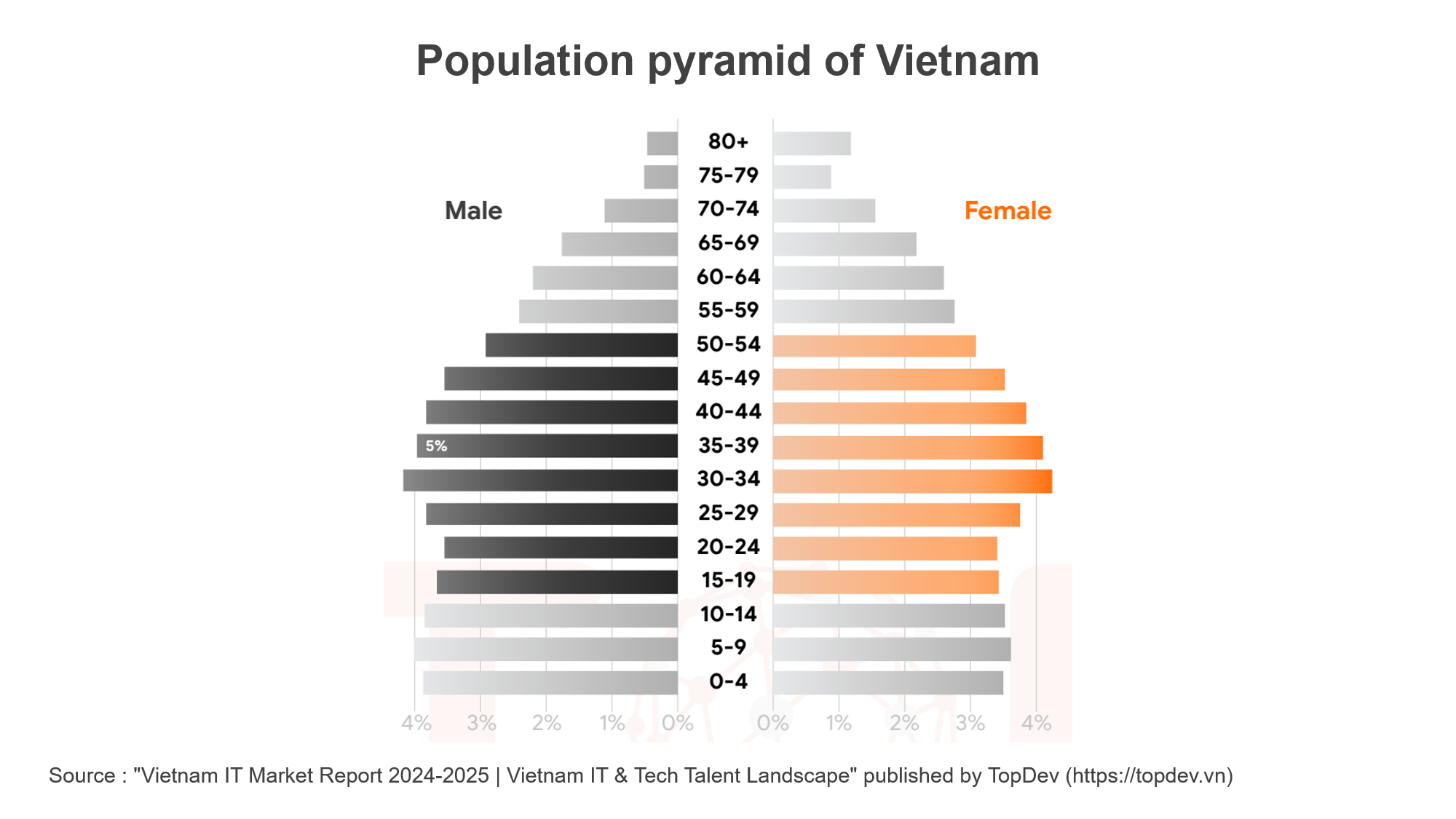
Population pyramid of Vietnam


Vietnam's youthful population, as depicted by its population pyramid, makes its median age fairly young at 33.1 years as reported by the CIA’s The World Factbook. For perspective, on the other end of the scale, the median age in the U.S. is 38.9, in the U.K. 40.8, in Germany 46.8, in Singapore 39.4, in Australia 38.1, and in Japan 49.9. This youthful age profile, where the larger segment of the Vietnamese population belongs to the age relative to the working force, provides a solid advantage for the country in promoting its IT sector.

For software developers and IT professionals, it is essential to keep pace with the changing leaps in technology. The younger workforce is generally flexible, eager to learn, and quick to embrace new tools and practices. Moreover, with Vietnam having a high percentage of under-20s, it guarantees a steady supply of working-age talent for many decades forward.

As highlighted in the article Key insights and trends for software developers in Vietnam 2024-2025, talented individuals in Vietnam increasingly seek careers in the IT sector, drawn by attractive salaries and growth opportunities. This trend aligns with the government’s strategic focus on developing IT talent, ensuring that Vietnam’s software development workforce continues to grow in both quality and quantity.


Vietnam’s IT Service Revenue

The revenue trend for the IT services industry in Vietnam is useful information. Vietnam has experienced continuous growth in IT service revenue over the years, and this upward trajectory is projected to continue. By 2024, the sector is expected to reach $2.07 billion, with a compound annual growth rate (CAGR) of 11.51% from 2024 to 2026. Looking further ahead, Vietnam’s IT service revenue is forecast to expand to $3.2 billion by 2028.


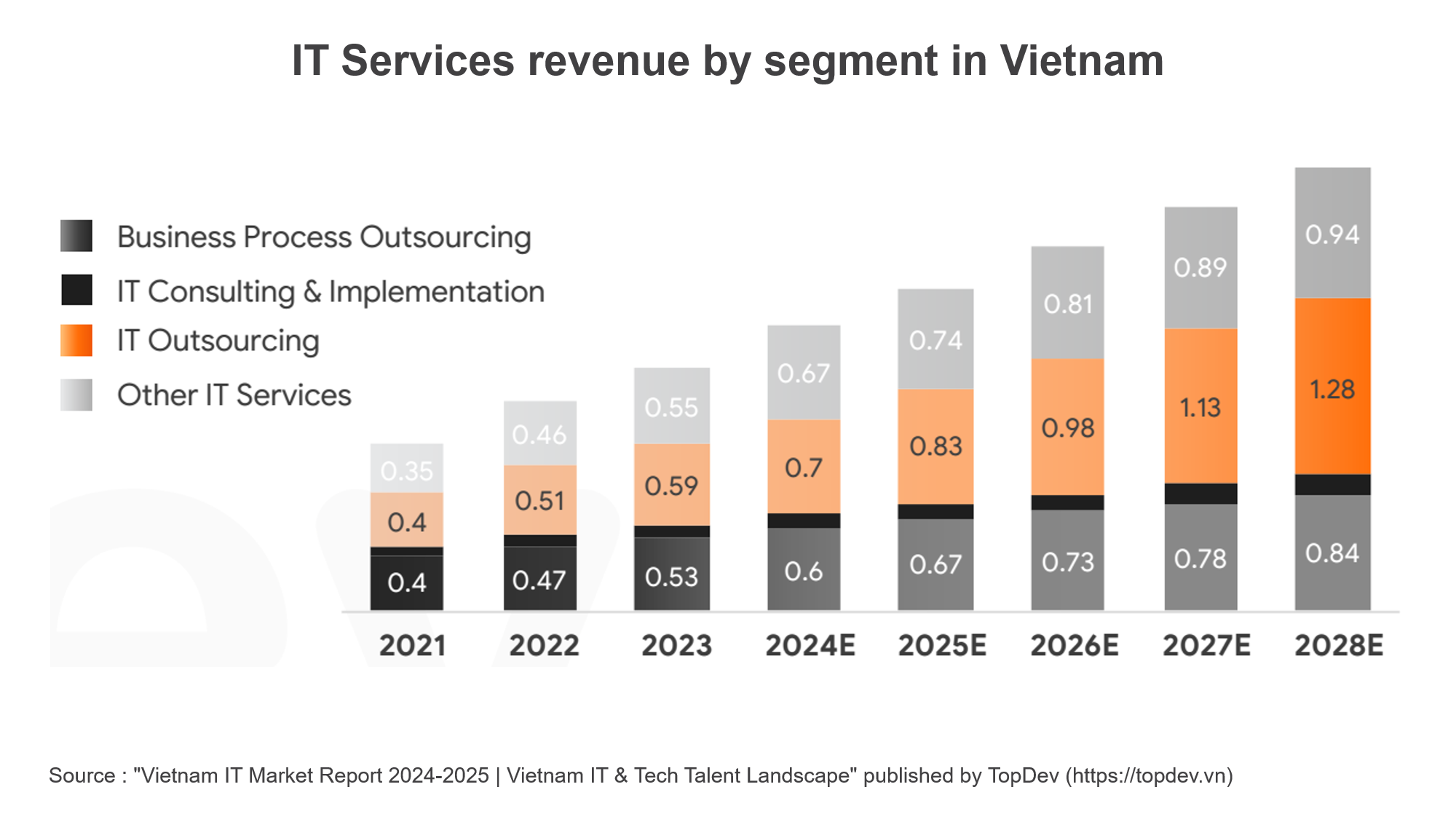
IT Services revenue by segment in Vietnam


The growth in the IT Outsourcing segment of the four segments—Business Process Outsourcing (BPO), IT Consulting & Implementation, IT Outsourcing, and Other IT Services—is particularly noteworthy. Vietnam's IT Outsourcing revenues are projected to grow dynamically from $0.7 billion in 2024 to $0.83 billion in 2025, $0.98 billion in 2026, $1.13 billion in 2027, and $1.28 billion in 2028, almost doubling in size within a period of four years.

This growth comes through a possible commercial advantage of Vietnam as one of the most captive destinations for outsourcing. While global demand for IT solutions continues to increase with a shortage of qualified IT professionals, Vietnam has strategically positioned itself as a reliable and cost-competitive partner for businesses round the globe.

Given those trends, Vietnam is poised to further expand in software outsourcing and offshore software development. The advantage of providing high-quality IT services at affordable prices makes it remain an attracting country in meeting the global demand of IT.


Average Salaries and Rates for Software Developers in Vietnam

As noted earlier, Vietnam has a rich, highly skilled IT labor force and serves as a fast-growing destination for IT outsourcing. One major reason for Vietnam's attractiveness is the cost of IT talent.
The report mentioned the average gross salary for software developer in Vietnam is around $1,300 per month. Including various costs such as management costs, the average hourly rate for software developers in Vietnam is around $20 to $40. Naturally, these rates vary depending on the developer's level, years of experience, skills, and tech stack etc.

Like this, the salary and rates levels of developers in Vietnam are low when compared to Western countries. This feature opens the door for strong cost competitiveness of Vietnam and a cost-effective alternative to having local developers or outsourcing to local software companies in many parts of the world.

While labor costs remain subdued, the quality of software developers is on an upward trend in Vietnam, which reflects advances in the experience and skill levels of the workforce. By outsourcing to Vietnam, offshore development offers an acceptable blend of quality and expense because of the competitiveness of developers there.

The balance between level of technologies and IT workforce cost-effectiveness puts Vietnam in an advantageous position to be one of the leading software outsourcing and offshore development destinations. Companies can access skilled developers across a wide array of technologies at a fraction of the cost compared to Western markets.


Conclusion

Vietnam's IT sector is one of the most remarkable success stories. With over 100 million people and still growing, the median age in Vietnam is about 33 years, presenting a young workforce with a high proportion of working-age people. This demographic advantage, together with the fact that 55,000-60,000 computer science and IT-related students come in every year, provides long-term talent supply for IT professionals.

In 2024, approximately 560,000 experts are already working in IT-related fields, and this number is expected to increase more in the coming years. With both private and public initiatives churning out IT talent in droves, this human resource from Vietnam has indeed been highly developed to continue attracting attention globally.

The revenues of the IT Outsourcing industry of Vietnam are thus seen to surge and probably double in the next four years. It replicates the growing reputation of the country as one of the most favored destinations for offshore software development and outsourcing. With abundant skilled professionals at economical rates, Vietnam can well cater to the increasing demand for software development services across the globe.

Arguably, one of the most significant competitive advantages for Vietnam is cost-effectiveness. It making the country much cheaper compared to Western nations and even to many other outsourcing countries around the world. While it remains affordable, its quality and developer expertise are improving day by day to offer businesses a perfect blend of cost and capability.

For companies considering software outsourcing or offshore development, Vietnam really has much to offer. With the powerful workforce, rapid industry growth, and unmatched cost competitiveness, it is unparalleled for a variety of businesses in search of high-quality and scalable IT solutions.

If one considers outsourcing or offshore development, then no doubt Vietnam will also be among those worthy destinations to head to. Immense opportunities avail here, and their values as an IT outsourcing hub can only rise upwards in the time to come.


About ISB Vietnam

As a leading software development and offshore services provider, we specialize in delivering high-quality and cost-efficient solutions for our partners for the past 20 years.

ISB Vietnam is proud to have a team of highly skilled software developers based in Vietnam, known for their technical expertise and commitment to excellence. Leveraging a vast network of developers both within Vietnam and across the globe, we are uniquely positioned to deliver tailored software development solutions that meet the diverse needs of our clients.

For any inquiries related to IT Outsourcing Solutions, we are the right partner.

Don’t hesitate to contact us to discuss how we can work together to make your project a success.


Related Posts

Top Software Outsourcing Companies in 2025: Find the Best Partner for Your Business

Why Outsource App Development? Key Benefits, Hidden Costs, and How to Get It Right

View More
1 2