

PostgreSQL is one of the most popular relational database management systems (RDBMS), known for its reliability, extensibility, and powerful feature set. While query performance is rarely a concern during the early stages of development, it often becomes a challenge as datasets grow from thousands to millions of rows.
As data volume increases, database queries can become a major bottleneck, leading to slower API response times and degraded application performance. One of the most effective ways to address this issue is through indexing.
Indexes are specialized data structures that allow PostgreSQL to locate data more efficiently, significantly reducing query execution time and minimizing expensive full table scans. When used correctly, indexes can dramatically improve the performance of large-scale applications.
In this article, we'll explore what PostgreSQL indexes are, how they work, and how different index types can be used to optimize database performance.
The Concept of Indexing in PostgreSQL
Indexes operate conceptually similar to a book's index.
Suppose you have a 1,000-page book and need to locate the 'Optimization' chapter. In the absence of an index, you must read to read through every page sequentially (in database terminology, this is referred to as a Sequential Scan). This process is highly inefficient.
Conversely, with an index, you can search for the keyword, find it on page 850, and navigate directly to that page. The underlying mechanism of PostgreSQL indexes follows this exact logic. Rather than scanning an entire table to retrieve specific records, PostgreSQL queries the index data structure to pinpoint the exact disk location of the requested data, thereby increasing query performance drastically.
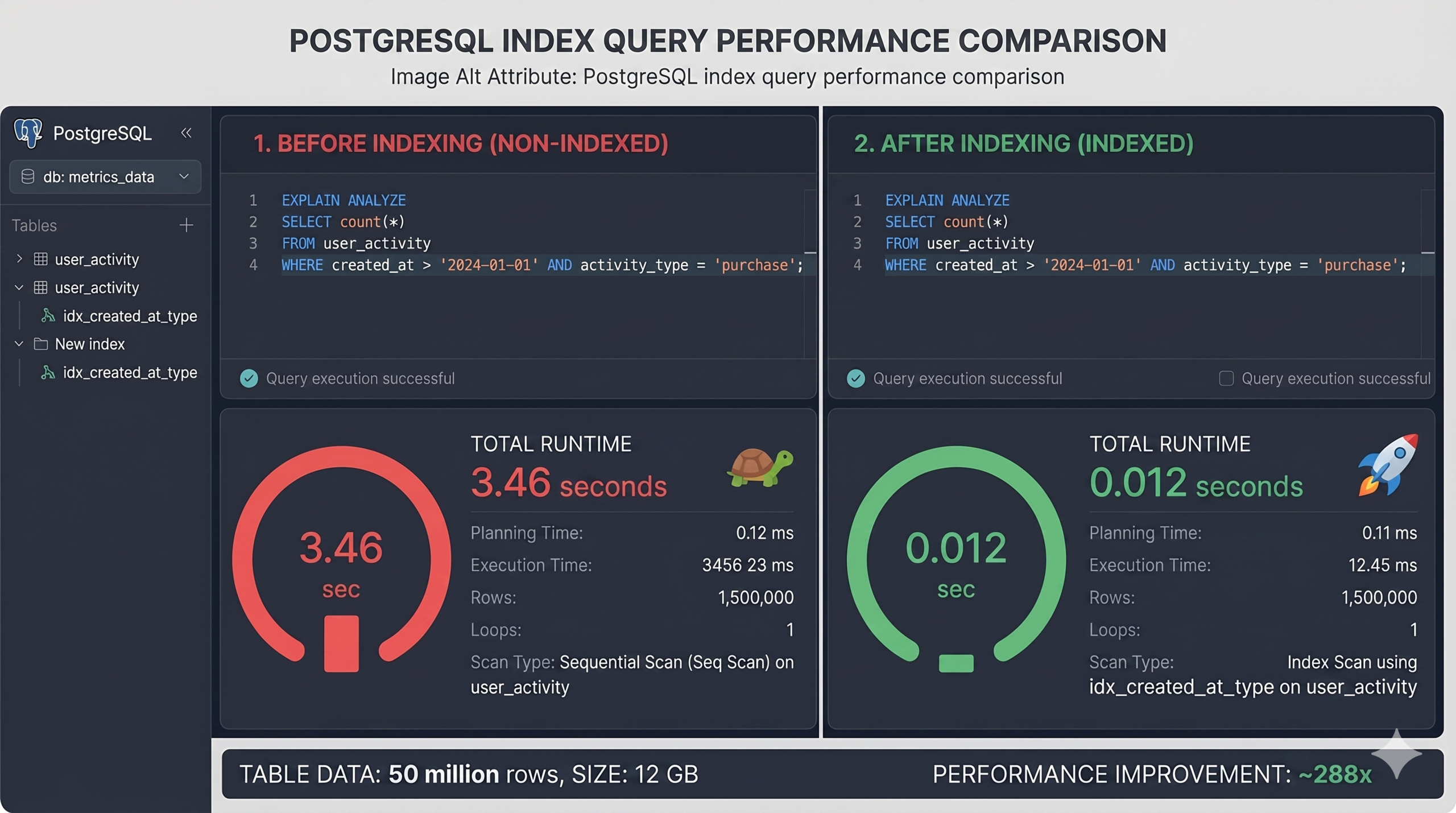
How to Create a Basic Indexes in PostgreSQL
Establishing a basic index involves a simple syntax. The following are the most commonly used commands for index management in PostgreSQL:
CREATE INDEX index_name ON table_name(column_name);
In certain scenarios, the objective extends beyond merely accelerating search queries to ensuring strict data uniqueness within a specific column (e.g., email addresses or usernames). You can enforce this constraint by creating a UNIQUE INDEX:
CREATE UNIQUE INDEX idx_users_email ON users(email);
Afterward, if you attempt to INSERT an existing email, PostgreSQL will immediately block the operation and throw an error.
B-Tree Architecture and the Power of PostgreSQL Indexes
Although PostgreSQL supports a wide variety of index types (such as Hash, GIN, and GiST), the default and most widely adopted is the B-Tree. A B-Tree index is not only highly efficient for equality comparisons, but it also covers a broad spectrum of condition types:
-
Comparison operators:
<,<=,=,>=,> -
Range conditions:
BETWEEN -
Set membership:
IN -
Null checks:
IS NULL,IS NOT NULL
When to Use and When to Avoid Indexes in PostgreSQL
Overusing indexes in PostgreSQL can actually backfire. Here are the core principles you need to master:
Columns You Should Index:
-
Index columns that frequently appear in
WHEREclauses. -
For
JOINoperations, prioritize indexing foreign key columns. -
Additionally, consider indexing columns that are regularly used for
ORDER BYorGROUP BYclauses.
Trade-offs to Consider:
-
Storage Consumption: Each index acts as a separate data structure that PostgreSQL stores physically on the disk. Creating an excessive number of indexes will bloat your database size.
-
Slower Write Operations (
INSERT/UPDATE/DELETE): Whenever you modify data in the primary table, the database must expend resources to update the underlying structures of all associated indexes.
Advanced Index Optimization Techniques in PostgreSQL
To maximize the potential of this database system, you shouldn't overlook the following advanced PostgreSQL indexing techniques:
A. Partial Indexes
For example, if you frequently query orders with a 'pending' status, you should only index those specific rows to save storage space
SQL:
CREATE INDEX idx_pending_orders ON orders (created_at) WHERE status = 'pending';
B. Expression Indexes
Similarly, if your query involves a function like LOWER(email), a standard index will be ignored by the database. The solution is to create an index directly on that specific expression:
SQL:
CREATE INDEX idx_lower_email ON users (LOWER(email));
C. Covering Indexes (Using INCLUDE)
Moreover, his technique allows you to retrieve data directly from the index without having to access the underlying table (an Index-Only Scan), delivering exceptionally fast performance:
SQL:
CREATE INDEX idx_email_include_name ON users (email) INCLUDE (name);
Other Specialized Index Types
In addition to B-Tree indexes, beyond the standard B-Tree, the PostgreSQL ecosystem offers several specialized index types tailored for specific use cases:
-
GIN: Ideal for indexing JSONB data, arrays, or powering Full-Text Search applications.
-
GiST: Perfectly suited for spatial, geometric, and coordinate data (commonly used with PostGIS).
-
BRIN: Specifically designed for massive tables (billions of rows) with highly sequential data (such as log tables), minimizing the index storage footprint to the absolute maximum.
Conclusion
Understanding and mastering PostgreSQL indexes is an essential skill for any Backend Developer or Database Administrator. It is the key to solving performance bottlenecks as your system scales. Finally, always remember to use the EXPLAIN ANALYZE command to verify whether your queries are actually hitting the indexes, and regularly clean up unused indexes to optimize storage costs. By implementing the right indexing strategy, your system will run smoothly even when dealing with tens of millions of rows!
Reference Links: