

Engineering Core
ISB Vietnam's skilled software engineers deliver high-quality applications, leveraging their extensive experience in developing financial tools, business management systems, medical technology, and mobile/web platforms.
In Part 1, we explored the "Big Picture"—the Russian Doll hierarchy of AI, how tokens work, and why AI sometimes tells "confident lies." We saw the trap of Overfitting, where an AI memorizes a "red bird" instead of learning what a bird actually is.
But to be a true IT pro in 2026, you need to know more than just the structure. You need to understand the specialized "jobs" AI can do and the different ways we "teach" it. Let’s dive into Part 2 with the essential terms from our list, explained simply but with the detail you need for a technical meeting.
The AI Senses: Seeing, Reading, and Guessing
1. The "Digital Eyes": Computer Vision
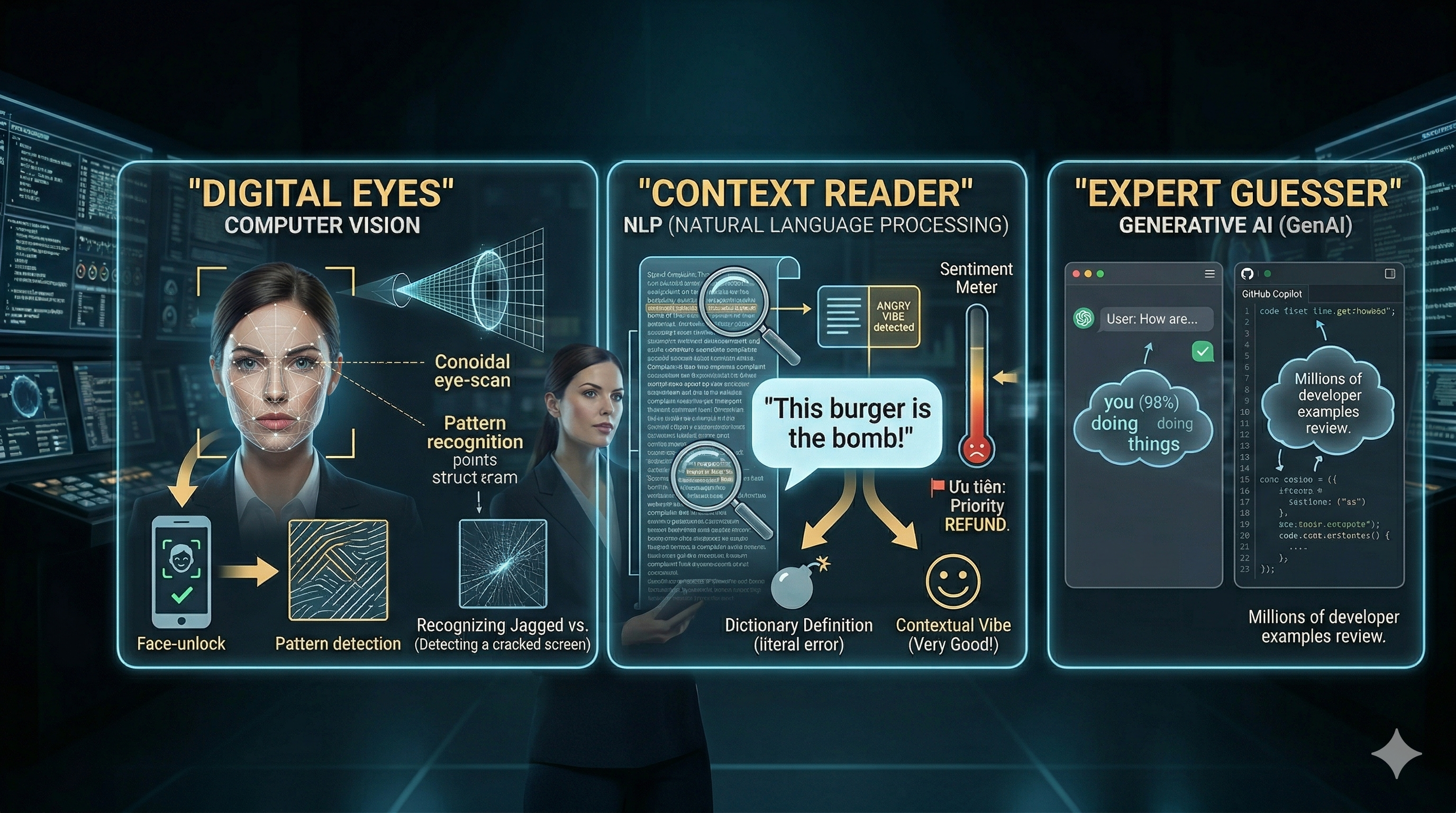
- When an AI walks into a room, it needs a way to see, which we call Computer Vision. Think of this as the AI’s Digital Eyes.
- Imagine you are training an employee to spot a cracked phone screen. You don’t explain the complex math of a fracture; you just show them a thousand photos of broken screens. The AI does the same—it doesn't "see" like we do; it just looks for jagged patterns where a smooth surface should be.
- This is exactly why your phone’s face-unlock works. It isn't "recognizing" you like a friend does; it’s just checking if the shape of your face matches the digital "map" you saved earlier.
2. The "Context Reader": NLP
- Once it can see, the AI needs to read. While computers are great at math, they are usually terrible at human slang. This is where Natural Language Processing (NLP), or our Context Reader, comes in.
- If you tell a regular computer "This burger is the bomb!", it might think an explosion is coming. NLP acts as a bridge, helping the machine realize that "the bomb" usually means "very good." IBM provides an excellent breakdown of how this tech reads the "vibe" of your words rather than just a dictionary definition. That’s why a customer service AI can read a long complaint and instantly flag it as "Angry" to prioritize a refund before a human even opens the inbox.
3. The "Expert Guesser": Generative AI (GenAI)
- Think about the Auto-correct on your phone. When you type "How are...", your phone suggests the word "you." It’s just guessing the next word based on what you usually type.
- Generative AI (like ChatGPT) is just "Auto-correct" but it has read almost everything on the internet. It is so good at guessing the next word that it can write entire essays or even computer code. It doesn't "know" the facts; it just knows what word usually comes next.
- When you use GitHub Copilot, you are using a "Super Auto-correct" for code. It sees your first line of code and guesses the next ten lines because it has seen millions of other developers write something similar.
The Human Side: Trust and Fairness
4. The "Black Box" Solution: Explainable AI (XAI)
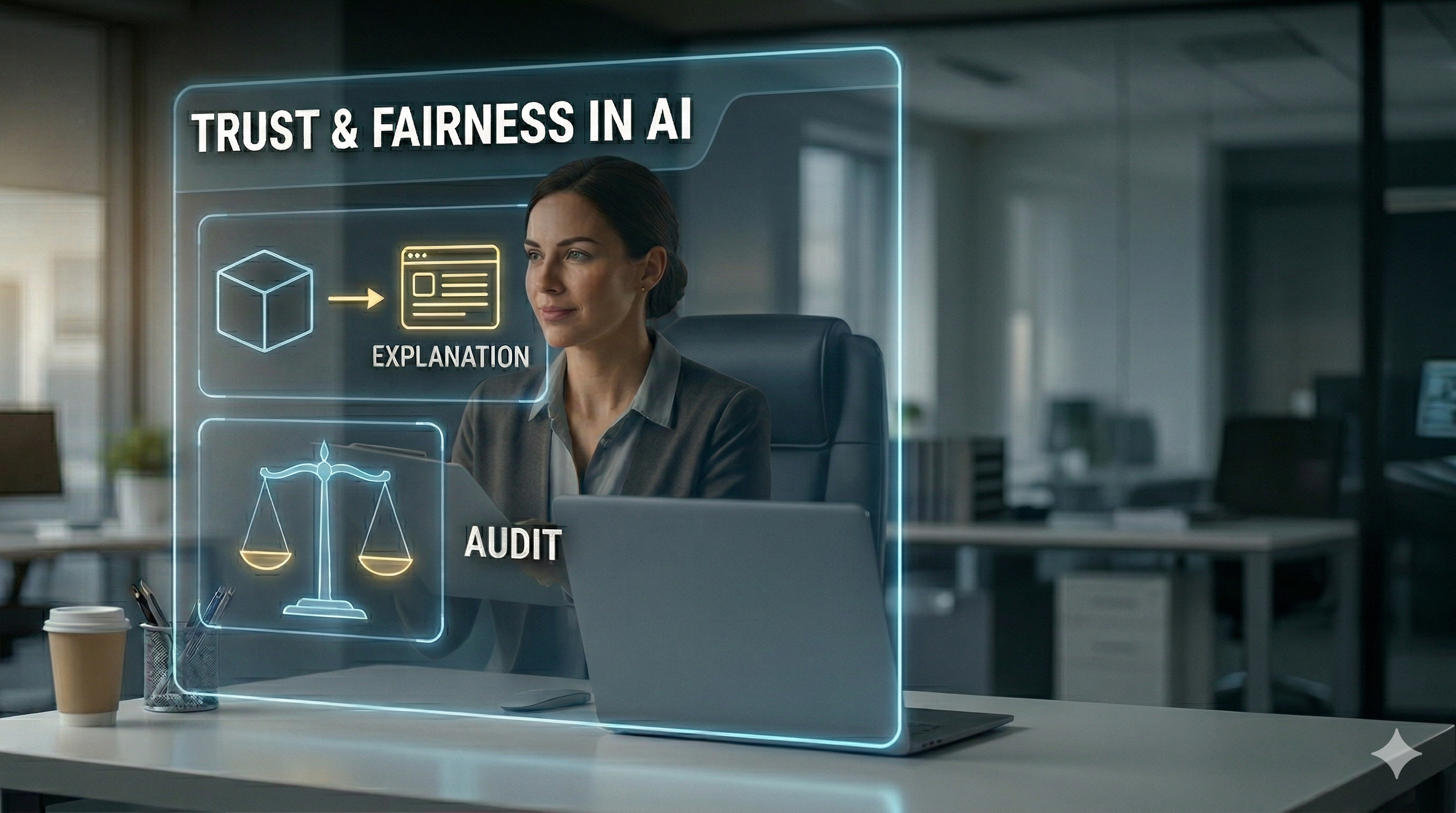
- In the IT world, we often call AI a "Black Box" because it can give you a perfect answer but can't explain how it got there. For example, if a medical AI says a patient is sick, a doctor can’t just say "because the computer said so." They need to know why.
- Explainable AI (XAI) is the solution—it’s the AI "showing its work." It uses special tools to highlight exactly which data points led to a decision. If an AI rejects a bank loan, XAI forces the machine to explain the reason, like "The applicant's income has been unstable for 3 months."
- This allows us to Trust the AI, Debug it when it makes a mistake, and ensure it follows the law. This is a key part of Cognitive Computing, where AI simulates human logic to help us make safer, smarter choices.
5. The "Mirror of Mankind": Bias & Ethics
-
- How Bias Happens: If you spend 20 years hiring only men for leadership roles, your company's data will show that "Successful Boss = Male." When you feed this data to the AI, it notices the pattern and starts rejecting female candidates. The AI isn't "sexist"—it’s just a bad copy of our history. It thinks it is being "efficient" by following the patterns it found in our old paperwork.
- The Goal of AI Ethics: This is our job to be "good digital parents." We don't just let the parrot repeat everything it hears. AI Ethics is the set of rules and checks we use to "clean" the data. We tell the AI: "Ignore gender when looking at talent." We audit the AI’s decisions to make sure it isn't picking up our old, unfair habits. We want the AI to be better than our past, not just a reflection of it.
Build the Future with ISB Vietnam
- Let’s turn these AI terms into your next big success—reach out to us today!
- Ready to join the AI revolution? [Check our open roles on the Career Page]
- At ISB Vietnam, we don’t just talk about these terms; we build with them every day. From architecting Computer Vision for smart factories to optimizing NLP for global communication, we turn complex concepts into scalable, secure software.
- Image source: Generated by Nano Banana 2